The 4Cs of Lab-Grown Diamonds: What B2B Buyers Need to Know
A practical guide to Cut, Color, Clarity and Carat for trade buyers sourcing lab-grown loose diamonds in bulk.
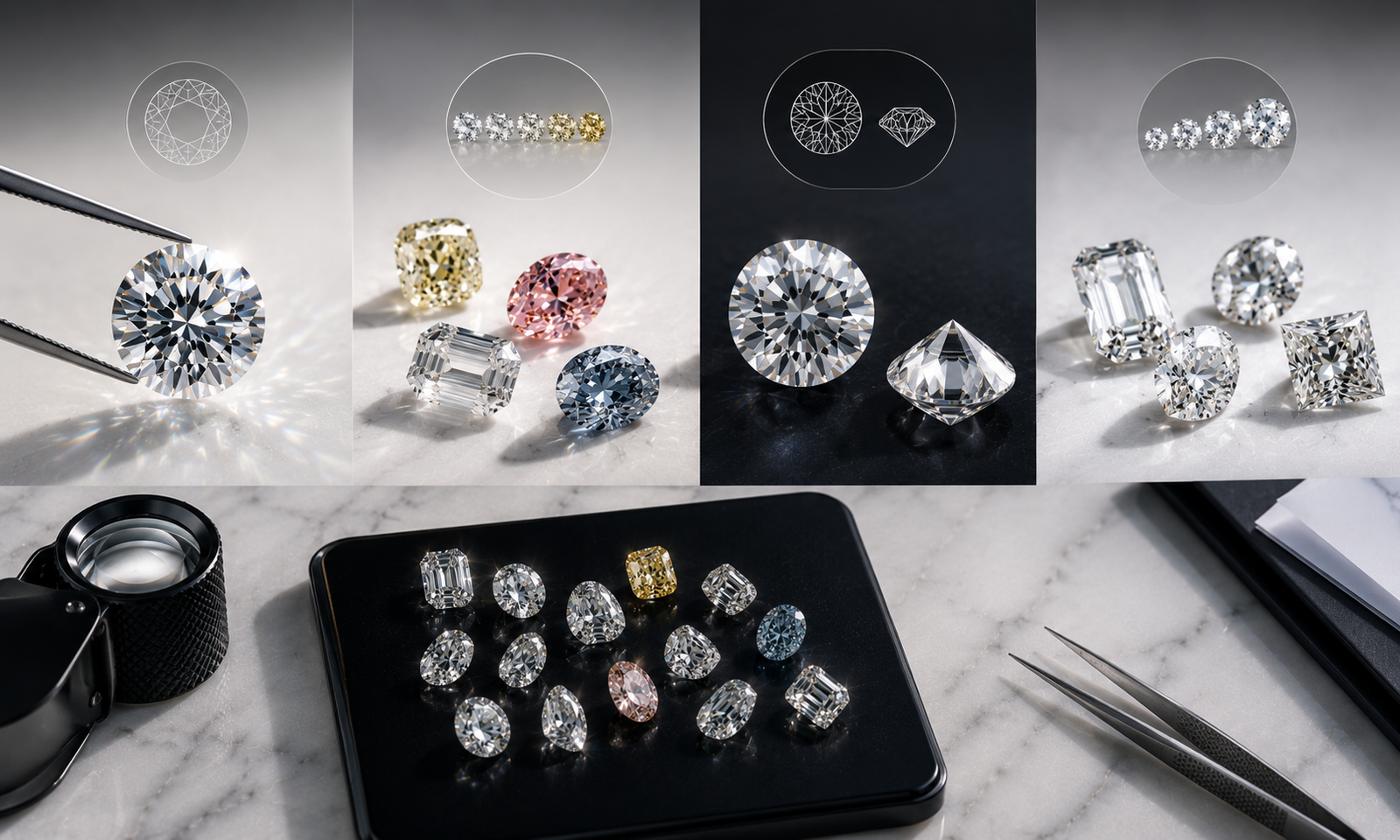
The 4Cs — Cut, Color, Clarity, and Carat — are the universal language of diamond grading. For B2B buyers, understanding how each applies to lab-grown diamonds (and where lab-grown differs from natural) is essential for making intelligent sourcing decisions at scale.
Cut: the most important C for brilliance
Cut quality determines how much light a diamond returns to the eye — what the trade calls "brilliance" and "fire." For round brilliants, the GIA and IGI use an Excellent/Very Good/Good/Fair/Poor scale covering proportions, polish, and symmetry. An Excellent in all three is the specification you want for premium retail goods.
Lab-grown diamonds have an advantage in cut quality: because they are produced in controlled laboratory conditions, manufacturers can better anticipate crystal shape and plan cuts to maximise the Excellent cut yield. Liora Diamond's standard is Excellent/Very Good minimum on all round brilliants.
Color: D–Z for whites, separate scale for fancies
White (colourless) diamonds are graded on a D-to-Z scale, where D is completely colourless and Z is light yellow. For fine retail, D–F (colourless) commands premium pricing. G–J (near-colourless) offers excellent visual value — most consumers cannot see the difference between F and H face-up in a ring setting. Below J, yellow tint becomes visible and pricing drops sharply.
Lab-grown diamonds are produced predominantly in the D–F and G–J ranges. CVD production naturally favours near-colourless to colourless material; HPHT post-growth treatment can achieve D–E colour from Type IIa CVD rough.
Clarity: eye-clean is the retail benchmark
The clarity scale runs FL (Flawless) through IF, VVS1, VVS2, VS1, VS2, SI1, SI2, I1, I2, I3. For B2B sourcing, the key threshold is "eye-clean": no inclusions visible to the naked eye at normal viewing distance. VS2 is reliably eye-clean; SI1 is eye-clean in most stones but requires stone-by-stone review; SI2 and below are not reliably eye-clean.
Lab-grown diamonds typically show different inclusion types than natural — lab-grown CVD stones may show graining or cloud-like features rather than crystals and feathers — but the same visibility rules apply.
Carat: the B2B weight sweet spots
Carat is weight, not size (though they are related). In the B2B market, certain weight ranges drive the highest volume: 0.30–0.50 ct (melee and small solitaires), 0.70–0.90 ct (value solitaires), and 1.00 ct (the benchmark "one carat" that drives the most retail marketing). Above 1.50 ct, the market thins but the margin per stone rises significantly.
Liora Diamond's core B2B inventory runs from 0.03 ct calibrated melee to 0.50 ct stones in high volume, with 0.50–2.00 ct made-to-order on 4–6 week lead times.