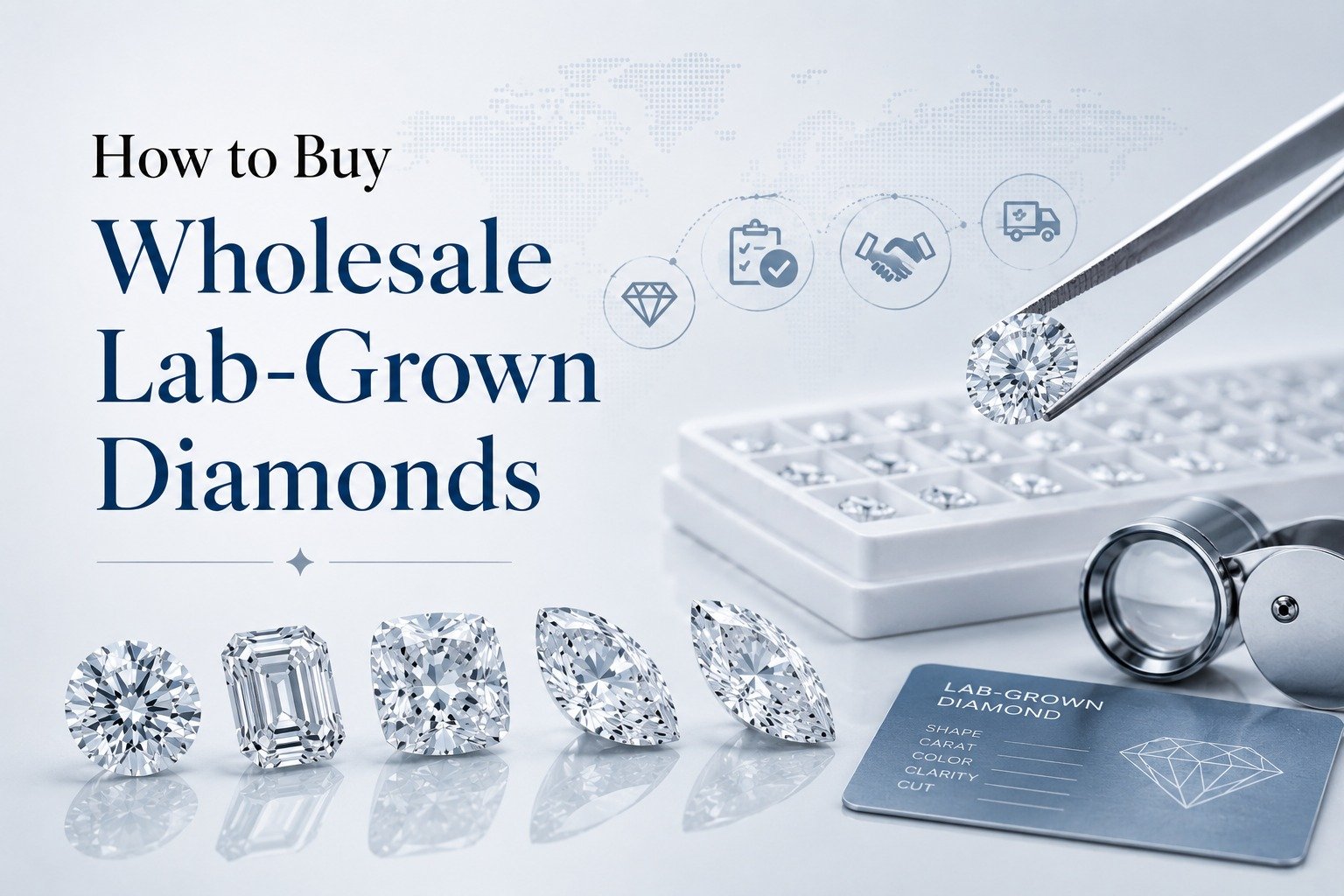
A practical B2B guide to buying wholesale lab-grown diamonds in 2026. Understand current pricing, CVD vs. HPHT production, IGI and GIA certification, parcel-level purchasing, supplier verification, and the common sourcing mistakes wholesale buyers should avoid.
Wholesale lab-grown diamonds have moved from a niche alternative to the default sourcing choice for a large share of the trade. For wholesalers, retailers, and manufacturers, the opportunity is real. But so is the risk of overpaying, misjudging quality, or partnering with an unreliable supplier.
This guide explains what B2B buyers actually need to know before placing a bulk order: current wholesale pricing, certification standards, production methods, and a practical vetting process for choosing a lab-grown diamond supplier.
Why B2B Buyers Are Moving to Lab-Grown Diamonds
Global mining output has settled at multi-decade lows as major deposits in Botswana, Canada, and Russia mature and ore grades decline. Lab-grown production capacity has expanded over the same period.
Fortune Business Insights values the global lab-grown diamond market at roughly $29.46 billion in 2025, with a projected climb to $91.85 billion by 2034, representing a compound annual growth rate of approximately 13.4%.
On the retail side, the category has already crossed a tipping point: lab-grown center stones now appear in more than 45% of US engagement rings, according to recent industry data.
For B2B buyers, that demand curve translates directly into inventory decisions. Retailers who do not stock lab-grown loose diamonds or lab-grown jewelry are increasingly leaving margin and market share on the table.
CVD vs. HPHT: Understanding What You’re Buying
Every lab-grown diamond is produced using one of two methods, and understanding the difference matters when evaluating a parcel.
Chemical Vapor Deposition (CVD)
In this process, the diamond grows crystal layer by crystal layer inside a sealed chamber filled with carbon-rich gas.
This is the dominant method for many gem-quality cushion and princess shapes sold into Western B2B and B2C markets, largely because CVD offers more consistent control over color and clarity outcomes.
High Pressure High Temperature (HPHT)
This lab-grown diamond production process replicates the conditions under which natural diamonds form, using extreme pressure and heat to crystallize carbon.
HPHT is the more cost-efficient method at scale and is responsible for a large share of production volume. China alone accounts for close to 40% of global gem-quality lab-grown output, much of it HPHT, while India performs more than half of the world’s diamond cutting and polishing.
Neither method produces an inherently inferior stone. Both yield diamonds that are chemically, optically, and physically identical to natural diamonds, with the same hardness, fire, and brilliance.
What differs is the cost structure and, occasionally, the typical color and clarity distribution. Serious wholesale buyers ask suppliers to specify the growth method for every parcel rather than treating “lab-grown” as a single undifferentiated category.
IGI vs. GIA Certification: Why It Determines Your Margin
Certification is not a formality in wholesale sourcing. It directly affects insurability, resale value, customer confidence, and how easily your customers can move inventory.
IGI, or the International Gemological Institute, certifies a large majority of the lab-grown diamonds available in the market and has developed dedicated grading reports and inscription standards for lab-grown stones.
GIA, or the Gemological Institute of America, is the long-established authority most closely associated with natural diamond grading. It also grades lab-grown diamonds, particularly for buyers who prefer to use the same laboratory across their natural and lab-grown diamond catalogs.
Both laboratories use the same fundamental 4Cs framework:
- Cut
- Color
- Clarity
- Carat weight
Both also laser-inscribe the stone’s report number directly onto the girdle. This matters enormously at the wholesale level because it allows buyers to verify that the physical stone in a parcel matches its grading report before payment is completed.
A wholesale supplier that ships uncertified stones or cannot produce matching inscriptions on request is not a supplier from whom you should regularly purchase repeat parcels.
2026 Wholesale Pricing: What to Actually Expect
Lab-grown diamond wholesale pricing has been through a sharp multi-year correction, and understanding where the market currently sits is essential when negotiating fairly.
Wholesale per-carat prices for lab-grown diamonds fell by roughly 74% between 2020 and 2025 as production capacity expanded. Global production increased from approximately one million carats in 2010 to more than nine million carats by 2023.
That decline has now visibly slowed. Q1 2026 data shows wholesale prices for polished lab-grown diamonds declining closer to 14% year over year, representing a meaningful deceleration from the annual drops of more than 40% recorded through 2025.
Analysts increasingly describe the market as approaching a production-cost floor rather than continuing to collapse indefinitely.
Below are rough approximate wholesale benchmarks for well-cut, IGI-certified CVD round diamonds in 2026:
| Carat Weight | Typical Wholesale Range Per Stone | Notes |
|---|---|---|
| 1 Carat | $350–$600 | D–F color with VS1–VS2 clarity generally commands the upper end. |
| 2 Carat | $1,000–$1,800 | This has become a common standard size for bridal parcels. |
| 3 Carat | $2,000–$2,600 | This remains one of the softest categories and is still down sharply year over year. |
Three-carat round diamonds remain one of the weakest wholesale categories, still down close to 28% year over year even as several other sizes begin to stabilize.
This is worth considering when deciding which carat weights to stock more deeply and which sizes should be ordered only against specific customer requirements.
These figures move according to color, clarity, cut quality, certification, and growth method, and they may continue shifting throughout 2026.
Any wholesale supplier quoting a single flat per-carat rate regardless of quality grade is oversimplifying the market. Ask for parcel pricing broken down according to the 4Cs rather than accepting a blended average.
Buying at the Parcel Level: How Wholesale Pricing Actually Works
Unlike retail transactions, where a single stone is priced individually, wholesale buyers typically transact in parcels. These are batches of stones matched according to shape, carat range, color, and clarity.
Confirm the following before committing to a parcel:
Matched Consistency
Ask whether the parcel has been matched for color and clarity or whether it is a mixed lot.
Matched parcels usually command a premium, but they save your team significant sorting time and reduce the possibility of returns from your own retail customers.
Certification Per Stone, Not Per Parcel
Every individual stone should carry its own IGI or GIA grading report and laser inscription.
A single certificate covering an entire bulk lab-grown diamond lot is not an acceptable substitute for repeat B2B purchasing.
Growth Method Disclosure
CVD and HPHT stones may be included in the same parcel unless you specify otherwise.
When your retail positioning depends on a particular growth method, communicate that requirement clearly before the supplier prepares the quotation.
Fancy-Color Availability
Pink, blue, and yellow lab-grown diamonds are a fast-growing wholesale category because their natural equivalents are extraordinarily rare and expensive.
A supplier that can certify color origin and provide consistent fancy-color parcels may offer meaningful differentiation for your jewelry storefront.
A Practical Checklist for Vetting a Wholesale Supplier
Before placing your first order, and especially before committing to a recurring parcel relationship, evaluate every prospective supplier using the following checklist:
- Do they certify every stone through IGI or GIA without exceptions in their B2B channel?
- Can they provide live or recently updated inventory rather than a static catalog that may not reflect current stock?
- Do they disclose the growth method, CVD or HPHT, when requested?
- What is their standard lead time for made-to-order specifications?
- Does their lead time align with the delivery promise you make to your retail customers?
- Is pricing transparent and quoted according to specification?
- Do they handle insured international shipping and customs documentation?
- What do their existing B2B clients say about consistency across repeat orders?
One excellent parcel means very little if the next parcel does not match.
A supplier that can answer these questions clearly is worth considering for a trial order. A supplier that cannot should be approached cautiously, regardless of how attractive the initial quotation appears.
The Wholesale Lab-Grown Diamond Buying Process
1. Define Your Specification
The first step is to define exactly what you need, including:
- Diamond shape
- Carat range
- Color grade
- Clarity grade
- Growth method
- Certification laboratory
- Required quantity
The more precise your purchasing brief is, the more accurate the supplier’s quotation will be.
2. Request Parcel Pricing Against Live Stock
A supplier working from real-time inventory can quote against diamonds that are actually available rather than relying on a catalog that may already be several weeks out of date.
3. Verify Certification and Inscriptions
Cross-check a sample of stones against their grading reports before confirming a large order, particularly when working with a supplier for the first time.
This step is especially important when the diamonds will be mounted into finished jewelry.
4. Confirm Lead Time for Made-to-Order Requirements
Custom specifications generally require approximately four to six weeks. Build this production period into the commitments you make to your retail customers.
5. Review Shipping, Insurance, and Customs Documentation
Before finalizing payment terms, confirm how the diamonds will be shipped, what insurance coverage is included, how claims are handled, and who is responsible for preparing customs documentation.
6. Place a Trial Order Before Scaling Volume
Consistency across repeat parcels, rather than the quality of a single sample, is the true test of a wholesale relationship.
Start with a controlled trial order and evaluate the supplier’s quality, documentation, communication, packaging, delivery time, and after-sales support before scaling your purchasing volume.
Why Sourcing Origin Still Matters
Even in a globalized lab-grown diamond supply chain, the location from which you source still carries weight.
Surat, India, has been a major center of diamond cutting and polishing for decades. The region performs more than half of the world’s diamond cutting and polishing volume.
That manufacturing depth has transferred directly into lab-grown diamond production, cutting, polishing, grading preparation, jewelry manufacturing, and export fulfillment.
B2B buyers sourcing from established Surat-based suppliers benefit from the concentration of cutting expertise, established export infrastructure, and long-standing familiarity with international certification and customs requirements.
Mistakes B2B Buyers Should Avoid When Sourcing Lab-Grown Diamonds
Even experienced retail buyers can make costly mistakes when they first move into wholesale lab-grown diamond sourcing. The following problems frequently occur across the trade.
Treating “Lab-Grown” as One Uniform Product
Quality still varies significantly.
A poorly cut, I-color, SI2-clarity diamond and a triple-excellent, E-color, VS1-clarity diamond may both technically be lab-grown, but they belong in completely different price tiers and retail positions.
Buying based only on the “lab-grown” label, without specifying the complete 4Cs, is how buyers end up overpaying for underwhelming stock.
Skipping Certificate Verification
It can be tempting to trust a supplier after several successful orders and stop checking inscriptions against grading reports.
However, spot-checking a sample from every parcel, including parcels from a trusted supplier, protects your business if the supplier’s own sourcing or quality-control process changes.
Ignoring the Growth Method Until It Is Too Late
A retailer that markets its stones as CVD-grown to support a premium positioning may face a serious customer-service issue if a delivered parcel is later discovered to contain HPHT stones.
Confirm the growth method in writing during the quotation stage rather than after the shipment arrives.
Underestimating Lead Time for Custom Specifications
Made-to-order carat weights, emerald and oval fancy shapes, and fancy-color parcels may require a four-to-six-week production period.
Buyers who promise faster turnaround times to their retail customers without confirming the upstream production schedule create avoidable delays and customer-service problems.
Chasing the Lowest Per-Carat Quote Without Checking Consistency
The cheapest quotation on a single parcel means very little if the next reorder does not match in color, clarity, or overall appearance.
Long-term wholesale relationships are built on repeatable quality, not one-off pricing.
Overlooking Customs and Insurance Documentation
International shipments without complete certification and customs paperwork may be delayed at customs, tying up working capital while the goods remain in transit.
Confirm documentation standards, insurance responsibility, and the claims process before placing the first order rather than after a shipment is delayed.
Conclusion
Lab-grown diamond wholesale pricing has begun to stabilize after a sharp multi-year decline. Production quality has become highly consistent across both CVD and HPHT methods, while certification through IGI and GIA gives buyers a genuine and verifiable basis for comparison.
The opportunity for wholesalers, retailers, and jewelry manufacturers is significant, but success depends on choosing a supplier that offers transparent parcel pricing, per-stone certification, disclosed growth methods, live inventory, and a proven record of consistency across repeat orders.
Liora Diamond: An Ultimate Hub for Certified Lab-Grown Wholesale Diamonds
Liora Diamond supplies IGI and GIA-certified lab-grown loose diamonds and fine jewelry from Surat, India.
Buyers can access continuously updated live stock, transparent parcel pricing, and made-to-order fulfillment with a standard production period of approximately four to six weeks.
Request B2B pricing or browse the live wholesale inventory to review currently available diamonds, grading details, and specifications.