Lab-Grown Diamond Industry Trends in 2026 (B2B Perspective)
Explore the key lab-grown diamond industry trends shaping 2026, from CVD technology and certification to pricing, supply chains, and growing demand for colored diamonds. Learn what B2B buyers should consider when sourcing certified loose lab-grown diamonds for long-term growth.
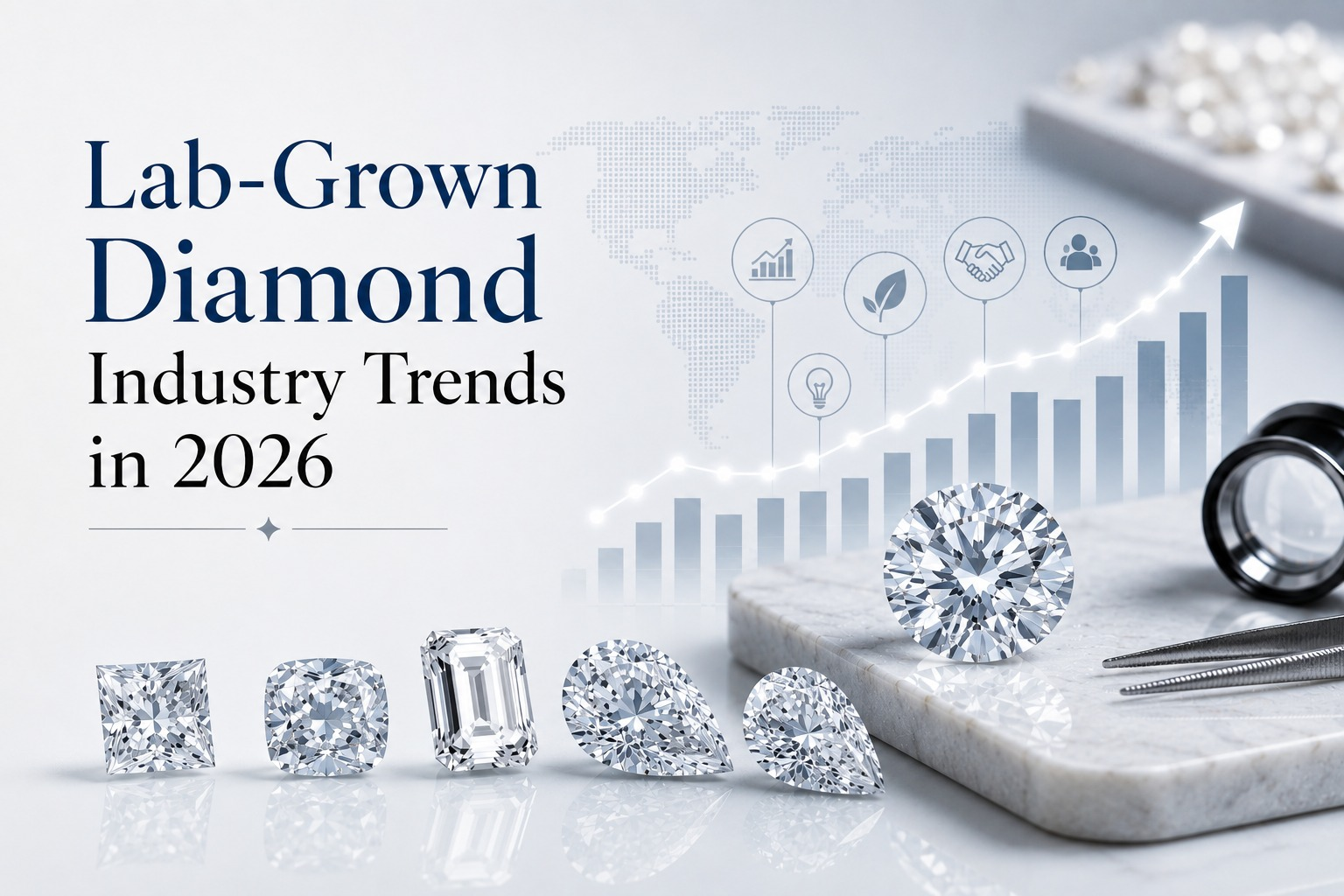
The lab-grown diamond industry has reached new heights in 2026. Once seen as a niche alternative, laboratory-grown diamonds are now a core sourcing category for jewelry manufacturers, wholesalers, and retailers looking to improve margins, strengthen inventory planning, and meet evolving customer preferences.
Across North America, Europe, the Middle East, and Asia, businesses are expanding their sourcing strategies to include both colorless and colored loose lab-grown diamonds.
For B2B buyers, keeping up with industry trends involves much more than watching diamond prices. Advancements in production technology, stricter certification standards, dependable supply chains, and growing demand for premium CVD lab-grown diamonds are influencing how businesses choose their suppliers.
At the same time, changing consumer expectations and global market dynamics continue to reshape purchasing strategies in the international diamond trade.
Here are the key trends shaping the lab-grown diamond market in 2026 and what they mean for businesses sourcing wholesale certified loose diamonds.
The Global Lab-Grown Diamond Market in 2026
Market Size and Growth
According to Fortune Business Insights, the global lab-grown diamond market is expected to reach USD 33.54 billion in 2026 and grow to USD 91.85 billion by 2034, representing a CAGR of 13.42% during the forecast period.
This growth is being supported by stronger retailer confidence, wider consumer acceptance, and continued investment in diamond-growing technology.
Asia continues to lead global production, while North America and Europe remain key markets for certified loose lab-grown diamonds, particularly for engagement rings, bridal jewelry, and premium fine jewelry collections.
What Is Driving Global Demand?
Several factors are influencing the lab-grown diamond industry in 2026. Jewelry manufacturers are increasing their purchases of CVD lab-grown diamonds because they provide consistent quality, dependable availability, and a wide selection of shapes and calibrated sizes.
Colored lab-grown diamonds are also gaining popularity, with pink, blue, yellow, and green diamonds increasingly appearing in contemporary jewelry collections.
For B2B buyers, these trends create opportunities to expand product offerings, maintain healthier inventory levels, reduce sourcing delays, and improve profitability by working with reliable wholesale lab-grown diamond suppliers.
B2B Buying Behavior Has Changed
The way jewelry manufacturers, retailers, and wholesalers source diamonds has changed considerably in recent years. In 2026, price is only one part of the purchasing decision.
B2B buyers now evaluate several factors before committing to long-term supplier relationships, including:
- Supplier reliability
- Inventory availability
- Production capacity
- Diamond certification
- Grading consistency
- Delivery reliability
- Communication and after-sales support
As the lab-grown diamond industry continues to grow, businesses increasingly understand that choosing the right supplier has a direct impact on inventory management, customer satisfaction, production efficiency, and overall profitability.
Retailers Are Buying Smarter, Not Bigger
Many jewelry retailers are moving away from holding large inventories and instead relying on faster, more flexible replenishment.
They prefer suppliers that maintain a wide range of certified loose lab-grown diamonds in ready stock and can ship orders quickly as demand changes.
This approach allows retailers to reduce inventory costs while introducing new jewelry collections more frequently.
Retailers are also making purchasing decisions based on actual sales data rather than assumptions. Fast-selling shapes, popular carat weights, and commercially strong color and clarity grades receive higher priority.
This helps businesses improve sell-through rates and avoid investing heavily in slow-moving inventory.
Manufacturers Want Reliable Supply Partners
For jewelry manufacturers, sourcing involves much more than finding high-quality diamonds. They need B2B diamond suppliers capable of consistently delivering the same specifications across every order, whether they are purchasing hundreds or thousands of stones.
Consistent cut quality, accurate grading, calibrated sizing, and dependable production schedules make it easier to maintain uniform quality across complete jewelry collections.
Buyers also expect suppliers to offer clear communication, recognized certification, flexible order quantities, and reliable delivery timelines.
As competition increases across global jewelry markets, businesses are choosing supply partners they can depend on for the long term.
Colorless Lab-Grown Diamonds Continue to Lead Global Demand
Although colored lab-grown diamonds are becoming increasingly popular, colorless diamonds continue to account for a major share of global B2B demand.
Demand remains especially strong among engagement ring manufacturers, bridal jewelry brands, wholesalers, and large retailers that require a steady supply of certified loose lab-grown diamonds throughout the year.
For these businesses, consistent quality and dependable availability are just as important as competitive pricing.
Round Brilliant Remains the Industry Benchmark
The Round Brilliant remains one of the most sought-after diamond shapes in the wholesale market because of its lasting consumer appeal and exceptional brilliance.
At the same time, buying preferences are becoming increasingly diverse.
Diamond shapes experiencing strong demand include:
- Round
- Princess
- Oval
- Emerald
- Cushion
- Pear
- Radiant
As jewelry brands expand their engagement ring collections and offer more personalized designs, suppliers that maintain a balanced inventory across multiple shapes are better positioned to serve evolving market requirements.
Commercial Sizes Drive High Trading Volume
Much of the wholesale demand continues to focus on commercially popular diamond sizes rather than exceptionally large stones.
Diamonds between 0.50 and 2.00 carats remain particularly important because they suit the pricing and design requirements of many bridal and fine jewelry collections.
Buyers also commonly seek commercially desirable combinations such as DEF color with VS and VVS clarity grades, depending on the intended product category and target market.
For international buyers, consistency has become a major priority. Uniform grading, calibrated sizes, and precise cutting standards help manufacturers:
- Streamline jewelry production
- Reduce adjustments during stone setting
- Improve matching across multi-stone designs
- Maintain consistent quality across collections
- Reduce production delays
Suppliers that consistently deliver these standards are building stronger long-term relationships with wholesalers and jewelry manufacturers worldwide.
Fancy Colored Lab-Grown Diamonds Are Becoming a High-Growth Category
One of the fastest-growing areas of the lab-grown diamond industry is the demand for fancy colored diamonds.
Once primarily associated with custom-made jewelry, colored lab-grown diamonds are increasingly becoming part of commercial collections offered by jewelry brands, luxury retailers, and independent designers.
Improvements in production technology have made these diamonds more consistent in color and quality, giving B2B buyers access to a wider product range without the extreme cost and limited availability associated with natural fancy-color diamonds.
Jewelry Brands Are Expanding Beyond Traditional White Diamonds
Consumer preferences are shifting toward more distinctive and personalized jewelry. Many brands are introducing colorful designs to differentiate themselves in competitive markets while continuing to offer traditional colorless diamond collections.
This enables retailers to launch fresh collections, appeal to new customer groups, and offer unique jewelry while maintaining attractive retail margins.
Popular colored loose lab-grown diamonds include:
- Pink
- Blue
- Yellow
- Green
- Orange
These colors are used across engagement rings, anniversary jewelry, cocktail rings, pendants, earrings, bracelets, and limited-edition collections where distinctive design plays an important role.
Manufacturing Quality Is Driving Buyer Confidence
The growing popularity of colored lab-grown diamonds is closely linked to improvements in manufacturing quality.
Modern producers can achieve stronger color saturation, improved crystal quality, and greater consistency across production batches.
This makes it easier for jewelry brands to create matching collections and reorder stones with greater confidence.
B2B buyers also increasingly look for suppliers that can provide certified colored diamonds across multiple shapes, carat weights, and color options.
Access to dependable inventory helps businesses plan collections more efficiently while reducing sourcing challenges and production delays.
CVD Technology Continues to Shape the Future of Manufacturing
Chemical Vapor Deposition (CVD) technology continues to play an important role in the lab-grown diamond industry.
Although both CVD and HPHT methods are used to grow diamonds, manufacturers continue to invest in CVD production because the process can provide greater control over several manufacturing variables.
Key advantages include:
- Controlled crystal growth
- Consistent quality
- Scalable manufacturing
- Production flexibility
- Improved availability across larger carat sizes
These advantages support reliable production of loose lab-grown diamonds for jewelry manufacturers and wholesalers that depend on consistent inventory.
Better Crystal Quality Through Process Innovation
CVD manufacturing continues to advance through improvements in reactor technology, growth monitoring, process control, and post-growth treatment.
These developments help manufacturers increase the production of gem-quality diamonds with strong optical performance.
Modern CVD facilities can produce diamonds with characteristics such as:
- High crystal purity
- Consistent color
- Improved clarity
- Reliable production of larger carat sizes
- Higher manufacturing efficiency
This level of consistency helps jewelry manufacturers maintain similar quality across repeat orders and standardized product collections.
Higher Production Capacity Meets Growing Demand
As global demand continues to increase, manufacturers are expanding CVD production while investing in automation, precision cutting, quality control, and digital grading technologies.
For B2B buyers, increased production capacity can result in shorter lead times, better inventory availability, and greater flexibility when placing bulk or recurring lab-grown diamond orders.
Many jewelry brands now prefer working with suppliers that can provide a complete selection of certified colorless and colored lab-grown diamonds rather than managing multiple vendors.
Production volume alone, however, is no longer enough to stand out.
Buyers increasingly evaluate wholesale lab-grown diamond suppliers based on:
- Manufacturing expertise
- Consistent quality
- Grading accuracy
- Dependable delivery
- Inventory availability
- Ability to support long-term business growth
Certification Is No Longer Optional in Global Diamond Trade
As the lab-grown diamond market continues to grow, certification has become an important requirement rather than simply an additional benefit.
Retailers, jewelry manufacturers, wholesalers, and importers increasingly expect higher-value loose lab-grown diamonds to be supplied with independent grading reports.
Certification helps verify quality, reduce purchasing risk, improve inventory management, and give buyers greater confidence when sourcing diamonds internationally.
For suppliers serving the USA, Europe, the Middle East, and other major jewelry markets, providing certified diamonds has become an important part of professional B2B diamond trade.
Independent Grading Builds Buyer Confidence
Independent grading laboratories such as IGI (International Gemological Institute) and GIA (Gemological Institute of America) assess diamond characteristics according to established grading standards.
Depending on the grading report and diamond category, these assessments may include:
- Carat weight
- Color
- Clarity
- Cut and proportions
- Fluorescence
- Growth origin or laboratory-grown identification
For B2B buyers, certification provides several practical advantages:
- Consistent quality verification
- Faster purchasing decisions
- Reduced inspection requirements
- Greater confidence in remote sourcing
- Easier resale to retailers and end customers
- Reduced risk of grading disputes
Transparency Has Become a Business Expectation
Today's buyers expect more than an attractive diamond. They increasingly expect clear product information, accurate grading, and reliable documentation throughout the sourcing process.
Many jewelry brands and distributors also evaluate a supplier's manufacturing standards and quality-control processes before entering long-term supply agreements.
Suppliers that provide certified laboratory-grown diamonds, detailed specifications, high-quality images, and reliable documentation are better positioned to earn repeat business.
In a competitive global market, transparency helps build trust, strengthen business relationships, and support long-term partnerships.
Supply Chain Trends Every B2B Buyer Should Watch
The global supply chain for laboratory-grown diamonds is becoming increasingly efficient, transparent, and technology-driven.
Manufacturers are replacing traditional inventory systems with integrated production and digital inventory platforms that allow buyers to source certified diamonds more quickly and accurately.
For jewelry brands and wholesalers, this can mean better inventory planning, faster fulfilment, and improved sourcing efficiency.
India Continues to Lead Manufacturing
India remains one of the most important hubs in the global lab-grown diamond industry, supported by extensive expertise in diamond cutting, polishing, manufacturing, and international trade.
Manufacturing centres such as Surat supply certified colorless and colored loose lab-grown diamonds to jewelry businesses across the USA, Europe, the Middle East, and Asia.
Many manufacturers are upgrading facilities with advanced CVD technology, automation, precision equipment, and improved quality-control systems to meet growing international demand.
Faster Delivery Matters More Than Ever
Short lead times have become an important factor in supplier selection.
Jewelry brands require reliable partners that can support new product launches, custom requirements, and inventory replenishment without unnecessary delays.
Manufacturers with ready-to-ship stock, efficient export processes, and dependable logistics can provide a significant advantage to businesses placing recurring or bulk orders.
Digital Sourcing Is Becoming the Standard
B2B buyers increasingly expect access to real-time inventory, grading reports, high-resolution images, videos, and detailed diamond specifications before making purchasing decisions.
Digital inventory platforms make it easier to compare diamonds, accelerate purchasing decisions, and improve sourcing accuracy.
Suppliers that combine efficient manufacturing with transparent digital inventory systems are helping set new standards for certified loose lab-grown diamond sourcing.
Lab-Grown Diamond Price Trends in 2026
Stability Is Gradually Replacing the Price Race
Lab-grown diamond pricing continues to evolve in 2026 following several years of significant price corrections caused by expanding manufacturing capacity and increased global competition.
Industry analyst Edahn Golan reported that wholesale lab-grown diamond prices declined considerably during 2025, although the rate of decline slowed toward the end of the year.
For jewelry brands and wholesalers, greater pricing predictability can make it easier to plan collections, forecast inventory, and maintain consistent retail pricing strategies.
Commercial-Grade Diamonds Remain in Strong Demand
Wholesale transactions continue to focus heavily on commercially popular diamond specifications suitable for bridal jewelry, earrings, pendants, and everyday fine jewelry.
Diamonds between approximately 0.50 and 2.00 carats continue to represent an important part of the wholesale market because they provide a balance between visual presence, versatility, and commercial pricing.
Premium larger stones and fancy colored lab-grown diamonds can occupy different pricing segments depending on production availability, color intensity, grading, cut quality, and market demand.
Buyers Are Prioritizing Value Over the Lowest Price
B2B buyers increasingly look beyond the lowest price per carat.
Reliable grading, certified inventory, consistent quality, dependable delivery, and responsive communication can provide greater long-term business value than choosing a supplier based solely on the lowest quotation.
Key factors buyers consider include:
- Certification and grading consistency
- Reliable production and delivery
- Inventory availability
- Responsive communication
- Consistent quality
- Predictable long-term pricing
Strategic Sourcing Improves Profitability
As the lab-grown diamond industry matures, more businesses are focusing on strategic sourcing rather than continuously chasing the lowest prices.
Working directly with experienced manufacturers can provide better cost control, consistent access to certified loose lab-grown diamonds, and greater flexibility for repeat or custom orders.
In 2026, successful B2B sourcing increasingly depends on predictable pricing, reliable supply, consistent quality, and strong supplier relationships.
Sustainability Is Moving Beyond Marketing
Sustainability is becoming an increasingly important consideration in supplier selection across the lab-grown diamond industry.
Jewelry retailers, manufacturers, and global brands are paying closer attention to responsible production, transparent sourcing, energy use, and environmental practices alongside quality and pricing.
This trend is particularly relevant in markets where brands have formal sustainability and supply-chain reporting requirements.
Buyers Expect Greater Transparency
Certification remains important, but B2B buyers also increasingly want clear information about manufacturing processes and product origins.
Suppliers that provide grading reports, accurate specifications, production information, traceable inventory, and complete documentation make it easier for buyers to verify products and meet procurement requirements.
Sustainability Can Add Business Value
The environmental impact of lab-grown diamonds varies significantly depending on the production method, manufacturing efficiency, and electricity source used during diamond growth.
Manufacturers using renewable or lower-carbon energy sources may be able to reduce the environmental footprint associated with production.
For many B2B buyers, sustainability is one consideration among several when comparing suppliers with similar quality, pricing, production capabilities, and service levels.
Businesses that combine responsible manufacturing with consistent quality, transparent practices, and dependable supply can create a stronger proposition for international jewelry brands.
Future Outlook: What to Expect Beyond 2026
The lab-grown diamond industry is expected to continue evolving as jewelry brands expand their collections and manufacturing technology improves.
Advances in production are likely to improve quality, increase manufacturing efficiency, and broaden the availability of colorless and colored loose lab-grown diamonds for B2B buyers.
The market is also becoming increasingly quality-focused.
Buyers are prioritizing certified diamonds, consistent grading, reliable supply, and manufacturers capable of delivering comparable standards across repeat orders.
These factors are likely to play an increasingly important role in sourcing decisions over the coming years.
Long-Term Partnerships Will Drive Growth
More jewelry manufacturers, wholesalers, and retailers are prioritizing long-term supplier relationships over short-term price advantages.
Reliable partners help businesses manage recurring orders, custom requirements, inventory replenishment, and growing production needs with greater confidence.
Strong partnerships can also improve inventory planning, reduce supply-chain risks, and support sustainable business growth in competitive international markets.
Partner with Liora Diamond
For businesses seeking a dependable sourcing partner, Liora Diamond supplies certified colorless and fancy colored loose lab-grown diamonds to wholesalers, jewelry manufacturers, retailers, designers, and private-label brands worldwide.
With advanced manufacturing capabilities, strict quality control, diverse inventory, and reliable global supply, Liora Diamond helps businesses source consistent, high-quality diamonds for different stages of jewelry production.
Whether you need ready-stock certified diamonds, calibrated parcels, recurring wholesale supply, or custom requirements, our team can help you source diamonds according to your business needs.
As the industry continues to evolve, companies that focus on trusted partnerships, consistent quality, transparent sourcing, and dependable supply will be better positioned for long-term growth.
Contact Liora Diamond for a custom wholesale lab-grown diamond quote and discuss your sourcing requirements with our B2B team.