Matched Pairs of Big Laboratory-Grown Diamonds (2 ct+ Each): How Matching Works
A trade guide to matched pairs of lab-grown diamonds from 2 ct each. It explains what matched means, which tolerances to put in writing, why fancy-colour pairs and fancy shapes need extra checks, what a good pair video shows, and how to brief a supplier in the USA, the UK, Italy, or Hong Kong.
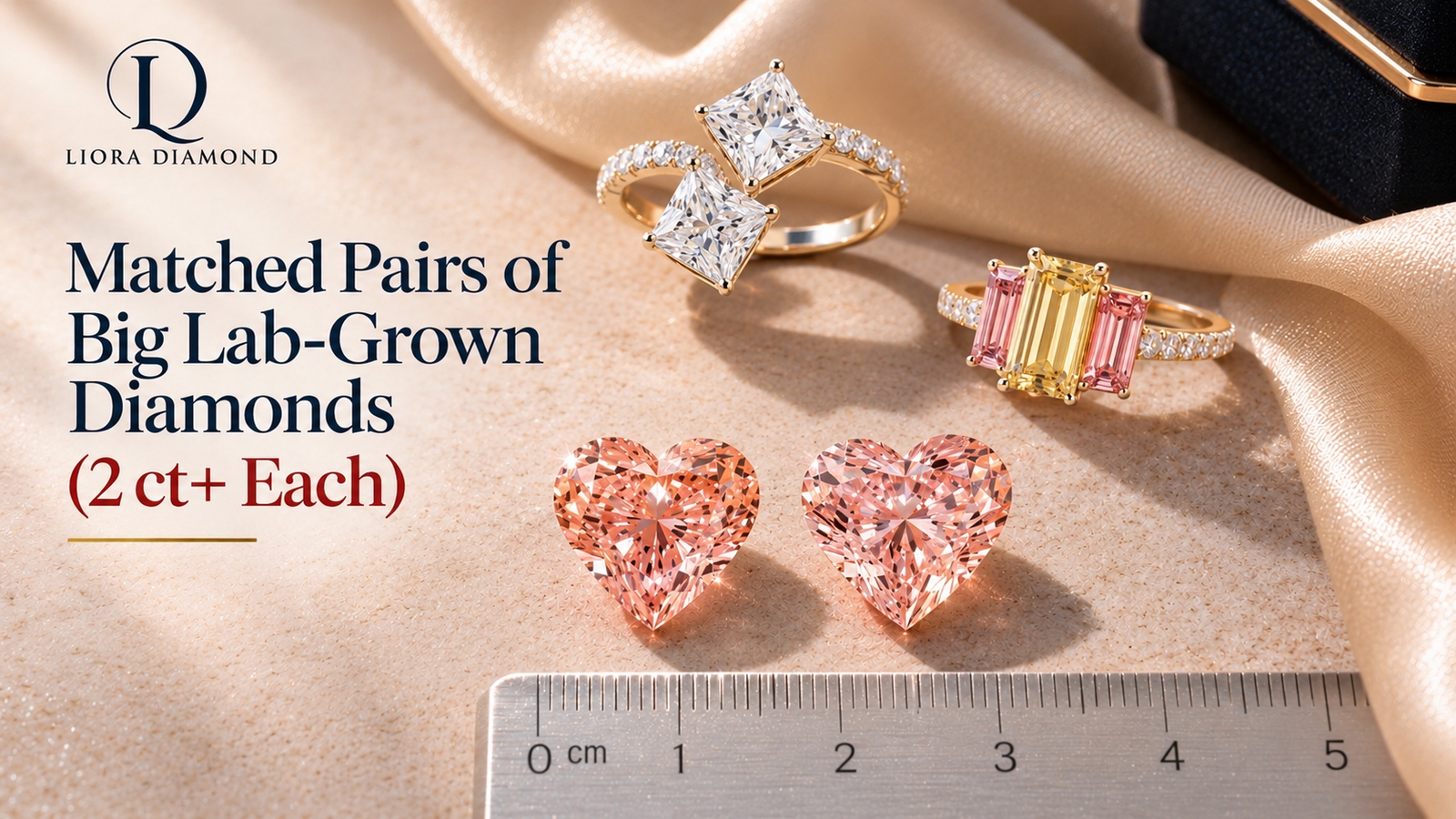
Two diamonds with the same report grades are not automatically a pair. A pair is two stones that look like one stone when they sit side by side in a pair of earrings, on either side of a centre stone, or in a toi-et-moi ring. That depends on colour, clarity, measurements and make together, and on the light you view them in. This guide explains how matching works for big lab-grown diamonds from 2 ct each, which tolerances to put in writing, how fancy-colour pairs differ from white pairs, and how to brief a supplier so the pair that arrives is the pair you approved. Liora Diamond supplies matched lab-grown pairs to trade buyers, and the details below follow Liora's own Big Diamonds.
Key takeaways
- Matched means four things, not one. Liora's Big Diamonds page says pairs are matched for colour, clarity, measurements, and make, from 2 ct each, with video of the pair together before you commit.
- Pair weight is quoted as a total. Earring listings quote total carat weight across both stones, so a 4.00 ct pair means two stones of roughly 2.00 ct each, and you should always ask for each stone's individual weight and report.
- Retail guides give a starting point for tolerances. A size difference of no more than 0.1 to 0.2 mm, colour within one grade, and similar table size within 1%, while another warns that even a one-grade colour difference is noticeable side by side. Treat these as starting points and agree your own in writing.
- Fancy colour is harder to match than white. GIA describes coloured diamond grades by hue, tone and saturation, so two stones sharing a grade line such as Fancy Intense can still differ in how the colour reads next to each other.
- Pairs are a growing part of big-stone trade. DMCC reported that the UAE traded 76.9 million carats of lab-grown material in 2025, up 91.5%, worth US$1.3 billion (this includes industrial material), and Liora's UK, Italy and Hong Kong pages all list matched pairs and layouts among the specifications buyers request.
Quick answer
- What is a matched pair of lab-grown diamonds? A matched pair of lab-grown diamonds is two stones chosen to look identical face-up, with agreed colour, clarity, measurements and make, so earrings or a three-stone design read as one.
- How are big lab-grown diamond pairs matched for earrings? Suppliers compare report grades, millimetre measurements and proportions, then film both stones together in the same light, and the buyer approves the pair before invoicing.
- Where can I buy matched pairs of lab-grown diamonds wholesale? Liora Diamond supplies matched lab-grown diamond pairs wholesale to trade buyers, from 2 ct each, with larger pairs sourced to order and IGI reports as standard on big stones.
What "Matched" Means In a Pair
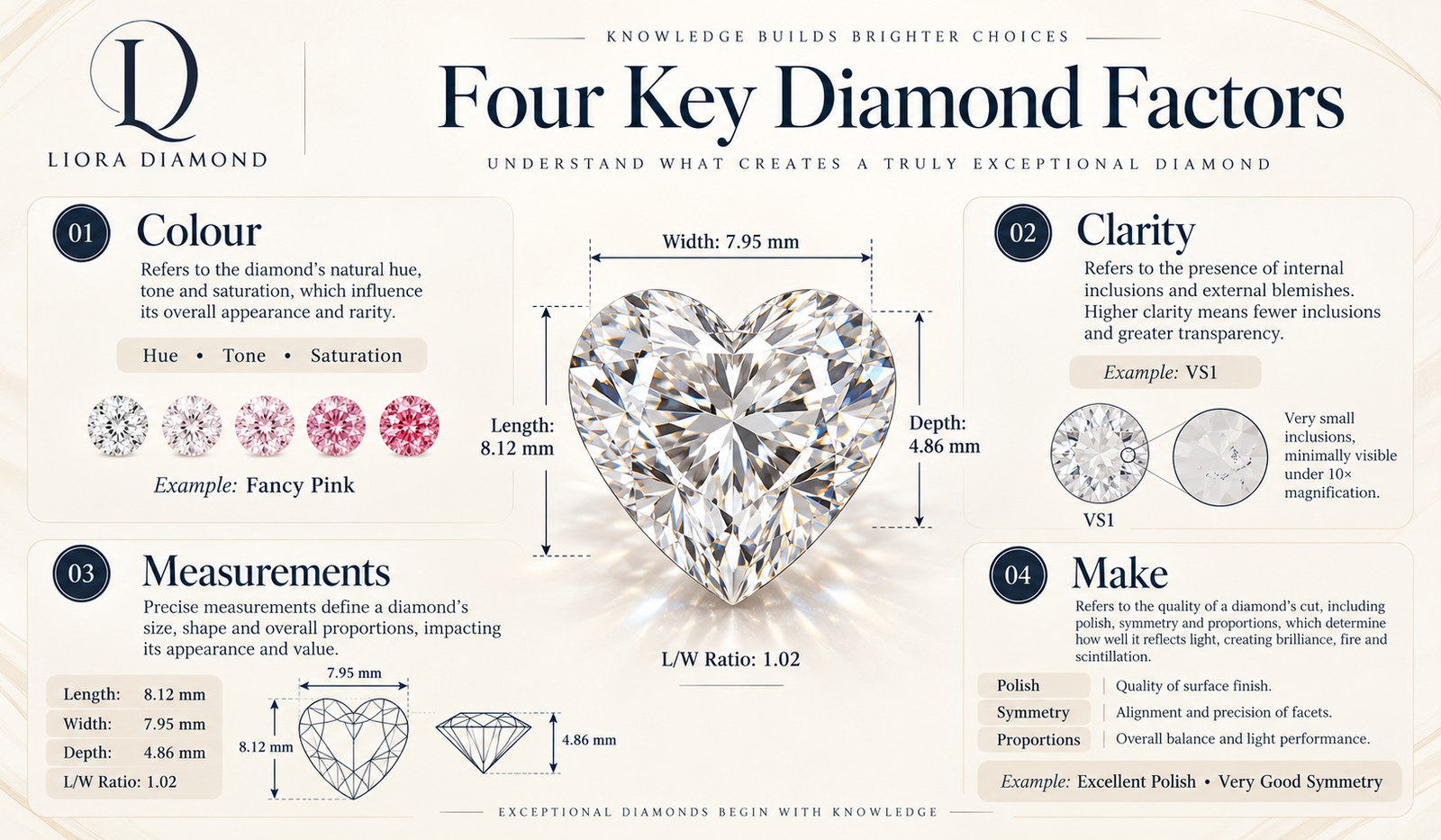 The word is used loosely in retail, so it helps to break it into the four things Liora's Big Diamonds names: colour, clarity, measurements, and make.
| Matching factor | What it controls | Where you check it |
|---|---|---|
| Colour | Whether the two stones look like the same colour in the ear or setting | Report colour grade, then video of both stones together |
| Clarity | Whether one stone shows an inclusion the other does not | Report clarity grade, then magnified and face-up video |
| Measurements | Whether both stones present the same face-up size and outline | Length, width and depth on each report |
| Make | Cut quality, proportions and symmetry, which drive brightness | Report cut and finish information where given, then video |
The point most buyers miss is that carat weight is not on this list. Two stones can weigh the same and still look different, because one is cut deeper and the other spreads wider. Face-up size comes from millimetre measurements, not from weight. That is why a pair is specified by measurements and make as well as by weight.
The guidance in the complete guide to the 4Cs of lab-grown diamonds and the explainer on cut grades and why they matter cover the grading side, and why diamond certification matters for B2B buyers explains why each stone needs its own report.
Tolerances to Ask for B2B Wholesale Diamonds
There is no single industry standard for pair tolerances, which is exactly why they belong in your order. Physical size should be similar within 0.1 to 0.2 mm, colour grades within one grade, and table size within 1%. A difference of even one colour grade between left and right is noticeable in person and stark in photographs, and they recommend the same cut grade for both stones. GIA's own stud earring guidance is shorter: you are buying two diamonds, so the designer must make sure their 4Cs match.
These sources describe white diamonds, and they differ from each other, so do not copy a figure into your specification as if it were a rule. Liora's approach for parcels is to agree tolerances with the buyer up front, and the same logic applies to pairs. A workable brief looks like this.
| Item | Example of what to write |
|---|---|
| Colour | Identical grade line on both reports, including any modifier |
| Clarity | Same grade, or no more than one grade apart if both are eye-clean |
| Length and width | Within 0.10 mm of each other (adjust to your design) |
| Depth and proportions | Similar depth percentage and table size; ask for the figures from both reports |
| Cut and finish | Same grade where the report shows one |
| Evidence | Both report numbers, measurements, and video of the pair together |
Round stones usually give the tightest match, because there is no orientation to worry about. Fancy shapes add one more check, covered below.
White Pairs vs Fancy-Colour Pairs Diamonds
White pairs are matched on a grade scale where each step is small and well understood. Fancy-colour pairs are matched on hue, tone and saturation, and a single grade word covers a wide span. Gemological Institute of America explains that its coloured diamond system is based on the presence of colour and describes colour by hue, tone and saturation, and that the grade word describes the combined effect of tone and saturation. In practice, two Fancy Intense Pink stones can sit at different points within Fancy Intense, and one may lean slightly warmer. Next to each other in earrings, that shows.
Three habits help with fancy pairs.
- Match the full grade line, not just the intensity. A modifier such as Brownish, Purplish, or Orangey changes the colour, so an Intense Pink and an Intense Purplish Pink are not a pair.
- Judge in daylight video of both stones together. Liora's fancy colour notes that colour on a screen varies and advises asking for video under daylight. A side-by-side clip in one light is more reliable than two separate product photos.
- Specify the hue family and the intensity range you will accept. If your design tolerates two neighbouring grades, say so; if it does not, say that too. Our guides to Fancy Intense vs Fancy Vivid for pink and yellow stones and the wholesale fancy coloured lab-grown diamonds guide explain how the grades differ.
For colour-specific context, read the large pink lab-grown diamonds guide, the pink lab-grown diamond wholesale guide, and the white vs fancy colour sourcing guide.
Diamond Shape Matters: Mirror Pairs and Orientation
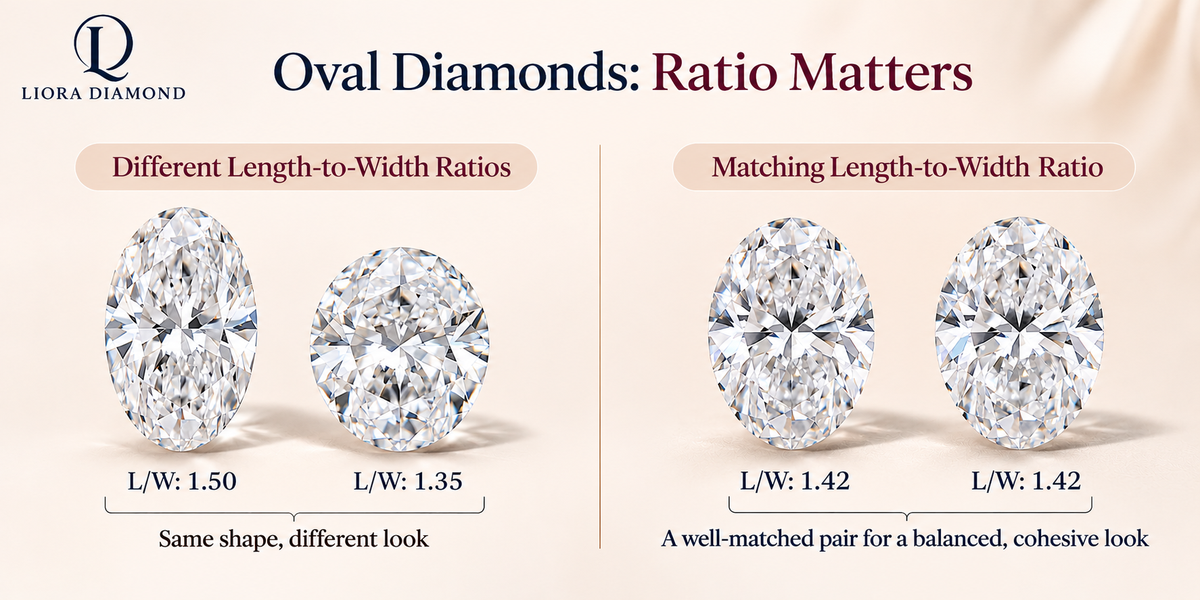 Some shapes need more than a grade match. Pear, oval, marquise, heart, and other non-round outlines can differ in length-to-width ratio even when carat weight is the same, and a pair with different ratios looks uneven in earrings. Pear shapes also face a left-and-right question: whether the two points should lean the same way or mirror each other is a design decision, and it is worth stating on the order. Liora's pear, oval, and radiant filters show the outlines buyers ask for most.
For these shapes, add a length-to-width ratio range to your brief, for example, "ratio 1.45 to 1.50 on both stones", and ask for the length and width of each stone separately. The same applies to heart and cushion stones, where the corner and shoulder shape can differ between two stones of the same weight.
Big Pairs: From 2 ct to 5 ct+ Each
Liora's Big Diamonds offers matched pairs from 2 ct each and says that pairs from 2 ct each are common, while larger pairs are sourced to order. There is 10 to 20 ct as selected stock, grown to order, and 20 ct+ as on request. Liora's UK, Italy, and Hong Kong pages describe big diamonds as singles and matched pairs from 3 ct to 30 ct+.
Size changes how a pair behaves in the trade.
- 2 ct to 3 ct each is the most workable range for earrings and three-stone designs. Matching stock exists in more shapes, so the choice is wider.
- 5 ct each is a statement pair. The shortlist is narrower, and each stone's measurements matter more because small differences are easier to see at that size. See the 5 carat wholesale guide for how shapes and grades step up.
- 10 ct each and above is high jewellery. The pair is usually sourced to order, and the conversation moves to setting, insurance, and timing. Our 10 carat and 20 carat guides cover those size bands.
Stock that already looks alike on paper is where a pair usually starts. Liora's range includes several
- 5.01 Carat IGI-graded Heart Fancy Intense Pink
- 5.01 Carat VS1 CVD-grown Heart Fancy Intense Pink
- 5.01 Carat VS2 Clarity Heart Fancy Vivid Pink
- 5.01 Carat Heart Shape Fancy Vivid Pink
Whether two such stones make a pair is decided by their measurements and a video of them together, which the trade desk checks before proposing a pair. Browse the stones from 5 ct or the Big Diamonds to see the range.
Video of the Pair Together
A report tells you each stone's grades. Video tells you how the two stones behave as a set. Liora's Big Diamonds says the trade desk will propose matching pairs or sides with video of the set together, and offers a 360-degree video of each stone, with filming on request in daylight, under UV, or next to a ruler.
A useful pair video shows four things:
- Both stones side by side, face up, in daylight, with a ruler or measuring reference in frame.
- Both stones tilted together, so you can compare how brightness and colour change with angle.
- Both stones from the side, so you can compare depth and proportions.
- Both reports on screen with the numbers legible and matching the stones in the clip.
If you plan to resell the pair, keep the video and reports with your order file. It protects you if a customer later asks why two stones were chosen. Our guide to IGI-certified lab-grown diamonds wholesale explains what the report gives you, and Liora's big stones are supplied with an IGI grading report as standard, with GIA grading available on request and the report shared before invoicing.
Pairs for Earrings, Three-stone Rings and Layouts
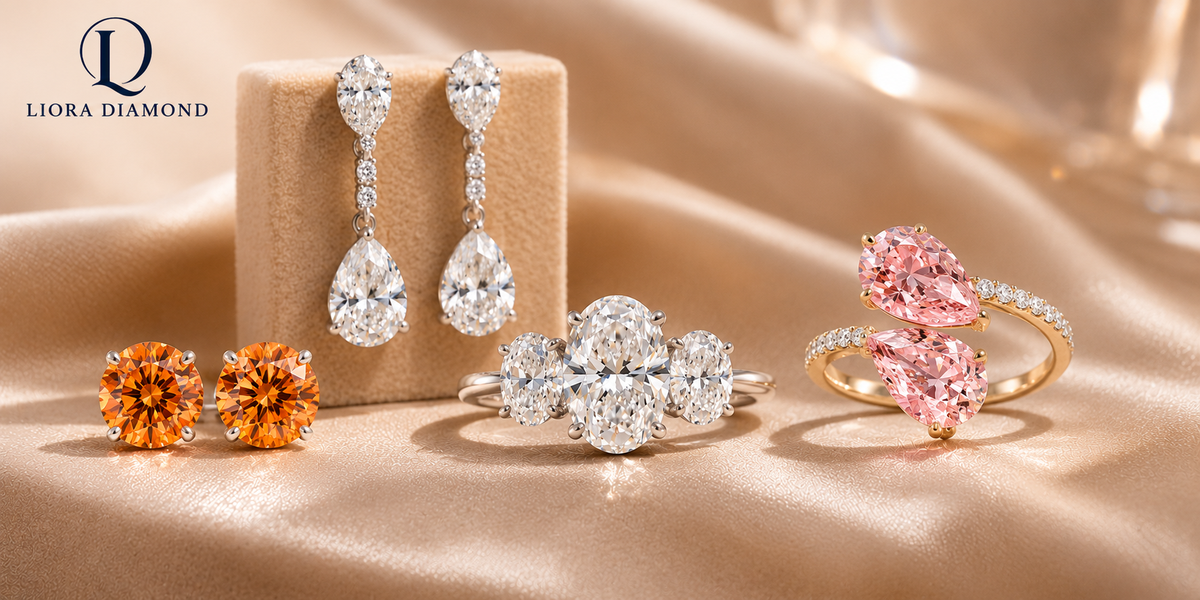 The same two stones can serve different designs, and the design changes what "close enough" means.
| Design | What the match must achieve | Extra check |
|---|---|---|
| Stud earrings | Identical face-up size and colour at a glance, on each side of the face | Same measurements and depth so both sit at the same height in the setting |
| Drop earrings | Same outline and ratio, with mirrored or parallel orientation as designed | Length-to-width ratio and point direction |
| Three-stone ring | Side stones that complement the centre stone in size and colour | Liora says side stones can be cut to fit your centre stone |
| Toi-et-moi | Two stones that read as equals, or deliberately differ in size | Agree whether the stones should match or contrast |
For three-stone work, Liora's Big Diamonds says to send the centre stone's measurements or a catalogue stone reference. Liora's UK page lists toi-et-moi and three-stone combinations among the popular specifications for UK buyers, and notes that Hatton Garden buyers can request centre stones and pairs for bespoke commissions. If you make the finished piece, the guide to choosing a lab-grown diamond supplier for jewelry manufacturers and Liora's B2B jewelry page cover production specifications.
Melee and side stones in the same design
Large pairs often sit inside a halo or pavé. Liora's fancy colour says melee and small stones are sorted by hue and intensity so a halo, pavé band or eternity ring reads as one colour, and that parcels are calibrated by size to your setting with tolerances agreed up front. A photo of the whole parcel is sent before shipping, and repeat orders are matched to the previous parcel. Ask for the pair and the side stones to be reviewed together, because a perfect pair can still clash with a halo that leans a different shade.
Buying Pairs in the USA, UK, Italy and Hong Kong
The pair itself is the same in every market. What changes is paperwork, tax, and the way each market buys. Liora's country states the following, and each says its guidance is not legal or tax advice and recommends checking import rules with a customs broker.
| Market | What Liora's page says about pairs and trade | Importer of record settles |
|---|---|---|
| USA | Orders arrive with a commercial invoice, packing list and original grading report for each stone, with every stone invoiced as lab-grown | Import duty and any state taxes |
| UK | Big diamonds as singles and matched pairs from 3 ct to 30 ct+; hallmarking applies to finished gold, silver and platinum jewellery above legal weight thresholds; USD quotes, with a GBP indication on request. | Import VAT and any duty |
| Italy | Big diamonds as singles and matched pairs from 3 ct to 30 ct; calibrated melee, baguettes and side stones for production runs in Valenza and Vicenza. | VAT and any duty |
| Hong Kong | Big diamonds as singles and matched pairs from 3 ct to 30 ct; matched layouts listed among common requests, with supply planned around fair dates | Check customs rules with your broker. |
For market context, see our guides on sourcing 5 carat+ lab-grown diamonds for U.S. jewelers, lab-grown diamond wholesale trends in the USA and big and fancy-colour sourcing for UAE wholesalers. Liora's shipping policy sets out how shipping works, and the Canada and Belgium specific pages cover two more markets where buyers ask for pairs.
How to Request a Matched Pair
A precise brief produces a better shortlist. Start with the structure in our RFQ template for big lab-grown diamonds and adapt it for pairs.
| Field | Example of what to write |
|---|---|
| Shape and orientation | Oval, ratio 1.40 to 1.50; parallel orientation for drop earrings |
| Carat band (each stone) | 2.00 to 3.00 ct each |
| Colour | Same grade line on both reports; for fancy colour, hue family and acceptable intensity |
| Clarity floor | VS2 or better on both |
| Match tolerance | Length and width within 0.10 mm; similar depth and table |
| Report | IGI on each stone |
| Evidence | Both report numbers, measurements, and daylight video of the pair together |
| Use and market | Retail earring line or custom order; USA, UK, Italy or Hong Kong |
If you are comparing suppliers before you commit, read how jewelry stores choose reliable diamond suppliers and how to buy wholesale lab-grown diamonds in B2B. For the growth methods behind most big stones, see the CVD diamond supplier guide, and for colour-focused work see the fancy colour lab-grown diamond supplier guide.
Ask Liora for a Matched Pair
Send the shape, carat band for each stone, colour or hue, clarity floor, match tolerance, design, and market. Liora's trade pages state a US$2,000 minimum order, replies usually within one business day, and payment by bank transfer against a pro-forma invoice, with photos, 360-degree video, and grading reports shared for shortlisted stones before you pay. The enquiry form lists "Matched pairs and layouts" as an option. Start by exploring Big Diamonds, the fancy colour lab-grown diamonds, or the lab-grown diamond wholesale.
Ask for a matched pair, or contact the trade desk.
Frequently asked questions
1. Can two stones with different carat weights still make a pair?
Yes, if the weight gap comes from cut rather than size. Face-up size is set by length and width in millimetres, so a slightly heavier stone cut deeper can show the same outline as a lighter one cut shallower. The reverse also happens: two stones of equal weight can look uneven. Judge the pair on measurements, proportions and video first, and on weight second. Ask for each stone's weight individually, since pair listings often quote only the total, and agree an acceptable weight gap in writing if your customer expects equal-weight stones.
2. Can you match a pair to a stone I already have?
Liora's Big Diamonds says to send the centre stone's measurements or a catalogue stone reference, and that side stones for three-stone rings can be cut to fit your centre stone. For the best result, send the length, width, and depth in millimetres, the report grades, and a photo or video of your stone in daylight. The trade desk can then propose candidates with video of the set together. If your existing stone is fancy colour, include its full grade line so the hue family and intensity can be compared like for like.
3. Do larger pairs take longer to source?
Liora's Big Diamonds pairs from 2 ct each are common, and larger pairs are sourced to order. It also says stock stones ship fastest, while growing to order suits exact specifications and larger sizes. A pair at 10 ct each or above therefore follows a different path from a 2 ct pair taken from stock. Ask the trade desk for a timeline when you send the brief, and give your required delivery date at the same time so the supply plan can start from it.
4. Should both stones carry separate grading reports?
Yes. Each stone should have its own report, because the report is what proves each stone's grades and measurements and lets you compare them. Liora's Big Diamonds' big stones are supplied with an IGI grading report as standard, with GIA grading available on request, shared before invoicing. Keep both report numbers with the order, and ask that the stones are inscribed so the paperwork can be matched to the stone. When you resell, pass on both reports with the pair.
5. Is a pair priced as two single stones?
Not necessarily. A pair's price reflects each stone's carat, grade, and shape, and the effort of finding two that match, so it should be quoted for the exact pair rather than estimated from singles. Earring prices are usually quoted as a total for both stones, so check whether a number refers to one stone or two. Liora quotes on request for the stones you name through its trade desk, in US dollars, so send the brief and ask for a per-stone and total figure.