Importing Lab-Grown Diamonds into the UK: VAT, Duty, Paperwork and Disclosure
A trade guide for UK jewellers importing lab-grown diamonds. It answers whether VAT and duty apply, which commodity code to use, who needs an EORI number, why parcels get held, whether stones need a hallmark, and how to word lab-grown in ads, with a reusable landed-cost formula.

Most UK jewellers who search for a lab-grown diamond supplier UK buyers can trust end up asking the same handful of practical questions before they order a 5 ct, 10 ct, or 20 ct stone from abroad.
- Do you pay VAT on a lab-grown diamond imported into the UK?
- Is there customs duty?
- What commodity code goes on the invoice?
- Do you need an EORI number?
- Why do diamond parcels get held at customs?
- And once the stone clears, can you actually call it a diamond in your advert?
This guide answers those questions in the order buyers ask them, with a reusable landed-cost formula and a line-by-line reading of a lab-grown invoice the way a customs officer sees it. Liora Diamond supplies lab-grown diamonds to the UK trade, and the supply details below follow Liora's own UK, Big Diamonds, FAQ and shipping pages.
Key takeaways
- Yes, import VAT applies at 20%. The charge is worked out on the customs value plus transport, insurance and any duty up to the first UK destination, so a £12,000 stone with £180 freight and insurance and no duty carries £2,436 of import VAT.
- Duty depends on the commodity code, so ask before you order. Polished synthetic diamonds that are not set or strung sit under the "diamonds, synthetic or reconstructed, worked" heading (7104 91 00), and the duty rate for your code and origin is a broker's call, not a guess.
- The importer pays at clearance. Liora's shipping policy says import duties, VAT, and customs fees are paid by the importer of record, normally the buyer, and a VAT-registered business can postpone and reclaim import VAT on the same return.
- Hallmarking covers the metal, not the stone. A UK hallmark becomes legally required from 1 g of gold, 7.78 g of silver, 0.5 g of platinum or 1 g of palladium, so a loose lab-grown diamond never needs one.
- Disclosure has been tested in 2026. The UK advertising regulator told two jewellery brands to change ads that did not make clear their diamonds were lab-grown, and said disclosure belongs inside the ad itself, not only on the page behind it.
Quick answer
- Do you pay VAT on lab-grown diamonds imported into the UK? Yes, import VAT at the standard 20% is charged on stone value plus freight, insurance and duty, and VAT-registered buyers can usually postpone and reclaim it on their VAT return.
- Is there import duty on lab-grown diamonds in the UK? Duty depends on the commodity code and country of origin, so confirm the rate for polished synthetic diamonds with a customs broker before ordering a large stone.
- Can UK jewellers call lab-grown stones diamonds? Yes, with a clear qualifier such as lab-grown or lab-created placed inside the advert, product title, listing and invoice, not only on a landing page behind them.
Where do UK Jewellers Buy Big Lab-Grown Diamonds Wholesale?
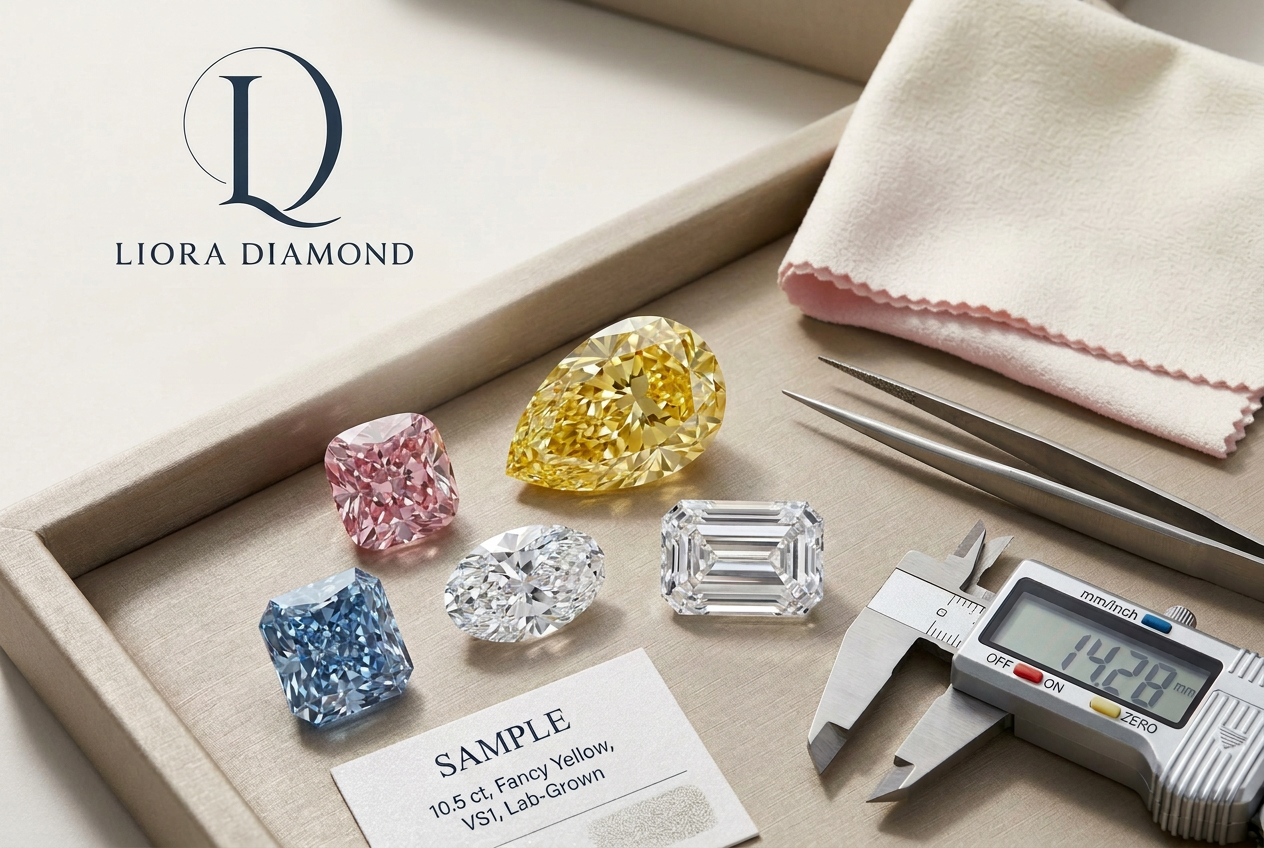
UK trade buyers source from three places: UK-based wholesalers who hold stock, overseas growers and cutters who sell direct, and online trade platforms. Direct import widens the choice at large sizes, which is why it is the route for most 5 ct+ and fancy-colour orders. Liora's UK page lists big diamonds from 3 ct to 30+ carats as singles and matched pairs, and names who it serves: Hatton Garden jewellers who want centre stones and pairs, Jewellery Quarter manufacturers who want calibrated melee and side stones, and online bridal brands. The shapes UK buyers request most are oval, emerald and elongated cushion centres, with toi-et-moi and three-stone designs, eternity-band melee and fancy yellow and pink for fashion ranges. Browse the oval diamonds, the pear-cut stones, or the diamonds from 5 ct, or read the UK supplier page and the broader wholesale supplier guide.
Size changes the import plan, because it changes how long the stone takes to reach you. Liora's Big Diamonds puts 3 to 5 ct as usually in stock, 5 to 10 ct as stock with a short lead time, 10 to 20 ct as selected stock or grown to order, and 20 ct+ as on request. Our size guides for 5 carat, 10 carat, 20 carat and 30 carat stones show what each band involves. If you shop by colour, the large pink diamond and large yellow diamond guides cover the fancy-colour side.
Do You Pay VAT On Lab-Grown Diamonds Imported into the UK?
Yes. Import VAT applies to diamonds that arrive from outside the UK, including loose lab-grown stones. UK government guidance sets the value for VAT as the customs value plus incidental expenses such as packing, transport and insurance up to the first UK destination, plus any customs duty payable, and the VAT is normally charged at the standard rate, which is 20%. The detail that catches buyers out is the base: you pay VAT on the stone, the freight, the insurance and the duty, not on the stone alone.
A landed-cost formula you can reuse
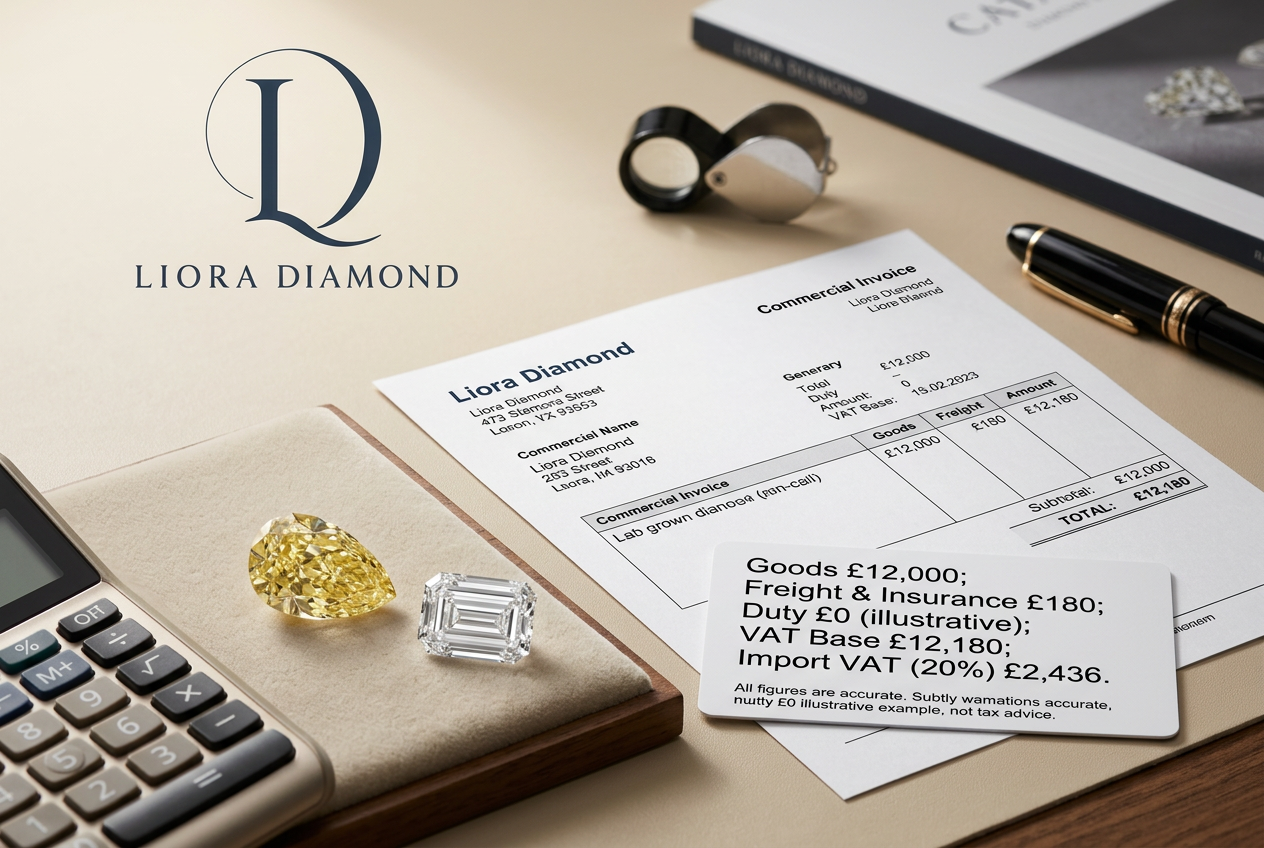 Use the formula below as a template for your own costing sheet. The numbers are illustrative only, not a Liora quote and not a duty rate.
| Line | Amount (£) | How it is built |
|---|---|---|
| A. Goods value on the invoice, in sterling | 12,000 | Converted from the US dollar invoice at the rate on the day |
| B. Freight and insurance to the UK | 180 | Included in the value for VAT |
| C. Customs duty | 0 | The real rate comes from your commodity code and origin |
| D. Value for VAT | 12,180 | A + B + C |
| E. Import VAT at 20% | 2,436 | D × 0.20 |
| F. Total cash at the border if you pay on import | 2,436 | E, plus any broker or courier fees |
If you are VAT-registered and use postponed VAT accounting, line E is declared on your VAT return and reclaimed as input tax on the same return, subject to the normal rules, so it does not tie up cash. If you are not VAT-registered, import VAT is payable in full at importation. Liora quotes trade prices per stone in US dollars, excluding shipping, insurance and import duties, so lines B, C and E are always additional to the number you see on a stone listing.
Is There Import Duty on Lab-Grown Diamonds in the UK?
It depends on two things: the commodity code the goods are declared under, and where the goods come from. Duty is not a flat "diamond rate", and the bare word "diamond" on an invoice does not tell customs which rate applies. What is certain is that a duty line exists in the landed-cost calculation, that it feeds into the VAT base, and that the rate can differ between suppliers in different countries. Ask a customs broker for the duty rate on your declaration code and your supplier's country of origin before you commit to a large stone, and put the answer in your costing sheet as line C.
What is the commodity code for lab-grown diamonds in the UK?
Lab-grown stones are classified as synthetic, not natural. Under the UK trade classification, the heading for polished synthetic diamonds is "diamonds, synthetic or reconstructed, worked, whether or not graded but not strung, mounted or set" (7104 91 00), while rough or only sawn synthetic diamonds sit under a separate code (7104 21 00). A stone that is already set in a ring falls outside this heading. The practical lesson is to decide on the product before you decide on the code: loose polished stones, rough, melee parcels and finished jewellery are four different declarations. Your broker confirms the full code used on the declaration.
Do You Need an EORI Number to Buy Diamonds from Abroad?
If you are the one importing, yes. UK government guidance says a business planning to import goods needs an Economic Operators Registration and Identification number, which is quoted on customs declarations. There are two ways around doing the paperwork yourself. Most businesses hand customs work to a specialist broker, and a non-UK trader can arrange for an agent in the UK to import and supply goods on their behalf. Liora's UK page suggests checking import rules with a customs broker. Decide who the importer of record is before the order is placed and write it on the pro-forma, so that nobody assumes the courier will "just sort it".
Who Clears the Parcel: You, Your Broker or the Courier?
The three routes feel similar until something goes wrong. Choose before you pay, not after the courier calls.
| Route | What you do | Best for | Watch for |
|---|---|---|---|
| You as importer of record | Hold an EORI number, supply the declaration details, pay or postpone the VAT. | Regular importers and VAT-registered businesses | You own any error on the declaration |
| Your own customs broker | Give the broker the invoice, packing list and reports in advance | Occasional large purchases where classification matters | Broker fees on top of tax |
| The courier's clearance service | Respond to the courier's request for details and pay what it invoices | Small, simple consignments | Some couriers add handling fees on top, and a query can stall the parcel |
Liora's FAQ says it can advise on shipping terms that suit your set-up, and its shipping policy says terms for each order appear on the invoice. Read that line before paying. Our guide to buying wholesale lab-grown diamonds in B2B covers the order flow around it.
Read a Lab-Grown Diamond Invoice the Way Customs Does
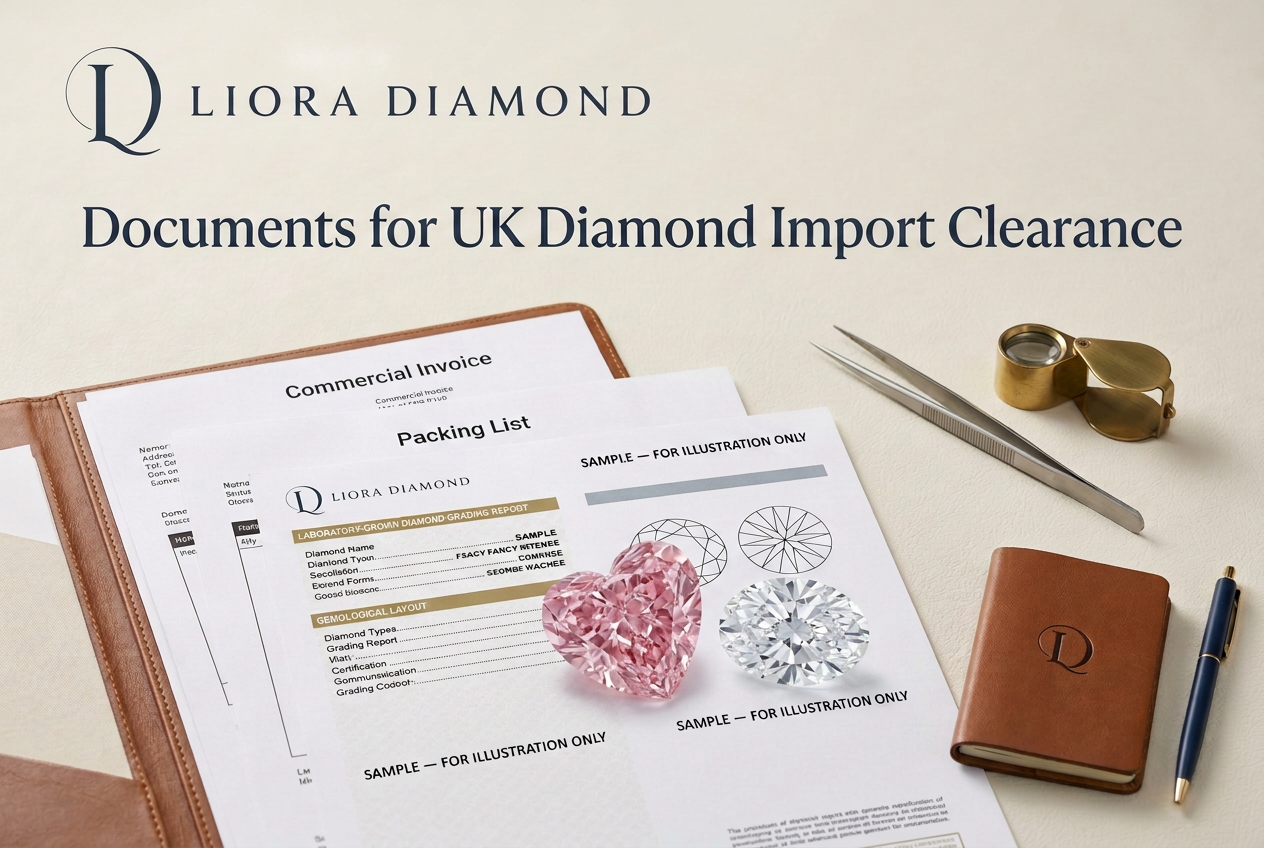
This is the part most import guides skip. A parcel is cleared against its paperwork, and a vague or inconsistent invoice is the most common reason a high-value parcel stalls. Liora's shipping policy states that each parcel includes a commercial invoice and packing list describing the goods as laboratory-grown, original grading reports for graded stones, and any declarations the customs authority requires. Below is an illustrative invoice line, with what each field tells the person clearing it. It is a sample, not a real invoice.
| Invoice field | Illustrative entry | Why it matters at clearance |
|---|---|---|
| Description of goods | Laboratory-grown diamond, CVD, polished, loose | Says it is synthetic (not natural), states it is loose and polished, and points to the right commodity code. |
| Specification | 5.01 ct, heart, Fancy Intense Pink, VVS2 | Lets the officer match the stone to the report and the value |
| Report number | One report number per stone | Ties the physical stone to its grading paperwork |
| Quantity and weight | 1 piece, carat weight as on the report | Must agree with the packing list |
| Unit and total value | In US dollars, per stone | Becomes the customs value on which VAT is calculated |
| Country of origin | Where the goods were made | Can affect whether a duty rate or preference applies |
| Consignee and importer details | Your business name, address, VAT and EORI numbers | Missing or mismatched details are an avoidable cause of delay |
| Shipping terms | Which charges the invoice leaves to you | Tells you what you will be asked to pay when the courier arrives |
Three checks cut most of the risk. The description should say laboratory-grown and not just "diamond". The invoice, packing list, and report should give the same weight and report numbers. And the value should be a real transaction value, because the customs value drives the VAT you pay. Liora's FAQ says goods are described as laboratory-grown throughout, and that grading reports state the growth method (CVD or HPHT) and disclose any post-growth treatment. For help reading those reports, see how to verify a lab-grown diamond report before you pay and our explainer on why diamond certification matters. For the growth methods named on the report, see the CVD and HPHT supplier guides.
Why Do Diamond Parcels Get Held at UK Customs?
A held parcel is often a paperwork or value query rather than a problem with the stone. The causes worth ruling out are practical and mostly avoidable:
- A description that does not match the report. If the invoice says "diamond" and the report says laboratory-grown, the clearing agent has to ask which is right.
- A value that looks too low or too round. The customs value drives the tax, so a figure that does not look like a real transaction invites questions.
- No importer details. A missing EORI number, VAT number, or contact phone number leaves nobody to answer the query.
- A courier that asks you, not your broker. If a broker is handling the entry, tell the courier before it books the delivery.
- Payment not made in time. Where the courier collects duty and VAT before delivery, an unpaid request holds the parcel.
Liora's shipping policy says transit is normally three to seven business days and that transit times depend on customs, and its stock goods usually ship two to three business days after payment clears and documentation is complete. If the order is for a client with a fixed date, such as a wedding or a show, say so when you send the brief and build a few days of clearance margin around it. Every shipment is insured for its invoice value until delivery, and the policy asks you to report loss or damage within 48 hours of the expected delivery date, so keep the unboxing photographs with the order file.
Can You Call it a Diamond? What UK Advertising Rules Say about Lab-Grown
You can, with a clear qualifier. In 2026, the UK advertising regulator ruled against two jewellery brands whose ads did not make clear that the diamonds were lab-grown. It said that whether a diamond is natural or synthetic is material information, that a clear qualifier is needed, and that explanatory text on the website behind the ad does not make up for leaving the qualifier out of the ad itself. One of the brands changed its ads by putting the word lab before diamonds. Liora's UK page says UK trading standards expect lab-grown diamonds to be clearly described, and the practical rule is simple: put the qualifier where the reader first sees the product.
| Where the stone is described | Clear | Risky |
|---|---|---|
| Paid or social ad | "Lab-grown diamond ring" in the ad copy | "Diamond ring" with the explanation only on the landing page |
| Product title | "5.01 ct lab-grown diamond heart, Fancy Intense Pink" | "5.01 ct diamond heart" with the qualifier lower down |
| Receipt and label | Growth method and "laboratory-grown" carried over from the report | Dropping the qualifier when you re-issue the details |
| Trade price list | Report numbers beside each stone, lab-grown stones listed separately | Natural and lab-grown stones in one undifferentiated list |
Train counter staff to give a one-line answer to "is it a real diamond?" that matches your listings. For the context behind the question, see natural versus lab-grown diamonds from a supplier's perspective, why jewellery brands are switching to lab-grown diamonds and the 2026 B2B industry trends review.
Does a Lab-Grown Diamond Need a Hallmark?
No, because hallmarking applies to precious metals. Under UK law, articles below 1 g of gold, 7.78 g of silver, 0.5 g of platinum or 1 g of palladium are exempt, so a hallmark is required from those weights upward; a loose stone is never hallmarked, and a ring only needs one if its metal passes the threshold for that metal. Liora's UK page notes that it can supply finished pieces ready for a UK hallmarking office and advises buyers to confirm the route with that office. If you plan to have settings made for your stones, read the B2B jewelry page and our guide to choosing a lab-grown diamond supplier for jewelry manufacturers, and agree on who arranges hallmarking before production starts.
Where This Fits With Sourcing in Other Markets
The import mechanics differ by market, even though the stone is the same. If you also sell in the US, read sourcing for U.S. jewelers and USA wholesale trends. Liora has market pages for Canada, Australia, Belgium and Italy, and the guides to Hong Kong buyers and UAE wholesalers show how the same process looks in two trading hubs. To work out what to specify for pink and yellow stones, see Fancy Intense versus Fancy Vivid and the fancy colour lab-grown diamonds page.
Ask Liora for a UK Lab-Grown Diamonds Quote.
Liora's UK page states a trade minimum of US$2,000 per order, a quote within one business day, payment by bank transfer against a pro-forma invoice before dispatch, and insured delivery with photos, 360-degree video and grading reports shared before you pay. Liora is trade-only and does not sell to UK consumers or contact customers of its trade buyers. Send your specification through the Big Diamonds enquiry form using the structure in our RFQ template for big lab-grown diamonds; read the shipping policy and FAQ first if you want the full terms, or contact the trade desk. Add your importer details and the delivery date you need. This guide is general information, not legal or tax advice, so check your position with a customs broker or accountant.
Get a UK quote for a large lab-grown diamond
Frequently asked questions
1. Do trade prices for lab-grown diamonds include VAT?
No. Liora's listing prices are trade prices per stone in US dollars, excluding shipping, insurance, and import duties, and import VAT comes on top at clearance. This matters when you compare quotes, because a supplier that quotes delivered and duty-paid is not comparable with one quoting ex-works. Ask each supplier to state which charges are included, then add the missing lines to the same sheet. When you sell the finished piece to your own customer, VAT on that sale is a separate calculation, so keep the import VAT record and the sales VAT record apart.
2. Should I ask for a price in pounds or US dollars?
Ask for both. Liora quotes in US dollars, the common currency of the diamond trade, and can give a sterling indication on request. You pay by bank transfer against a pro-forma invoice, so the actual cost in pounds depends on the exchange rate on the day you pay, and the customs value at the border can move again before clearance. Treat the sterling figure as a planning number. On a £12,000 stone, a 1% currency movement is £120, so build a small allowance into any fixed price you quote your own customer.
3. Is it better to buy from a UK wholesaler or import directly?
It depends on what you need. A UK-based wholesaler that holds stock saves you the import steps and may suit a stone you need this week, but the range at large sizes and in fancy colours can be narrower, and it adds another link to the price chain. Importing directly widens the choice, particularly for 5 ct+ stones and matched pairs, and lets you speak to the people who source the stone, at the cost of managing clearance and tax yourself. Many UK jewellers use both: stock for urgent small jobs, direct import for planned large or custom commissions.
4. What if the stone arrives and it is not what I approved?
Photograph the parcel before opening it, then compare the stone with the report number, weight, measurements, and the video you approved, and contact the trade desk the same day with the evidence. For transit loss or damage, Liora's shipping policy asks for a report within 48 hours of the expected delivery date. Liora's published pages do not set out a returns procedure, so agree inspection and return terms in writing before you pay, particularly for a 10 ct+ stone. A written note of what you will accept protects both sides.
5. Is the stone insured once it reaches my premises?
Liora's shipping policy says every shipment is insured for its invoice value until delivery. After you sign for it, the stone is your risk unless your own stock or block policy covers it, so confirm when your cover starts and what it pays for a single high-value stone. A 10 ct+ stone can be worth more than a per-item limit, and cover for stones held on approval, in a safe, or in transit to a setter can differ. Ask your insurer in advance and note the start date on your receiving record.