Complete Guide to the 4Cs of Lab-Grown Diamonds (For Wholesale & Retail Buyers)
Cut, color, clarity, and carat—learn how the 4Cs apply to lab-grown diamonds and why they matter differently for wholesale and retail buyers, The 4Cs—cut, color, clarity, and carat—determine a diamond's quality and price, but grading lab-grown diamonds comes with its own nuances that every wholesale and retail buyer should understand. This complete guide breaks down what each C means for lab-grown stones, how it affects sourcing decisions and margins, and what to look for on a certificate before you place your next order
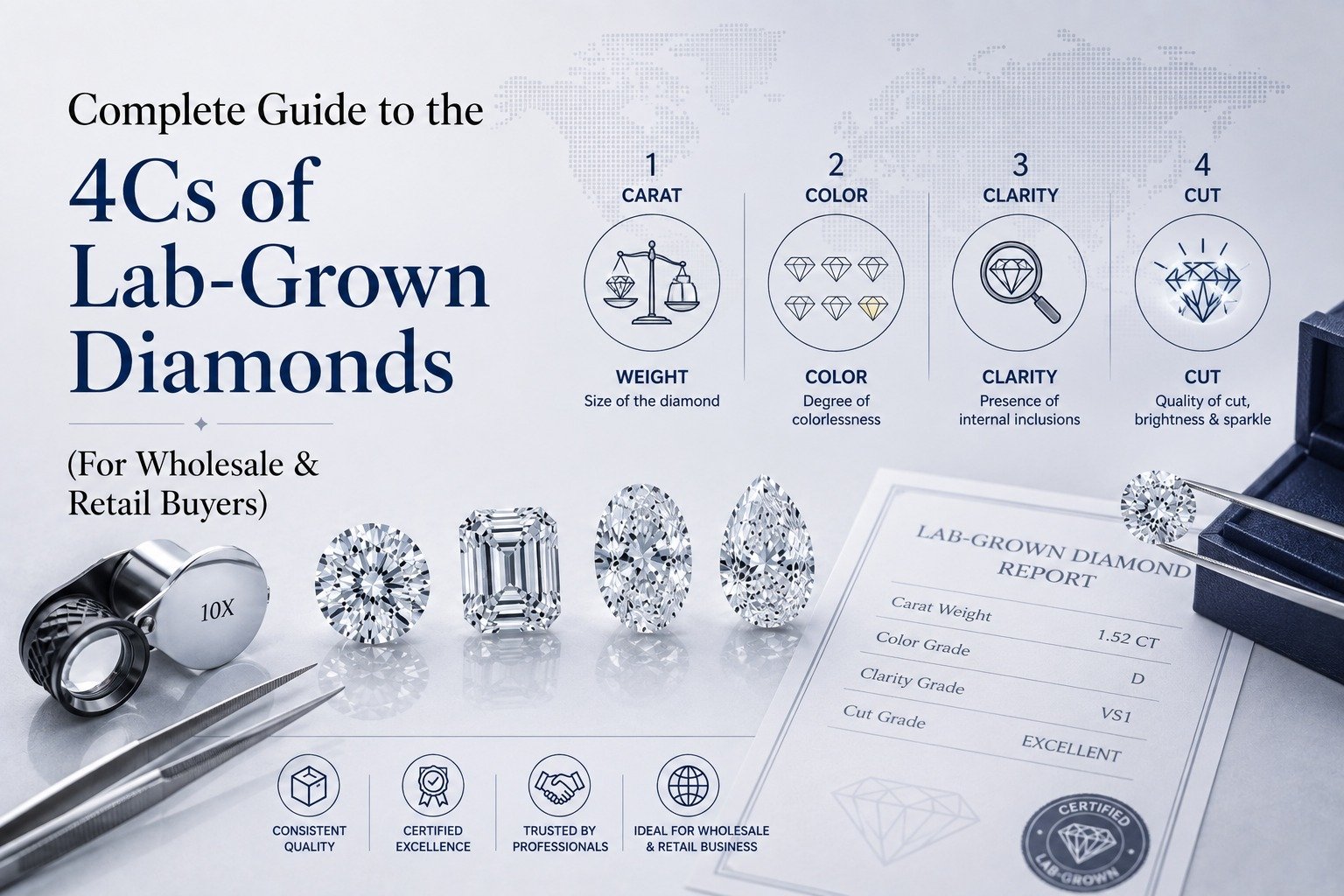
Most "4Cs" guides are written for a bride-to-be standing in a showroom, not for a buyer trying to fill a parcel order or stock a display case. If you're sourcing lab-grown diamonds for resale as a wholesaler, retailer, or manufacturer, the 4Cs mean something different to you. They're not a generic checklist. They're a pricing model, a quality-control tool, and a risk filter all at once for your jewelry brand.
This guide explains cut, color, clarity, and carat specifically through a B2B lens: how each factor behaves differently in lab-grown stones versus natural, and how it moves your cost per carat. Also, where buyers commonly get burned when a "certified" parcel doesn't match its paperwork.
What Are the 4Cs, and Why Do They Behave Differently in Lab-Grown Diamonds?
Cut, color, clarity, and carat weight are the four criteria GIA established in the 1940s to standardize diamond grading. IGI and GIA both apply the same 4C framework to lab-grown stones as they do to natural ones. This diamond has identical optical and chemical properties to a mined one, and it's graded on the same D-to-Z color scale and FL-to-I3 clarity scale.
What's different is the distribution. Lab-grown production, whether CVD (Chemical Vapor Deposition) or HPHT (High Pressure High Temperature), skews toward higher color and clarity grades far more consistently than natural rough. For a buyer, that means near-colorless, eye-clean inventory is available at scale and at a price point that would be unrealistic in natural goods. That single fact reshapes how you should be buying.
1. Diamond Cut: The Factor That Determines Sellability
Introducing the first 4C, a diamond cut. It has five grades: Excellent, Very Good, Good, Fair, Poor, that measures how well a stone's facets return light. It's the hardest C to compensate for after the fact. Why? A poorly cut stone will look lifeless in a customer's hand regardless of its color or clarity numbers on paper.
For resale inventory, cut quality is your return-rate insurance. A parcel of Excellent or Very Good cut stones moves faster on the counter and generates fewer post-sale complaints than a mixed-cut parcel bought purely on price per carat. When you're browsing live diamond inventory, filter by cut grade first, then negotiate on color and clarity, not the reverse.
Diamond shape also plays into cut consistency. For example, round brilliants have the most standardized cut-grading data of any shape, which is why they remain the safest volume play for retail counters. Fancy shapes carry more subjectivity, so buyers sourcing oval cut, cushion cut, or emerald cut stock should ask for proportion data (table %, depth %, length-to-width ratio) alongside the certificate, not just the grade.
2. Diamond Color: Where Lab-Grown Gives You a Real Margin Advantage
Color is graded D (colorless) through Z (light yellow/brown). In natural diamonds, D-F stones command a steep premium because they're genuinely rare. In lab-grown, D-F and G-H production is far more common, which is precisely why lab-grown wholesale pricing sits 75-85% below natural at equivalent grades.
The B2B implication: don't default to buying the lowest color grade "because it's lab-grown so it's cheap anyway." The spread between G-H and I-J is still meaningful in lab diamonds, and G-H stones face up whiter under standard retail lighting. This matters for engagement ring and halo settings where color is most visible. If your customer base favors fine jewelry rather than fashion pieces, stock G-H as your baseline, not J.
Fancy color lab-grown diamonds include pinks, reds, blues, green, brown, and yellows, and deserve a separate note here. Because CVD growth conditions can be controlled to encourage specific color centers, fancy color stock is far more available and consistently priced than fancy color natural, which remains one of the rarest categories in the trade. This is an underused margin opportunity for retailers who haven't added colored diamonds to their case yet.
3. Diamond Clarity: What CVD vs. HPHT Actually Means for Your Grading Sheet
A clarity chart helps to identify and measure inclusions and blemishes on the FL (Flawless) to I3 (Included) scale. Here's a distinction most 4C guides skip entirely: CVD and HPHT diamonds tend to show different inclusion patterns, not just different quantities.
CVD stones more commonly show pinpoint inclusions and occasional graining, which typically doesn't affect visible clarity at VS grades and above.
HPHT stones can sometimes carry metallic flux inclusions from the growth process, which is a detail worth flagging to jewelry manufacturers doing prong-setting or resizing, since these inclusions can occasionally affect durability at the surface.
Neither point is a red flag: both methods produce excellent VS1-VVS2 material at scale. But a wholesale buyer who understands growth method, not just the clarity number, can set customer expectations correctly and avoid disputes later. Ask your supplier whether a parcel is CVD, HPHT, or mixed before you commit, and request that it's noted on the invoice.
For most retail and bridal jewelry, VS1-VS2 is the sweet spot: eye-clean under 10x magnification for the vast majority of stones, at a meaningfully lower price per carat than VVS grades.
4. Diamond Carat: How Weight Breaks Actually Move Your Cost
Carat weight is simply the diamond's mass: one carat equals 200 milligrams. What matters for buyers isn't the raw weight; it's where a stone sits relative to standard round brilliant cut diamond weight breaks:
| Carat Weight | Size |
|---|---|
| 0.30ct | 4.3mm |
| 0.50ct | 5.1mm |
| 0.70ct | 5.7mm |
| 0.90ct | 6.2mm |
| 1.00ct | 6.4mm |
| 1.50ct | 7.4mm |
| 2.00ct and so on | 8.1mm |
Price per carat jumps separately just above each break, which means a 0.98ct stone can be priced noticeably lower per carat than a 1.01ct stone of otherwise identical grade.
This is one of the most exploitable inefficiencies in wholesale sourcing. If your customer doesn't have a hard requirement for "1 carat or above," a 0.90-0.97ct stone in the same cut/color/clarity bracket delivers near-identical face-up size at a better margin. If your buyers specifically need round-number carats for marketing purposes, browse 1 carat and above stock directly and budget for the break-point premium accordingly.
Melee (small, calibrated stones typically under 0.18ct used for pavé and accent settings) is graded on the same 4Cs but sold by parcel consistency rather than individual certificates in most cases: color and clarity uniformity across the whole parcel matters more than any single stone's grade.
The Fifth C for B2B Buyers: Certification
Consumer guides stop at four Cs. Wholesale buyers can't. Certification, which lab-grades the stone and whether that grading is verifiable, is arguably the most commercially important factor in a B2B transaction. Because it determines whether your customer, your insurer, and your customs broker will all accept the paperwork without dispute.
IGI certifies the large majority of lab-grown diamonds globally and is the standard most retailers expect to see on lab-grown stock.
GIA remains the benchmark for natural diamonds and has expanded lab-grown grading as well.
For resale purposes, match the certification to what your target market recognizes; a European wholesale buyer and a US bridal retailer may have different expectations.
Every stone should also carry a laser inscription on the girdle matching its certificate number. This is your fastest verification check on arrival, and the detail most counterfeit or swapped-stone disputes are managed on.
How the 4Cs Actually Move Wholesale Parcel Pricing
Retail guides talk about the 4Cs as quality descriptors. In wholesale, they're pricing levers, and they interact in ways that a per-stone consumer guide never has to explain:
Cut and color move price linearly within a grade band, but clarity moves it in steps. The jump from SI1 to VS2 is usually larger than VS2 to VS1, because SI1 is the lowest grade most retailers will put in a case.
Carat drives price exponentially, not linearly, because of the weight-break effect described above.
Parcel consistency carries its own premium. A matched parcel of 50 stones within a tight color/clarity range is worth more per carat than 50 stones of the same average grade bought individually. It saves the retail buyer sorting and matching labor downstream.
This is why two "Emerald Diamond VS1, G color, Excellent cut" parcels from different suppliers can be priced 15-20% apart. Here, one is genuinely matched and consistent, the other is an average masking a wide spread. When requesting bulk or parcel pricing, always ask for the full spread (min/max per grade), not just the average.
What Consistent 4C Grading Actually Feels Like on a Repeat Order
Here's the part most 4C guides never touch: the first parcel from a new supplier almost always looks fine on paper. The real test is the fifth or fifteenth reorder, whether "VVS1, G color" still means the same thing it meant three months ago, or whether the grading has quietly drifted toward the loose end of each range to protect the supplier's margin.
Buyers who've been burned describe a specific pattern: nothing on any single certificate is technically wrong, but the parcel as a whole "reads" lower than its stated grade once it's under the loupe next to the last batch. That's not a fraud you can prove stone-by-stone, but it's a consistency problem, and it only shows up over multiple orders.
The practical fix is boring but effective: keep a reference stone from every parcel, request the full grade spread (not the average) on every quote. After it, physically check laser inscriptions against certificates on arrival rather than trusting the paperwork alone.
Suppliers who welcome that level of scrutiny, rather than treating it as an insult, are the ones worth building a repeat relationship with. This is also exactly what a live, filterable stock feed is meant to solve: you're checking real inventory against real grades before you commit, not trusting a static catalog photo.
Sourcing Your Next Parcel
Understanding the 4Cs is one thing. Applying it profitably means working with a supplier who certifies every stone, discloses growth method on request, and prices parcels transparently rather than by blended averages. Liora Diamond ships IGI-certified lab-grown stock worldwide with laser-inscribed verification on every piece, and offers dedicated wholesale parcel pricing for retailers and manufacturers ordering at volume.
Ready to request parcel pricing on your next order? Get a wholesale quote and specify shape, carat, clarity, and quantity. Most business-to-business enquiries get a response within 24 hours.
FAQs
Which of the 4Cs matters most for resale margin?
Cut and clarity typically offer the best margin-to-perceived-value ratio in lab-grown, since buyers can source Excellent cut, VS-clarity stones at a fraction of natural pricing. Carat weight is where cost scales fastest, so it's the lever to negotiate hardest on for volume orders.
Do lab-grown diamonds use the same 4Cs grading scale as natural diamonds?
Yes. IGI and GIA grade lab-grown diamonds on the identical D-to-Z color scale and FL-to-I3 clarity scale used for natural stones. The grading criteria don't change; only the typical distribution of grades in the available supply does.
Is IGI or GIA better for lab-grown diamonds?
Neither is objectively "better." They're both internationally accredited labs. IGI certifies most lab-grown volume in the trade today, while GIA is the traditional benchmark most associated with natural stones. Match your certification choice to what your specific market and customer base recognize.
What clarity grade should a wholesaler stock for engagement rings?
VS1-VS2 is the standard sweet spot: eye-clean for nearly all stones, priced well below VVS grades, and broadly accepted across bridal retail markets.
Why do two diamonds with the same 4C grades have different prices?
Certification lab, parcel consistency, proportions (not just cut grade), fluorescence, and where the carat weight sits relative to a pricing break-point can all create a price gap between two stones with identical stated grades.
```