Lab-Grown Diamond Price per Carat by Size: Why Big Stones Step Up
A trade explainer on lab-grown diamond price per carat by size. It shows why per-carat price steps up above 3 ct, what growth time, crystal strain, and cutting loss add, why weight grows faster than face-up size, and how to compare quotes fairly with a worked 4.90 ct versus 5.02 ct example.
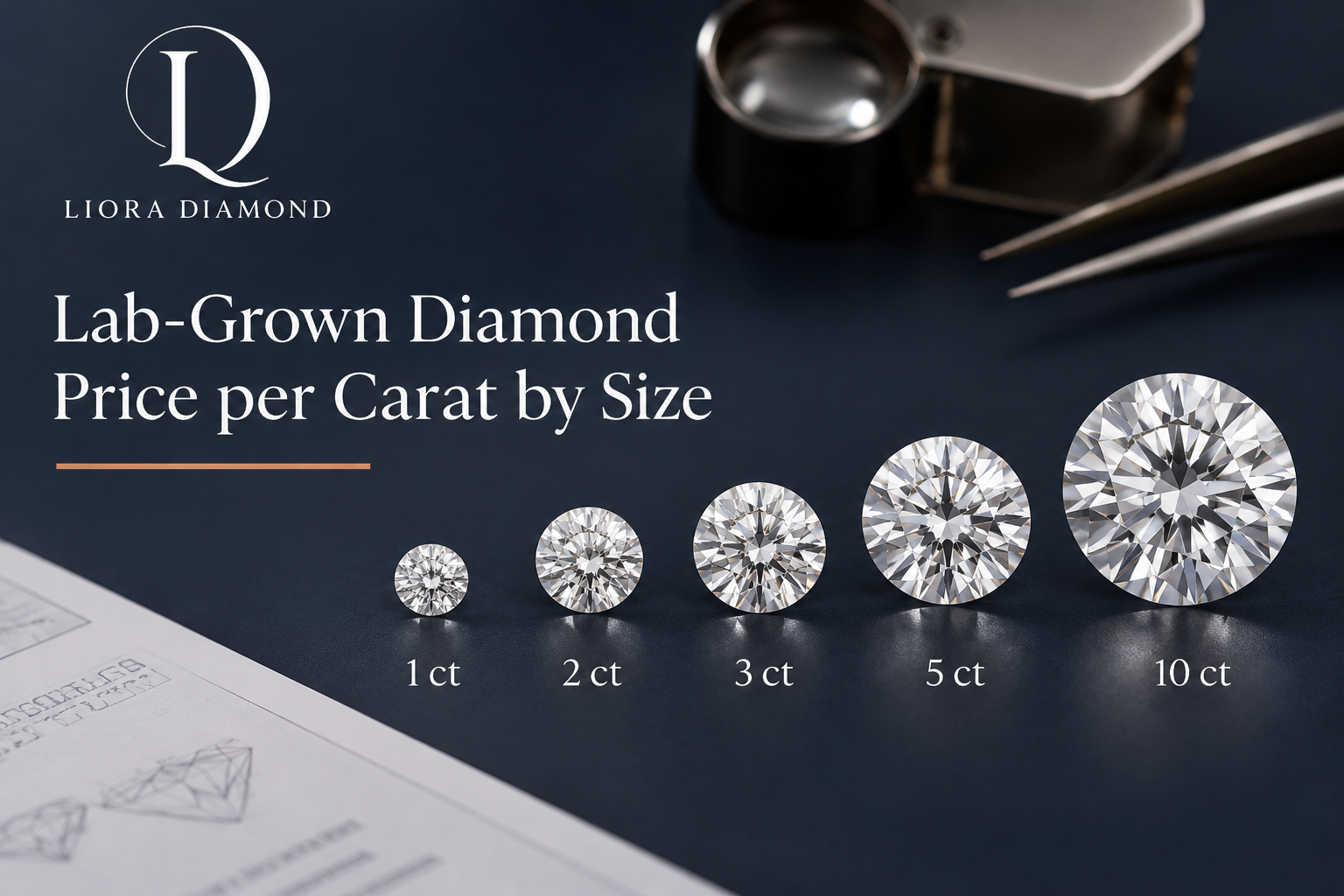
Ask for a quote on a 2 ct stone, then on a 5 ct stone, and the second number rarely comes out as simply "2.5 times the first." The price per carat has moved, too. For anyone buying lab-grown diamonds at trade volume, that movement is the most misread number in the whole purchase: some buyers expect it to stay flat because the stones are made in a reactor, others expect it to climb as steeply as it does for mined stones. Neither is right.
This guide explains how lab-grown diamond price per carat behaves as size increases, what happens in the growth chamber and on the cutting wheel that causes it, how to read a quote so two stones of different sizes can be compared fairly, and the levers that bring the per-carat figure down without making the stone look smaller. No price list is published here because trade prices change by specification and quote date. What the guide gives you is the logic behind the numbers, so you can test any quote against it.
Key takeaways
- Price per carat does step up with size, but gently. Liora's big diamonds price more steeply above 3 ct, and the climb is far shallower than the near-exponential curve seen in mined stones, so a 10 ct lab-grown diamond is a pricing question, not a pricing shock.
- Growth is slow, and size multiplies the slow part. A single growth run for chemical vapour deposition (CVD) diamond can take three to four weeks, and thick crystals are built layer by layer, so every extra millimetre of crystal is time inside a reactor.
- Weight is a cube; face-up size is not. Doubling the carat weight of a well-cut round makes it only about 26% wider, so a 10 ct looks around 1.3 times the width of a 5 ct, and price per carat has to be read against what the eye actually sees.
- The record keeps moving. The largest faceted CVD-grown diamond reported in early 2022 was 16.41 ct, and by 2024 that benchmark had passed 75 ct, which is why 10 ct to 30 ct stones are now realistic trade specifications rather than showpieces.
- The cheapest-per-carat stone is often just below a round weight. Liora's big diamonds notes that prices step up at round weights, so a 4.90 ct can look the same as a 5.02 ct face-up and cost noticeably less.
Quick answer
- Does lab-grown diamond price per carat increase with size? Yes. Price per carat rises as carat weight increases, most noticeably above 3 carats, because larger rough crystals take longer to grow, carry more stress, and cost more to cut.
- Why does a 10 carat lab-grown diamond cost more per carat than a 5 carat? A 10-carat stone needs a thicker, longer-grown crystal and a larger cut loss, and far fewer are available to compare, so each carat carries more growth time and risk.
- How can I compare lab-grown diamond price per carat by size fairly? Divide the total quote by the exact weight, keep shape, colour, clarity, make, and report constant, and compare stones just under and just over round weights.
Does Lab-Grown Diamond Price Per Carat Really Rise With Size?
Yes, and the direction is the same as for mined diamonds, but the shape of the curve is different. With mined stones, large crystals are rare in the ground, so each extra carat is priced against scarcity. With lab-grown stones, the limiting factor is not scarcity in the ground but time, equipment, crystal quality, and the number of growth runs that survive. Those costs rise with size, but they rise smoothly rather than explosively.
Liora's big diamonds states the trade view in two lines: carat drives price more steeply above 3 carats, and prices step up at round weights. Taken together, they give you a working model with three zones.
| Size band | How per-carat price behaves | What drives it | Availability on Liora Diamond |
|---|---|---|---|
| Under 3 ct | Close to linear: total price scales roughly with weight, with small steps at 1 ct and 2 ct | Deep inventory, many comparable stones, mature growth recipes | Below the size bands on the big diamonds |
| 3 to 5 ct | Per-carat starts to climb, mainly at the 3 ct and 4 ct marks | Thicker crystals, fewer stones of a given colour and clarity | Usually in stock |
| 5 to 10 ct | Noticeable step at 5 ct, then a steady climb toward 10 ct | Larger rough, more cut loss, narrower stock | Stock and short lead time |
| 10 to 20 ct | Steeper again; price depends on the exact stone | Long growth, selected stock, stones often grown to order | Selected stock, grown to order |
| 20 ct and above | Quoted per stone, not from a rate card | Very few comparable stones; sourcing per brief | On request |
The first two columns are an industry explanation of how per-carat pricing behaves, not a Liora price list. The last column follows the availability wording on Liora's page. For stones within these bands, see the guides to 5 carat, 10 carat, and 20 carat lab-grown diamonds, and the entry-level guide to buying 1 carat stones wholesale for the baseline the larger sizes step up from.
What Happens in the Growth Chamber as the Stone Gets Bigger
CVD diamond is grown from a carbon-bearing gas. Gemological research describes the gas mix as mostly hydrogen, with hydrogen making up 90% to 99% of it, and a small share of methane; microwaves turn the gas into plasma and carbon settles onto flat diamond seed plates. Four features of that process explain why bigger crystals cost more per carat.
- Time is the main raw material. Technical descriptions of the process say the whole growth cycle can take three or four weeks, because the crystal builds up in thin layers and its final thickness depends on how long growth is allowed to run. A thicker crystal is simply longer in the reactor.
- The cycle is not one clean run. A batch may need several stop-and-start cycles. Between runs, the top surface is polished, and non-diamond carbon that has formed on it is removed before growth resumes. Each interruption adds handling and the risk that the crystal does not restart cleanly.
- Chamber space is shared. Several crystals grow at once, and the number depends on the chamber size and the number of seed plates. A reactor slot that grows many small crystals is capacity not spent on one large one, so a big crystal has to earn that slot.
- Thick crystals carry strain. Banded internal strain is a normal feature of CVD growth, and the thicker and larger the crystal, the more that stress can show up as fractures or as a stone that cannot be cut to the intended size. A crystal that fails is a growth cycle with nothing to sell at the end of it.
Colour adds a further step. Gemological laboratories report that most CVD-grown colourless stones start as brown crystals and are improved with a high-pressure, high-temperature treatment after growth, and that about 80% of CVD stones submitted for grading since 2020 had some post-growth processing. That is why a grading report that states the growth method and discloses any treatment matters more as the stone gets larger and the money at risk grows.
Liora's FAQ mentions the report states the method, and its pages state that every invoice and report describes the goods as laboratory-grown. For the basics of the two growth routes, see the CVD diamond supplier guide and the HPHT diamond supplier guide.
Why Cutting Makes the Per-Carat Figure Climb Again
 Growth only produces rough. A crystal comes out of the chamber as a flat, tabular plate, often with a rough edge of dark graphite that has to be cut away before shaping begins. The finished weight is whatever is left once that edge, the fractures, and the cutting loss are taken out. Two consequences follow.
- A bigger finished stone needs a much bigger crystal. To finish a 10 ct stone, you start with a crystal that weighs noticeably more than 10 ct. The price of the finished carats has to carry the weight that was cut away.
- Cut quality is more expensive to protect at size. A well-proportioned large stone usually costs more rough than a larger-but-shallow one. Liora's heavy carat diamonds lag stones with deep or shallow proportions, which is the check to run before comparing per-carat figures. A shallow 5 ct and a well-cut 5 carat are not the same product.
For what a cut grade is telling you, see the guide to diamond cut grades, and for the full grading picture, the complete 4Cs guide and the shorter 4Cs overview for B2B buyers.
The Per-Carat Trap: Weight Grows Faster Than Size
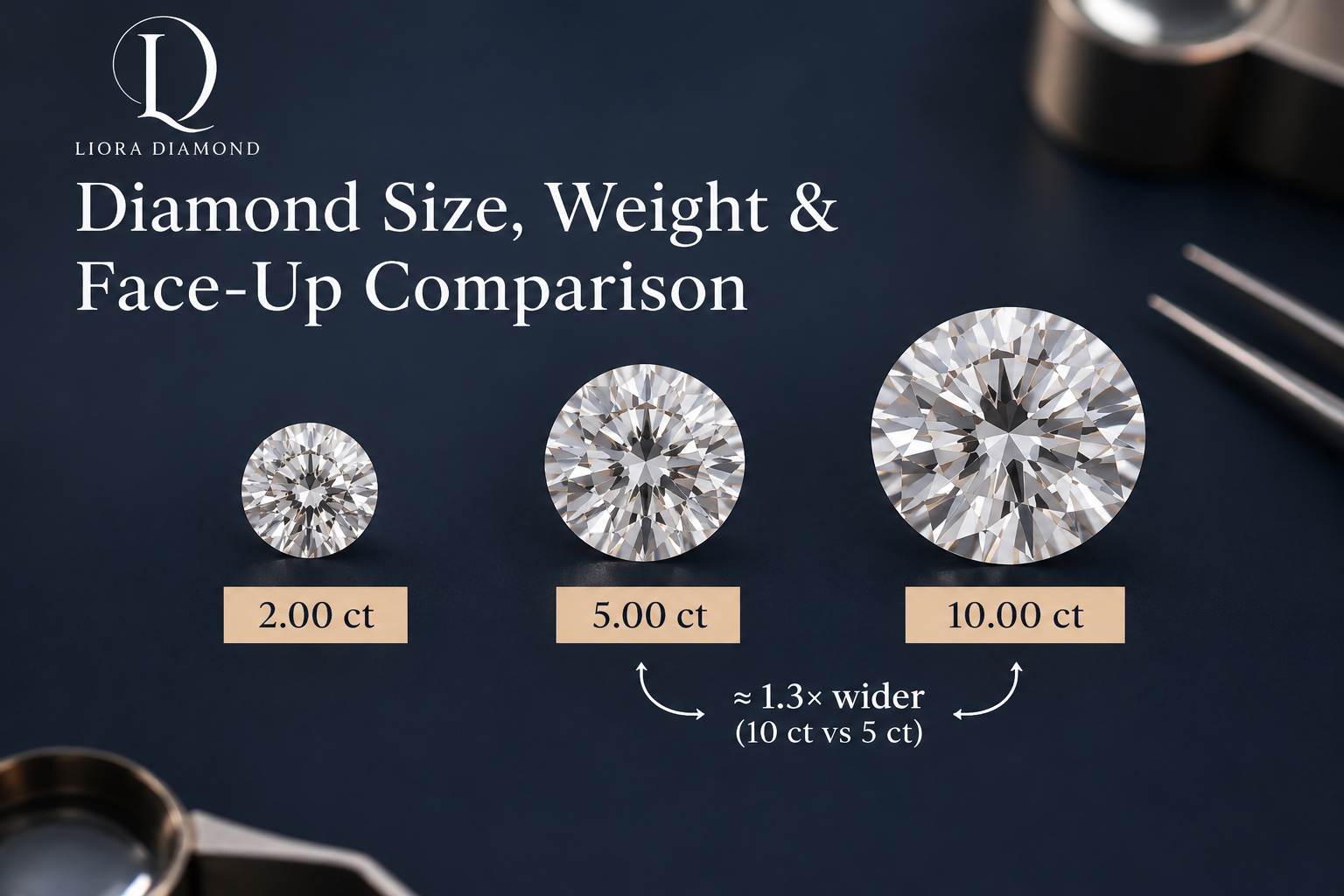 This is the part most pricing pages leave out. Diamond weight follows volume, so it grows with the cube of the stone's width. For a well-cut round brilliant, the diameters below are a standard rule of thumb. Fancy shapes differ, but the pattern holds.
| Carat weight | Approximate diameter, well-cut round | Width compared with the previous row |
|---|---|---|
| 1 ct | 6.5 mm | Baseline |
| 2 ct | 8.2 mm | About 26% wider than 1 ct |
| 3 ct | 9.4 mm | About 15% wider than 2 ct |
| 5 ct | 11.1 mm | About 18% wider than 3 ct |
| 10 ct | 14.0 mm | About 26% wider than 5 ct |
| 20 ct | 17.6 mm | About 26% wider than 10 ct |
Every doubling of weight adds only around a quarter to the width. That has two practical effects for a buyer. First, the per-carat price of a big stone should be judged against the extra size the customer will actually see, not against the weight alone. Second, a stone that is a few percent lighter than a round number can be almost indistinguishable face-up, which is why the off-weight saving in the next sections is real.
Worked example: comparing a 4.90 ct and a 5.02 ct stone
The figures below are invented to show the arithmetic. They are not a quote or a Liora price. Use the same method on any pair of quotes.
| Line | 4.90 ct stone | 5.02 ct stone |
|---|---|---|
| Total quote (US$) | 9,200 | 10,000 |
| Price per carat (total ÷ weight) | 1,878 | 1,992 |
| Difference in total | 800 lower on the 4.90 ct (8% of the larger total) | |
| Difference per carat | 114 lower per carat on the 4.90 ct | |
| Weight difference | 0.12 ct, or about 2.4% | |
In this example, the buyer saves 8% of the budget for a 2.4% difference in weight, and for a stone that is less than 1% narrower. That trade is why a jeweller who needs "a 5 carat look" often asks for a shortlist spanning 4.80 ct to 5.10 carat rather than a flat 5.00 carat and above. Match the choice to the customer: if the certificate weight is part of the sale, the round number may be worth paying for, and if the face-up size is what matters, it may not.
Seven Ways to Lower Price Per Carat Without Shrinking the Look
Each of these comes from how the price is built, so each can be tested on a real quote.
- Specify a weight window, not a weight. A range such as 4.80 ct to 5.10 carat lets the trade desk show stones on both sides of the step.
- Pick elongated shapes for a bigger look. Liora's big diamond finds that oval, pear, and radiant look larger per carat than rounds and cost less than rounds of the same weight. See the oval, pear, and radiant ranges.
- Choose G-H colour and VS clarity as the first test. Liora's G-H diamond color with VS clarity often gives the best value, while D-E is chosen for top bridal. Test the cheaper grade against the design before paying for the top one.
- Check the make before the grade. A stone with deep or shallow proportions can carry a lower price for a reason, and a well-made stone at a slightly lower grade often looks better than a poorly made stone at a higher one.
- Buy stock when the date allows it. Liora's stock stones ship fastest, and that growing-to-order option suits exact specifications and larger sizes. An exact spec and a fixed date cost more than a flexible one, so give the trade desk the real deadline.
- Consolidate the order. One parcel of a centre stone, a pair, and side stones means one set of documents and one shipment. For pairs, see the matched-pair requirements on the big diamonds page, which says pairs are matched for colour, clarity, measurements, and make from 2 ct each.
- Know which colour premium you are paying. A fancy-colour stone is priced on hue, intensity, and saturation as well as size, so compare like with like. The guide to Fancy Intense versus Fancy Vivid shows how one intensity step changes the specification, and the large pink stones and fancy-colour wholesale guides cover the colour side in detail.
How to Read a Trade Quote Line by Line
A fair comparison needs the same fields on both quotes. Check each of these before you look at the per-carat figure.
| Field | Why it changes the per-carat number |
|---|---|
| Exact carat weight | A 0.1 ct difference can sit on either side of a price step |
| Shape and measurements | Length-to-width ratio and depth change both the look and the price |
| Colour grade, or hue family and intensity for fancy colour | One grade of colour or one intensity step can move the figure more than a quarter-carat of size |
| Clarity grade | Two stones with the same grade can still differ in where the inclusion sits. |
| Cut and make notes | Proportions decide how much of the weight shows face-up |
| Report | Liora's page says big stones come with a grading report as standard, and a second report can be arranged on request, adding time and cost. |
| Stock or grown to order | Affects the ship date and sometimes the price |
| Currency and terms | Liora quotes in US dollars, with other currencies as an indication for budgeting only. |
Liora's trade desk replies with a shortlist, photos, video, reports, and trade prices, and the report number can be verified online before any money moves. For the check itself, the explainer on why diamond certification matters and the guide to certified lab-grown diamonds wholesale show what the report confirms. For the order flow, see how to buy wholesale lab-grown diamonds in B2B.
Why the Price of a Big Stone is Quoted Per Stone, Not Per Carat
Above about 10 carats, and especially at 20 carats and beyond, the number of comparable stones is small. A per-carat "rate" implies a market with many identical items. That market does not exist at this size, so the price follows the specific stone: its colour, clarity, proportions, the growth run it came from, and whether it is in stock or has to be grown. The practical rule for statement stones is to treat any per-carat figure as a conversion of the total, not as the basis of it.
This matters most for high jewellery and commissioned pieces. A 20 ct centre stone sits in a different pricing logic from a 2 carat one, and the buying process looks different too, which is covered in the guide to sourcing 20 carat stones for high jewellery. To write the brief, adapt the RFQ template for big lab-grown diamonds.
Get a Comparable Quote for the Sizes You Buy
To compare sizes properly, ask for the same specification at two or three weights in one enquiry. A request such as "oval, F-G, VS or better, report on each stone, at roughly 3 ct, 5 ct and 8 ct" gives you a clean per-carat comparison in a single reply. Liora's trade minimum is US$2,000 per order, quotes come within one business day, and the shortlist includes photos, video, reports and trade prices before you pay.
Browse listed stones from 5 ct to see the range, read the FAQ and shipping policy for terms, or send the brief through the big diamonds enquiry form. If you manufacture rather than resell, the B2B jewelry page and the guides on choosing a supplier as a jewellery manufacturer and how jewellery stores choose reliable diamond suppliers cover the wider decision.
Ask the trade desk for a per-carat comparison across sizes
Frequently asked questions
1. Is a lab-grown diamond price per carat the same at every size?
No. A small stone and a large stone are not priced on one flat rate. As weight rises, the price per carat moves up in steps, and the steps are larger above about 3 ct and at round weights such as 5 ct and 10 ct. The climb is gentler than for mined diamonds, but it is not zero. A flat per-carat assumption is the most common reason a first quote for a large stone looks higher than the buyer expected, so build a size-specific allowance into your budget.
2. Why do two stones of the same carat weight have different prices?
Weight is only one of the inputs. Colour, clarity, shape, proportions, polish, and whether the stone is stock or grown to order each move the number, and for fancy-colour stones the hue and intensity do as well. Two 5 ct ovals can sit well apart if one is a G VS with a good make and the other is an H SI with a deep pavilion. This is also why sharing a rate card for big stones would mislead: the rate would describe a stone that is not the one you are buying.
3. Is a bigger lab-grown stone a worse investment because the price can fall?
Trade buyers rarely buy lab-grown stones as a store of value, and it is safer not to plan around resale value. The better frame is margin: buy at a price that leaves room for your setting, finish, and mark-up, and treat the stone as inventory or a commissioned input. Stones that sell through quickly protect margin more than stones that sit. Large stones suit commissioned pieces with a client already attached, which is one more reason to confirm the brief before ordering.
4. Do grading reports add to the cost of a big stone?
Liora's big stones are supplied with a grading report as standard, and arranging a second report adds time and cost but helps with some retail customers. In practice, the report sits in the price of the stone rather than as a separate line, so ask whether the quote includes it and which report it is. Share the report number with the customer's insurer, since the same document supports a valuation later.
5. What is the smartest way to start when I do not know the exact size I need?
Start with the look, not the weight. Tell the trade desk the finger size, the setting style, and the face-up dimensions the customer is picturing, then ask for a shortlist at two or three weights around that target. Compare the per-carat figures with the method in the worked example above, and choose the stone you can see in the video rather than the number on the certificate. If the date is flexible, say so, since stock stones cost less in time than stones grown to order.