Diamond Cut Grades: Why Does It Matter for a Natural Look
Cut grade shapes how a diamond catches and reflects light. Here's why it's the factor that determines whether a stone looks natural, lively, and true to its quality grade, Of the 4Cs, cut is the one factor that can't be corrected after the fact—it determines how well a diamond reflects light, and ultimately how natural and lively it looks to the eye. This guide breaks down what cut grades actually measure, why a well-cut stone outperforms a larger but poorly cut one, and what to look for before you buy
 ```html
Diamond Cut Grades: Why Does It Matter for a Natural Look
Ask ten jewelers what sells a diamond, and most will say color or clarity first. Ask a gemologist, and the answer changes fast: cut. Of the 4Cs, cut is the one factor a lab cannot fully "fix" after the rough stone is faceted. It's the one that decides whether a diamond reads as alive and natural on a customer's finger or flat and glassy under store lighting. For wholesalers, retailers, and manufacturers sourcing loose stones at volume, understanding diamond cut grades isn't an academic exercise. It's margin protection, return-rate control, and the difference between a parcel that sells itself and one that sits in inventory.
This guide explains cut grading the way a sourcing manager actually needs it, not as a bridal-shopper primer. But as a working reference for buying, pricing, and explaining cut to the retailers and end customers down your supply chain.
What Is a Diamond Cut Grade, Really?
A diamond cut grade measures how well a stone's proportions, symmetry, and polish work together to control light. It is not the same as diamond shape (round, oval, cushion). Cut grade is a quality score within a shape, based on angles, facet placement, table percentage, depth percentage, girdle thickness, and culet size.
Independent labs, primarily the GIA (Gemological Institute of America) and IGI (International Gemological Institute), assess three visual outcomes when assigning a grade:
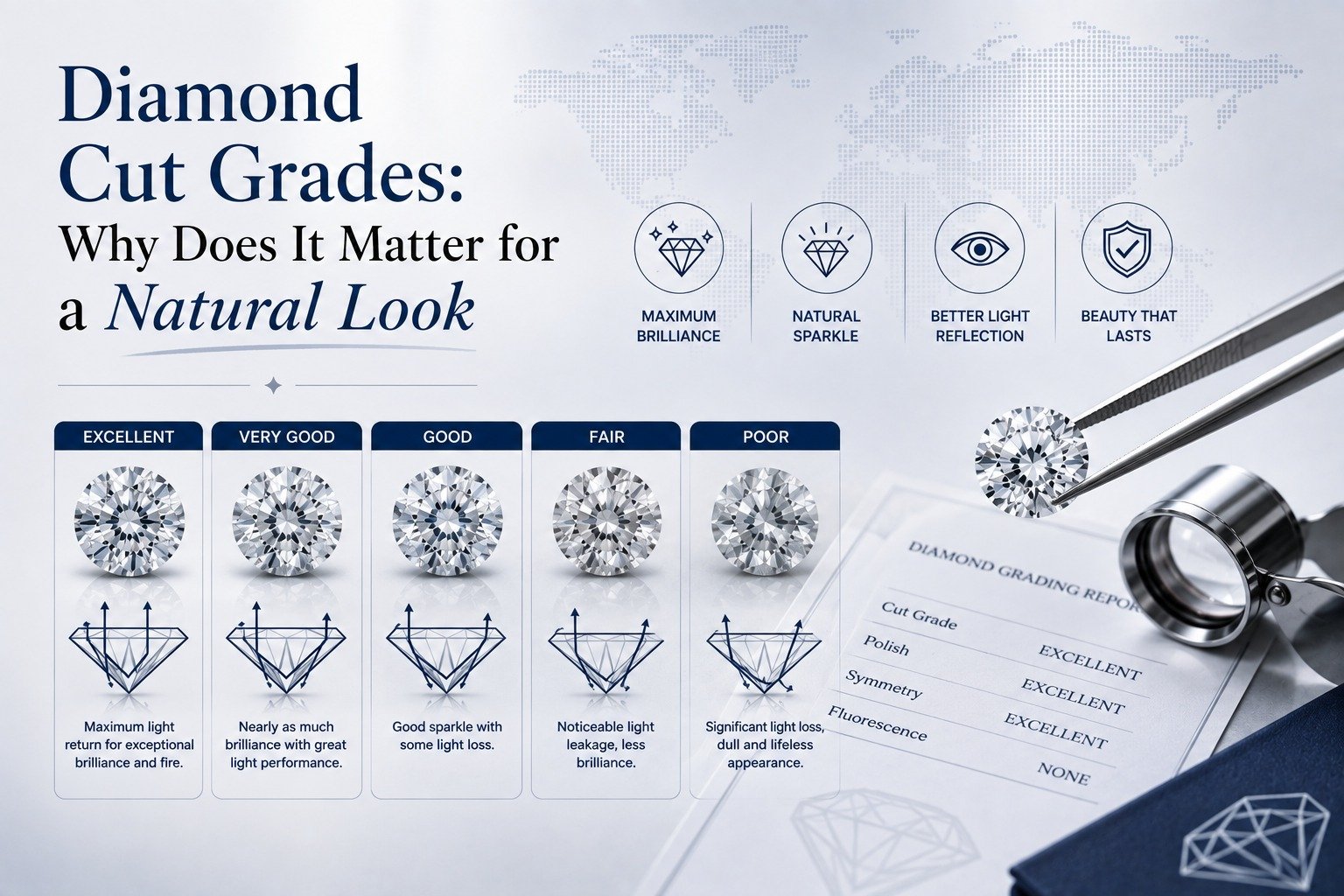
Brilliance is the total white light returned to the eye.
Fire is light dispersed into spectral colors.
Scintillation is the flash pattern created as the stone or the viewer moves.
A stone can have top color and clarity and still look dull if the cut is too shallow or too deep, because light escapes through the pavilion instead of bouncing back through the table. That's the core reason cut sits at the top of most sourcing checklists.
The GIA and IGI Cut Grading Scale, Explained for Buyers
GIA invented five cut grades.
GIA's cut scale runs five tiers: Excellent, Very Good, Good, Fair, and Poor. It's worth flagging a detail many buyers miss: GIA issues a formal cut grade only for standard round brilliant diamonds. Fancy shapes (oval, cushion, pear, emerald, marquise) don't receive an official GIA cut grade. Instead, proportions, polish, and symmetry are reported individually, and buyers have to interpret them together.
IGI represents lab-grown diamond certifications.
IGI, which certifies a large share of today's lab-grown output, uses a comparable five-tier scale and extends cut evaluation to a broader range of fancy shapes. This is one reason IGI paperwork dominates lab-grown melee and fancy-cut parcels.
Both systems are reputable and independently accredited. You can review methodology directly on GIA's 4Cs education pages and IGI's grading standards.
For a dealer, the practical takeaway is simple: never compare an "Excellent" GIA round to an "Ideal" or "Excellent" IGI fancy shape as if the labels are interchangeable. Match the certificate's actual proportion data, including table%, depth%, symmetry, and polish, against your buying standard, stone by stone.
Why Cut Grade Is the Real Driver of a "Natural" Look
Retail customers use the word "natural" to describe two different things, and both trace back to cut. First, they mean origin, like natural mined versus lab-grown. Second, and more often, they mean appearance: does the stone look organic, alive, and full of internal light, rather than artificially bright or oddly dark?
A well-cut diamond scatters light unevenly across its facets, producing the soft, shifting sparkle people associate with fine jewelry. An overly shallow or deep cut creates a "fish-eye" or dark "nail-head" effect, patches that look unnatural precisely because the light pattern is broken. This is true regardless of whether the stone is natural or lab-grown, which is why cut, not origin, is usually the bigger lever on perceived quality.
For dealers selling to retail jewelers, this matters commercially: a customer who feels a diamond "looks fake" rarely blames the cut grade by name. They blame the store. Cut education upstream prevents that complaint from ever reaching the sales floor.
Cut Grade vs. Diamond Shape: A Distinction Wholesale Buyers Can't Afford to Blur
Shape and cut grade get conflated constantly, including by buyers, and it costs money when it happens on a purchase order. Shape is the outline, including round, princess, oval, cushion, and emerald. Diamond cut grade is the quality of the faceting within that outline.
A princess cut and a round brilliant are graded on different proportion standards because their facet geometry is different.
A buyer evaluating a round brilliant parcel needs a different proportion checklist than one evaluating princess cut stock or cushion cut parcels.
Step-cut shapes like emerald cut diamonds behave differently; their open facets show clarity more readily and reward precise symmetry over raw brilliance.
This is why an experienced buyer weighs cut differently for step cuts than for brilliant cuts like oval cut diamonds.
If your buying team is sourcing across multiple shapes in wholesale loose stone for a mixed retail catalog, treat cut evaluation as shape-specific, not universal.
How Diamond Cut Grade Impacts Wholesale Pricing and Parcel Margins
Cut grade moves price at every point in the supply chain, and it moves it independently of carat and clarity. Two stones with identical carat weight and clarity can carry a meaningfully different wholesale price purely because one returns more light than the other.
For parcel buying, this creates a practical decision: buy strictly top-cut stock at a higher per-carat cost with faster sell-through and fewer returns, or buy a mixed-cut parcel at a lower blended cost that requires more sorting and grading effort on your end before resale. Neither approach is wrong. It depends on your retail tier and customer base, but it should be a deliberate sourcing decision, not an accident of whatever parcel showed up first.
Buyers who want to compare options quickly can filter IGI-certified lab-grown diamonds or browse best-value stones sorted by price to see how cut and price move together in real inventory.
Building a Cut-Consistent Inventory: A Sourcing Checklist
A few habits separate dealers who source cut well from those who source it by luck:
Set a floor grade per category. Decide your minimum acceptable cut grade for bridal versus fashion jewelry lines before you start buying, not while reviewing a parcel.
Read proportion data, not just the grade label. Two "Excellent" stones can still look different face-up. Table%, depth%, and pavilion angle tell you more than the word on the certificate.
Match cut standard to shape. Apply brilliant-cut criteria to brilliant shapes and step-cut criteria to step cuts, never cross-reference.
Request laser inscription and certificate matching on every stone, especially for larger orders, so cut data can't drift between quote and delivery.
Buy from a supplier with live, filterable stock rather than static PDF lists, so cut, clarity, and shape can be cross-filtered in real time. A live diamond catalog with a 30-minute refresh interval saves hours of frequent comparison into a spreadsheet that's already stale by the time it reaches your inbox.
The In-Store Effect: How Cut Grade Education Shapes Your Customer's Experience
This is the part most cut-grade guides skip entirely, because most of them are written for the end shopper, not the retailer standing across the counter. But cut grade doesn't stop mattering once a stone leaves your warehouse. It follows the stone into the fitting room, and it shapes how your retail customer feels about the purchase for years afterward.
Here's the pattern experienced retail buyers report.
A customer who understands why their diamond sparkles the way it does rarely comes back with a complaint. A customer who was only ever told "it's a good diamond," with no explanation of brilliance, fire, or scintillation, is far more likely to compare their stone unfavorably to a friend's ring. The question of whether they were overcharged, or a request for a return months later, even when the stone is objectively well cut, isn't really about the diamond. It's about the missing explanation.
For dealers supplying retail jewelers, this creates a simple, low-cost value-add.
They pass along plain-language cut education, not just certificates. A one-page proportion summary, a short explanation of why a specific cut grade was chosen for a specific setting, or even a note on why a slightly lower cut grade was priced accordingly. These small additions measurably reduce downstream return and renegotiation requests, because they give the retail sales associate language to use with the shopper in the room.
Suppliers who help their B2B clients sell smarter, not just stock deeper, tend to keep those clients longer. It's a small operational habit, but it directly protects the "natural, alive" impression a well-cut stone is supposed to create in the first place, right through to the moment it's tried on.
Does Cut Grading Differ Between Lab-Grown and Natural Diamonds?
No, and this is a common misconception worth correcting for retail-facing teams. Lab-grown diamonds are assessed on the same optical criteria, using the same 4Cs framework, by the same major labs. A lab-grown parcel and a natural diamond parcel with matching cut grades will perform almost perfectly under a loupe and under store lighting. Diamond origin affects price and rarity narrative, and it does not lower the bar for cut quality.
Sourcing Cut-Graded Diamonds at Wholesale
Cut grade is the one variable in the 4Cs that a buyer can actually control the outcome of by choosing suppliers who cut precisely, certify honestly, and share proportion data upfront rather than burying it in a PDF.
Liora Diamond maintains a live, filterable stock feed of IGI and GIA-certified loose diamonds for lab-grown and natural, with fancy color parcels and minimum 1-carat inventory available for repeat parcel buyers. For volume orders, custom specifications, or make-to-order requests, reach out for B2B parcel pricing and a member of our Surat-based sourcing team will respond with transparent, per-stone proportion data, not just a grade on a page.
FAQs
What is the best cut grade for a diamond?
GIA's top grade is Excellent, and IGI's top grade is typically labeled Ideal. Both represent the highest tier of light performance on their respective scales, but the two labels aren't strictly interchangeable. Compare important proportion data, not just the word.
Does diamond cut grade apply to all shapes?
GIA issues an official cut grade only for round brilliant diamonds. Fancy shapes are evaluated on proportions, polish, and symmetry rather than a single cut-grade label. IGI applies cut grading more broadly across shapes.
Is a higher cut grade always worth the extra cost for wholesale buying?
It depends on your retail segment. Bridal and fine jewelry lines generally justify top-cut sourcing because return rates and customer satisfaction scores improve. Fashion and volume lines can often work with a well-chosen Very Good grade at a better margin.
How can I tell if a diamond will look "natural" without seeing it in person?
Cross-reference the certificate's table%, depth%, symmetry, and polish grades; extreme outliers in any of these usually predict a duller or unevenly patterned stone, even before you view it.
Do lab-grown diamonds have lower cut grades than natural diamonds?
No. Cut grade is assessed identically regardless of origin, using the same lab standards that apply to natural diamonds. There's no difference you have to manage.
```