
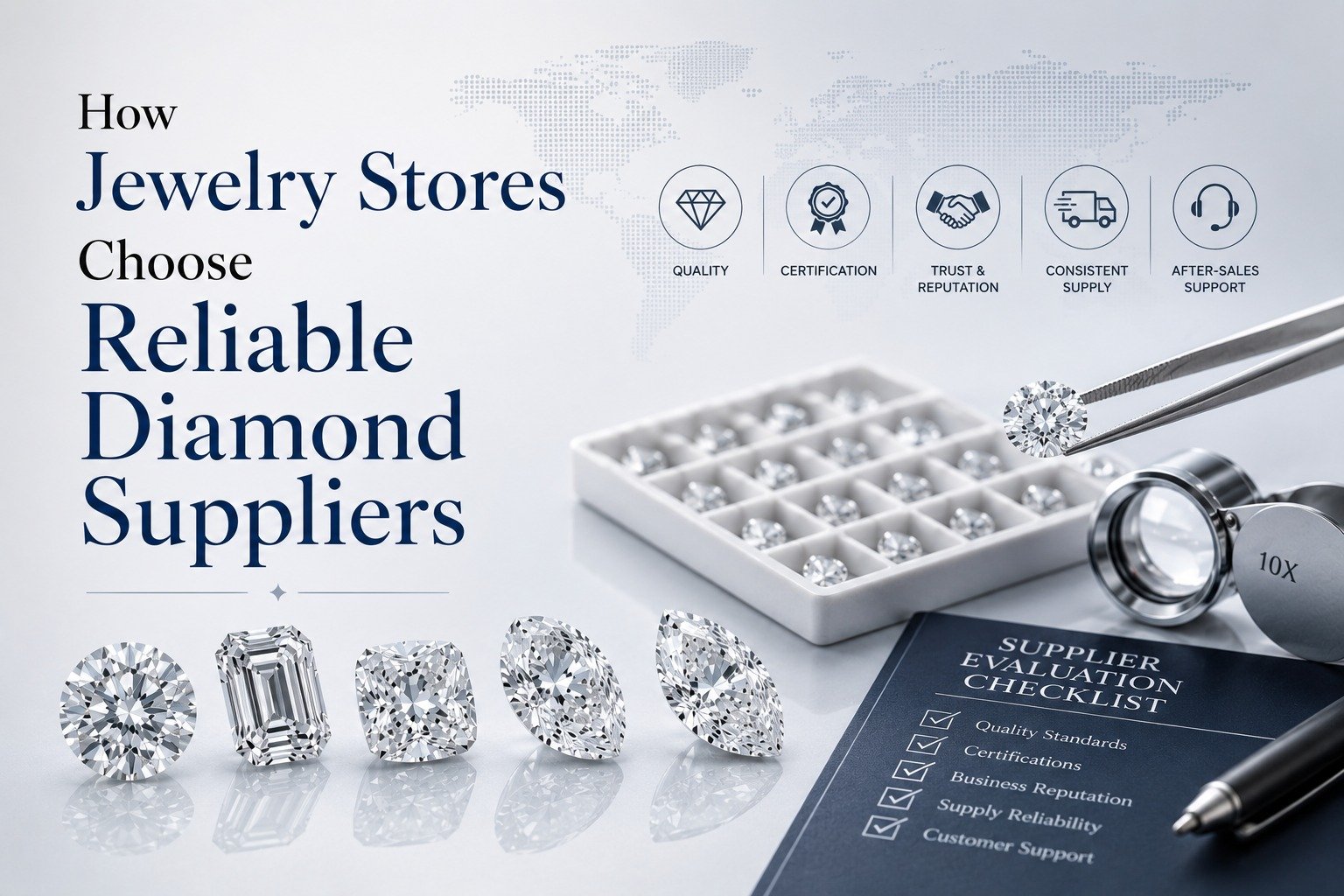
Choosing the right wholesale diamond supplier affects certification, margins, delivery times, inventory consistency, and customer trust. This guide explains the ten key factors jewelry retailers should evaluate when sourcing certified natural and lab-grown diamonds.
Every jewelry store’s reputation rests on something the customer never sees directly: the supplier behind the counter.
A ring can be beautifully designed, expertly set, and photographed to perfection. But if the diamond inside it is not what the paperwork says, the entire relationship with that customer is at risk.
This is why sourcing has quietly become one of the most strategic decisions a jewelry retailer makes, arguably more important than store location or window displays.
The stakes have also changed significantly in recent years. Lab-grown diamonds now account for a large share of engagement ring center stones sold in the United States. Some industry estimates place lab-grown adoption above 45% of engagement ring sales, while other reports cite figures as high as 61% in early 2026.
Wholesale prices for a one-carat lab-grown diamond have settled into a functional range of approximately $300 to $1,000, while comparable natural diamonds remain priced between roughly $4,600 and $7,000.
That price gap has restructured margins, buying behavior, and, most importantly, what retailers need from a B2B diamond supplier.
With more sourcing options than ever, including local wholesalers, overseas manufacturers, online B2B marketplaces, and direct-from-cutter relationships, jewelry stores must evaluate suppliers on far more than price per carat.
Below is a practical look at how experienced retailers vet and choose the partners on whom they build their businesses.
1. Certification Is the First Filter, Not an Afterthought
Ask any experienced jewelry buyer what disqualifies a supplier fastest, and certification will usually be the first answer.
IGI- and GIA-certified diamonds are the two standards that retail customers recognize, insurance companies accept, and appraisers trust. A diamond without a credible and verifiable grading report is a liability sitting in a display case, not an asset.
Retailers evaluating a wholesale diamond supplier generally check the following three areas:
Consistency of the Grading Laboratory
Mixed or lesser-known grading reports can create resale friction and make future appraisals more difficult.
Retailers generally prefer suppliers that consistently use established laboratories such as IGI or GIA across their inventory.
Laser Inscription
A diamond’s grading report number should be laser-inscribed directly onto its girdle.
This allows the retailer, and eventually the customer, to verify that the physical diamond matches the grading report supplied with it. This is important for both natural and lab-grown diamond inventory.
Independent Verifiability
Serious buyers independently verify grading report numbers before finalizing an order, particularly when purchasing larger stones or wholesale parcels.
This is why suppliers built around IGI and GIA certification, with laser inscription provided as standard rather than as an optional service, tend to win long-term trade relationships.
A jeweler who has to explain a certification gap to a customer will usually do it only once before changing suppliers.
2. Inventory Transparency and Real Stock Availability
The gap between what is advertised and what is actually available is one of the most common frustrations retailers experience when working with new suppliers.
A static PDF catalog or spreadsheet emailed once a week tells a buyer very little about what can actually ship today.
Live Stock Feeds Matter
This is where live inventory becomes essential for B2B diamond sourcing.
Suppliers that synchronize real-time inventory every 20 to 30 minutes, rather than once per day, allow retailers to quote their own customers immediately and confidently.
This removes the need for repeated communication such as, “Let me confirm whether that diamond is still available.”
For a retailer trying to close a sale at the counter or respond to an online inquiry on the same day, this difference is not cosmetic. It can determine whether the retailer wins or loses the sale.
Physical Inventory Location
Buyers also evaluate where the inventory is physically held.
Stock held domestically or in a known diamond trading hub generally ships faster and with fewer customs-related surprises than inventory that is drop-shipped from an undisclosed overseas location.
Overseas sourcing is not itself a warning sign. Surat, India, remains one of the world’s largest cutting and polishing centers for both natural and lab-grown diamonds.
What matters is whether the supplier is transparent about:
- The origin of the diamonds
- The current stock location
- The actual inventory status
- The expected dispatch date
- The realistic international delivery timeline
Clear information is more valuable than vague promises about immediate availability.
3. Consistency Across Repeat Orders
A single excellent parcel does not make a supplier reliable. Repeatable quality does.
Retailers who regularly reorder the same specification need every new batch to match the previous one in cut precision, color consistency, clarity, and grading accuracy.
For example, a retailer may regularly require:
- Matched 0.15-carat round VS1 diamonds for a tennis bracelet collection
- A parcel of calibrated melee diamonds for production jewelry
- Fancy yellow diamonds for a signature collection
- Matching oval or emerald-cut center stones for a bridal range
Repeat-order consistency is one of the most overlooked criteria in diamond sourcing because it only becomes visible after several orders, often after a retailer has already built a product line around that supplier.
Experienced buyers ask new suppliers for references specifically related to repeat-order consistency, not only first-order quality, before committing to larger volumes.
4. Transparent and Negotiable Pricing Structures
Wholesale diamond prices in 2026 commonly run 30% to 50% below retail prices, with an even wider gap in certain lab-grown and melee categories.
However, the raw discount percentage matters less than how transparently the pricing is structured.
Retailers increasingly prefer suppliers that offer:
- Clear parcel pricing connected to visible specifications such as shape, carat, color, clarity, and quantity
- Transparent pricing rather than an unclear “call for quote” model for every product
- No hidden margins added by unnecessary agents, distributors, or brokers
- Manufacturer-direct or close-to-source relationships
- Volume-based pricing that can be understood and planned in advance
Every additional layer between the manufacturer and the final invoice reduces the retailer’s potential margin.
Manufacturer-direct or close-to-source relationships generally provide competitive trade pricing while also improving cutting, calibration, and quality consistency.
Retailers building recurring product lines want a pricing model they can plan around. Prices should not fluctuate unpredictably from one order to the next without a clear explanation.
5. Turnaround Time and Customs Documentation
Speed matters, but so does the paperwork that makes fast shipping possible.
A supplier that promises quick dispatch but provides incomplete customs documentation can create delays that ultimately affect the retailer and the retailer’s relationship with the customer.
Retailers evaluating a supplier generally look for:
- Same-day or near-immediate shipping for certified loose diamonds already in stock
- A clearly defined production time for made-to-order products
- A standard lead time of approximately four to six weeks for fully custom finished jewelry
- Fully insured international shipping
- Accurate invoices and grading documentation
- Complete customs and export paperwork
- A clearly defined insurance claim process
Complete and accurate certification paperwork can make customs clearance straightforward. Incomplete documentation can delay an entire shipment and disrupt a store’s inventory plan.
6. Category Coverage: Can One Supplier Fulfil the Entire Order?
Few retailers want to manage five separate supplier relationships to complete one collection.
A supplier’s category depth is therefore an important evaluation criterion.
Retailers should consider the following questions:
- Can the supplier provide both round brilliant diamonds and fancy shapes?
- Do they carry oval, cushion, pear, emerald, radiant, and princess-cut diamonds?
- Can they supply certified fancy-color diamonds in pink, blue, and yellow?
- Can they provide calibrated melee diamonds for production jewelry?
- Can they maintain consistency across dozens or hundreds of small diamonds?
- Do they offer both natural and lab-grown diamonds?
- Can they provide loose diamonds and finished jewelry?
Retailers who consolidate sourcing with one capable supplier generally benefit from simpler logistics, fewer certification mismatches, and stronger negotiating leverage based on total purchasing volume.
7. Finished-Jewelry Capability, Not Just Loose Diamonds
A growing number of retailers prefer suppliers that can go beyond loose diamonds and manufacture fully finished, made-to-order jewelry.
This may include:
- Engagement rings
- Wedding bands
- Bridal sets
- Tennis bracelets
- Earrings
- Pendants
- Custom fine jewelry
Using one supplier for both the diamond and the setting removes a handoff between vendors, shortens the total lead time, and reduces the number of stages where an error may occur between design and delivery.
This capability matters most for retailers that offer custom or bespoke jewelry as a central part of their business.
Being able to specify the metal, setting style, diamond origin, shape, carat weight, and certification standard, and then receive a certified, ready-to-sell piece within a defined production period, is very different from coordinating a loose-diamond supplier and a separate bench jeweler.
8. Trade Tools and Communication
The strongest B2B relationships in the diamond industry are still built on responsiveness.
Retailers consistently prioritize suppliers that provide access to a genuine trade desk and a knowledgeable representative who understands diamond specifications, rather than relying entirely on a generic support-ticket system.
Strong communication should work alongside modern trade tools such as:
- Online inventory portals
- Live stock feeds
- Advanced diamond filters
- Application programming interfaces, or APIs
- Real-time availability updates
- Digital grading report access
- Fast quotation systems
A once-per-day emailed spreadsheet may be manageable for an occasional buyer. However, it becomes a genuine disadvantage for a retailer selling online or responding to frequent custom inquiries.
9. Track Record and Trade Reputation
Certifications and pricing sheets can be verified within an afternoon. A long-term track record cannot be created overnight.
Retailers place significant value on:
- How long the supplier has operated in the diamond trade
- How many repeat B2B partners the supplier serves
- The countries and markets in which the supplier operates
- References from existing wholesale clients
- Consistency in quality, delivery, and communication
A supplier with decades of family history in a diamond cutting hub such as Surat, or one that serves hundreds of active wholesale relationships across multiple countries, carries a different level of credibility than a newly listed marketplace seller with no verifiable history.
Retailers also pay attention to operational details that usually appear only in genuine reviews and references:
- Did each diamond match its grading report?
- Was the color consistent across the entire parcel?
- Did the fancy-color diamonds match the requested specification?
- Did the custom bridal set arrive within the promised timeline?
- Was the packaging secure and professional?
- Was the supplier responsive when a problem occurred?
These details separate a supplier that appears reliable on paper from one that has proven its reliability through repeat real-world orders.
10. Flexibility Between Lab-Grown and Natural Diamonds
Consumer demand is no longer settled entirely on one side of the lab-grown-versus-natural diamond discussion.
Demand is divided and increasingly segmented according to the customer, budget, product type, emotional preference, and occasion.
A retailer serving a broad customer base needs a supplier that treats both categories as certified and legitimate product lines rather than presenting one only as a cheaper alternative to the other.
Practically, this means confirming that the supplier grades and certifies lab-grown diamonds, including both CVD and HPHT stones, using standards comparable to those applied to natural diamonds.
Retailers should look for:
- Recognized grading laboratories
- The same fundamental 4Cs criteria
- Laser inscription for individual verification
- Clear disclosure of diamond origin
- Separate filtering for natural, CVD, and HPHT diamonds
- Immediate access to certification information
Retailers that can confidently offer natural and lab-grown diamonds side by side are better positioned to serve the full range of customer preferences without turning away business or overcommitting to a single category.
A Practical Diamond Supplier Vetting Checklist
Retailers evaluating a new diamond supplier generally review some version of the following checklist before opening an account:
- Is every diamond independently certified by IGI or GIA?
- Does every certified diamond carry a matching laser inscription?
- Is current inventory visible and verifiable rather than merely advertised?
- How frequently is the live stock feed updated?
- Does pricing scale transparently according to specification and order volume?
- What is the realistic lead time for loose diamonds?
- What is the realistic production time for made-to-order jewelry?
- Can the supplier provide both natural and lab-grown diamonds?
- Can the supplier provide round and fancy shapes?
- Can the supplier provide calibrated melee and fancy-color diamonds?
- Is international shipping fully insured?
- Does the supplier provide complete customs and certification documentation?
- What do existing B2B clients say about consistency across repeat orders?
- Does the supplier have a verifiable trade history?
No single supplier will necessarily score highest across every category.
The right fit depends on which criteria matter most for the store’s product mix, pricing position, target customer, inventory model, and sales process.
A bridal-focused boutique emphasizing natural diamonds and provenance will evaluate suppliers differently from a fashion-focused retailer building a fast-moving lab-grown diamond collection.
Where Liora Diamond Fits
Liora Diamond is based in Surat, India, one of the world’s largest diamond cutting and polishing hubs, and has been developed around the criteria serious wholesale buyers prioritize.
Every lab-grown diamond is supplied with an IGI or GIA grading report and matching laser inscription.
A continuously refreshed live stock feed provides wholesale lab-grown diamond partners with real-time visibility into current inventory rather than relying on a static catalog.
Parcel pricing is quoted transparently according to:
- Diamond shape
- Carat weight
- Color grade
- Clarity grade
- Certification
- Growth method
- Order quantity
Made-to-order jewelry follows a defined production period of approximately four to six weeks, supported by fully insured and documented worldwide shipping.
Backed by the Shah family’s five decades in the diamond trade and serving more than 200 B2B partners across over 14 countries, Liora Diamond works with wholesalers and retailers that need consistency across every order.
This may include a single certified loose diamond, a repeat parcel of matched fancy-color diamonds, calibrated melee for production jewelry, or a fully finished made-to-order jewelry piece.
For jewelry stores building or reassessing their sourcing strategy, the right partner is not simply the supplier offering the lowest quoted price.
It is the supplier whose certification, inventory visibility, pricing structure, quality, documentation, and turnaround remain dependable on the hundredth order just as they were on the first.
Request Wholesale Diamond Pricing
Need a quotation for certified loose lab-grown diamonds?
Share your required diamond shape, carat weight, color, clarity, certification preference, growth method, and order quantity with Liora Diamond to receive current wholesale pricing and available stock options.