Sourcing 5 Carat+ Lab-Grown Diamonds for U.S. Jewelers: Import, Disclosure and Lead Times
Discover how U.S. jewelers can source 5 carat+ lab-grown diamonds with confidence. Liora Diamond explores international import considerations, diamond disclosure requirements, supplier selection, and lead times to help jewelry businesses streamline bulk sourcing and meet customer expectations.
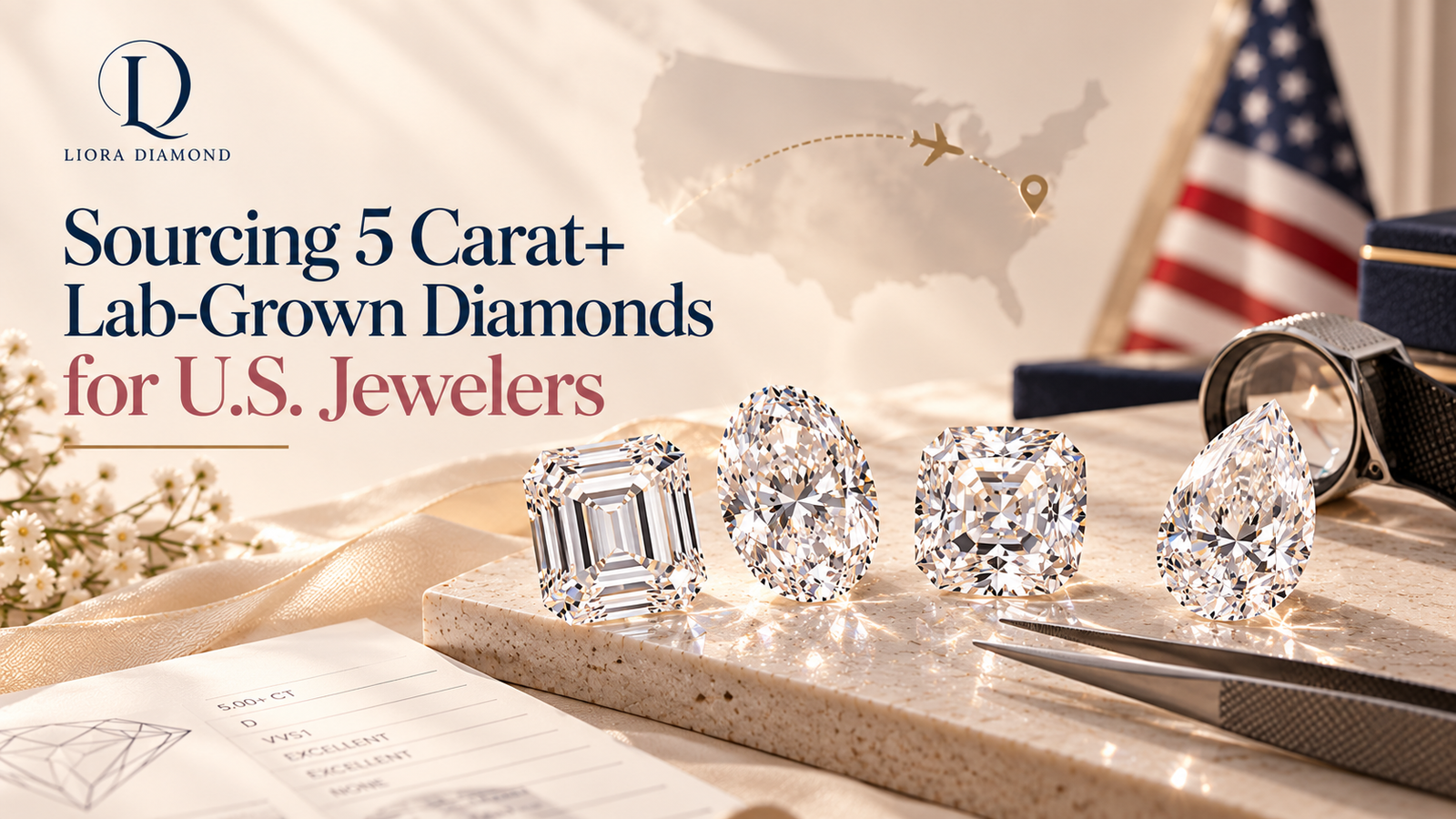
If you sell to U.S. customers and a client asks for a 5 ct colorless oval, a matched pair of 5 carat radiants, or 25 ct pink cushion, your local memo lines may not have it. Buying it overseas raises four practical questions:
1. Will the stone be described correctly
2. What paperwork comes with it
3. Who pays the duty
4. How long it will take
This guide answers those questions for anyone buying big lab-grown diamonds wholesale for the USA: stones of 5 carats and above, shipped to U.S. jewelers, wholesalers, and online brands. It covers what to ask for, what the FTC expects you to say, how a parcel clears customs, a realistic timeline, and how to hold a stone while your client decides.
Quick answer: A U.S. jeweler buying a 5 ct+ lab-grown diamond from an overseas trade supplier should expect the following:
1. An IGI report (GIA on request)
2. Photos and 360° video of the exact stone before paying
3. A pro forma invoice paid by bank transfer
4. Delivery by an insured valuables courier with a commercial invoice
5. Packing list and the original report
The importer of record (normally you) pays U.S. duty and any taxes. Stock stones typically ship within two to three business days of cleared payment and arrive three to seven business days later. Larger or unusual specifications take longer because they are grown to order.
What U.S. Jewelers Are Asking for at 5 Carat+
U.S. demand for large lab-grown stones splits into two groups, and they source them differently.
1. White center stones for bridal and high-end engagement.
U.S. buyers most often ask us for pears, ovals, elongated cushions, and radiants. Above 5 carats, shape matters more than at 2 carats, because elongated shapes look larger face-up than a round of the same weight and usually cost less per carat. A 5 carat oval can face up like a noticeably bigger stone than a 5 ct round.
2. Fancy-color statement stones for fashion and high jewelry.
Pink lab-grown diamonds and yellow stones lead U.S. requests, followed by blue and green. At 5 ct and above, these go into cocktail rings, pendants, and one-off pieces where color is the selling point. Private-label B2B jewelry also becomes important at that level.
What that means for your inquiry:
| Size band | Typical U.S. use | Shapes buyers ask for | How it is usually supplied |
|---|---|---|---|
| 5–10 ct | Cocktail rings, pendants, high-end bridal | Emerald, radiant, oval, pear | From stock, or a short lead time |
| 10–20 ct | High jewelry, showpieces, display stones | Emerald, radiant, cushion, pear | Selected stock, or grown to order |
| 20 ct+ | Collector and exhibition pieces | Emerald, radiant, pear | On request |
Most of our listed 5 ct+ stock is fancy color, with pink the deepest category and hearts and pears the most common shapes. If your client wants a white oval or radiant above 5 carats, expect us to source or grow it to your specification and give you a date before you commit. If your client is open on color, you can often see real stones on video the same week. Browse current big carat-weight diamonds to see what is in stock today.
For more details, check our guide to 10-carat wholesale diamonds and 20-carat lab-grown diamonds in bulk for jewelry.
3. Matched pairs
We match pairs for earrings, bracelets, and three-stone rings, including Toi et Moi rings, for color, clarity, measurements, and make. Pairs from 2 carats each are common; larger pairs are sourced to order. If you already have the center stone, send its measurements, and we will propose sides that fit it.
The Price Levers that Matter Most Above 5 Carats
Carat drives price more steeply as stones get bigger, so small choices change the quote:
1. Buy just under a round weight. Prices step up at 5.00, 10.00 and 20.00 ct. A 4.90 ct and a 5.02 ct can look the same face-up and be priced differently.
2. Color shows more in big stones. G–H with VS clarity often gives the best value; D–E is the choice for top bridal.
3. Choose an elongated shape if your client wants face-up size rather than a heavy carat number.
4. Ask about make. Good polish, symmetry, and a sensible depth keep a big stone lively. We flag stones that are cut too deep or too shallow.
Disclosure: What the FTC Jewelry Guides Expect
The FTC's Guides for the Jewelry, Precious Metals, and Pewter Industries (16 CFR Part 23) apply at every level of the trade, from manufacturers and suppliers to retailers. They cover labels, ads, websites, social posts, and any other marketing.
For laboratory-grown diamonds, the practical rules are:
1. Never use the word "diamond" on its own for a lab-grown stone. Under the Guides, the unqualified word "diamond" is reserved for mined stones.
2. Qualify it clearly. The Guides give "laboratory-grown," "laboratory-created," and "[manufacturer name]-created" as examples of acceptable qualifiers, or another word or phrase of like meaning.
3. "Cultured" is not enough by itself. You may use it only if it is also qualified by a clear and conspicuous disclosure that the stone is not mined.
4. Keep the qualifier next to the word it qualifies, and as visible. For terms such as "stone," "gem," and "gemstone," the Guides say the qualifier should come immediately before, with equal conspicuousness. Applying the same discipline to "diamond" across your listings and ads is the safest habit.
5. "Faux" does not count as a disclosure that a stone is lab-created.
We describe every stone we ship as laboratory-grown on the invoice and grading report, so your product listing, tag, and receipt match the paperwork. If you re-list our stones online, carry the same wording into the title and description, not only the small print.
This is general guidance for trade buyers, not legal advice.
Importing: Invoices, Reports and Who Pays Duty
What arrives with every parcel
Big Stones travel with a specialist, insured valuables courier, tracked door-to-door. For high-value consignments, we can arrange secure hand-carry on request. Each parcel includes:
1. A commercial invoice and packing list describing the goods as laboratory-grown
2. The original grading report for each graded stone
3. Any declarations your customs authority requires
The shipment is insured for its invoice value until delivery, and we never under-declare values. If anything is lost or damaged, report it within 48 hours of the expected delivery date, and we handle the claim with the carrier. See Liora Diamond's shipping policy.
Who pays U.S. duty and taxes?
The importer of record, usually the buyer, pays import duty, state taxes, and customs fees. Each order's shipping terms are stated on the invoice, and we can discuss which terms suit your setup.
We deliberately do not quote a duty rate in this article. U.S. duties on goods from several diamond-cutting countries changed more than once in 2026, and the applicable rate depends on your goods' classification and country of origin. Before you commit to a large stone, ask a licensed customs broker to confirm the current treatment for your shipment, and price the stone on landed cost (invoice + duty + fees + freight), not the invoice figure alone. Our 2026 U.S. sourcing trends article explains why country of origin now changes landed cost.
Three checks before your first import
- Confirm who the importer of record is and that your broker has the invoice and packing list before the parcel lands.
- Ask your broker which origin declarations apply to diamond imports at the time of shipment. U.S. diamond import rules have added origin-related requirements in recent years, and your broker files them.
- Match the report numbers to the stones. Report numbers can be verified on the grading lab's own website. Check them against the invoice on arrival. See our IGI-graded lab-grown diamonds.
General guidance for trade buyers, not legal or tax advice. Check import rules with your customs broker.
Timelines from Inquiry to Delivery of 5 Carat Weights Wholesale Stones
Here is what a typical order of a stock stone looks like for a U.S. buyer:
| Step | What happens | Typical timing |
|---|---|---|
| 1. Send the spec | Shape, carat range, color, clarity, lab, pair or single, quantity | Day 0 |
| 2. Shortlist | Matching stones with photos, 360° video, reports, and a trade price in U.S. dollars | Usually within one business day |
| 3. Confirm and pay | Pro-forma invoice, paid by bank transfer | When you and your client are ready |
| 4. Ship | Stock goods leave after cleared payment and completed documents | Usually 2–3 business days |
| 5. Transit and customs | Insured valuables courier to your door | Normally 3–7 business days, depending on customs |
Three things change that timeline:
1. Grown-to-order stones. Common shapes and colors from 3–5 ct usually take days. Larger or unusual stones take longer because we have to grow and cut the rough. We give you a date before you commit.
2. GIA grading. Big stones come with an IGI report as standard. We can arrange GIA grading, which helps with some retail customers, but it adds time and cost.
3. Customs clearance. Paperwork that matches the goods clears faster. Missing broker details are the most common cause of avoidable delay.
4. First orders are prepaid by bank transfer. Memo and payment terms can be discussed with established trade accounts after a history of paid orders.
Holding a Stone While Your Client Decides
Big-stone sales in the U.S. are often a two-step decision: you like the stone, then your client has to approve it. To make that easy:
1. Ask for a hold when you request the shortlist. Short holds on stock stones are usually possible. Tell us how long you need, and we will confirm what we can do for that stone.
2. Ask for the video your client needs. We send high-resolution photos and a 360° video of the exact stone you will receive, not a sample. On request, we can also film it:
- Next to a ruler, so your client sees the real size
- In daylight, which matters most for fancy colors
- Under UV, if your client asks about fluorescence
3. Share the report number. Your client, or your own team, can verify it on the lab's website before you pay.
For ongoing programs, such as a set of 5 ct ovals each quarter for a bridal line, we can reserve supply against a forecast rather than holding single stones.
Getting a U.S. Quote for Loose Lab-grown Diamonds Wholesale
The fastest rough quote for lab-grown diamonds comes from a precise brief. Include the following:
- Shape and any ratio preference (for example, oval 1.35–1.45)
- Carat range rather than one exact weight (for example, 4.80–5.30 ct)
- Color and clarity, or hue and intensity for fancy color
- Lab (IGI standard, GIA on request)
- Single, pair, or three-stone set
- Quantity and timeline, including the date your client needs the piece
We are a trade-only supplier to U.S. jewelers, wholesalers, manufacturers, and brands, and we quote U.S. buyers in U.S. dollars. Inquiries should be for business orders of US$2,000 or more. Our trade desk usually replies within one business day with available stones, photos, video, and grading reports.
Get a quote for your U.S. business.
Prefer to start with stock? See big lab-grown diamonds from 3 ct upward or our fancy color lab-grown diamonds.
Frequently asked questions
1. Who pays U.S. import duty on lab-grown diamonds?
The importer of record pays import duty, any state taxes, and customs fees for most orders; that is, the buyer. Each invoice states the shipping terms. Confirm the current duty treatment with a licensed customs broker, because rates for some origins changed in 2026.
2. Do big lab-grown diamonds arrive with their original grading reports?
Yes. Each parcel includes the original grading report for every graded stone, plus a commercial invoice and packing list describing the goods as laboratory-grown. Big stones carry an IGI report as standard, and GIA grading can be arranged.
3. Can you hold a big stone while my client decides?
Short holds on stock stones are usually possible. Tell us how long you need when you ask for the shortlist, and we will confirm for that stone. For repeat programs, we can reserve supply against a forecast.
4. How should I describe a lab-grown diamond to U.S. customers?
Use a clear qualifier such as "laboratory-grown" or "laboratory-created" with the word "diamond" every time. Under the FTC Jewelry Guides, "diamond" on its own implies a mined stone, and "cultured" needs an additional, clear disclosure that the stone is not mined.
5. How long does a 5 ct+ lab-grown diamond take to reach the U.S.?
A stock stone usually ships within two to three business days after payment is cleared and arrives three to seven business days later, depending on customs. Larger or unusual stones grown to order take longer, and we confirm the date before you commit.
6. Can I see the exact stone before I pay?
Yes. We send high-resolution photos, a 360° video, and the grading report for every shortlisted stone. We can also film it next to a ruler, in daylight or under UV.