20 Carat Lab-Grown Diamonds: Sourcing Statement Stones for High Jewelry
Discover how to source 20-carat lab-grown diamonds for high jewelry at Liora Diamond. Learn what to consider when buying statement stones, from shape, color, and clarity to grading, measurements, availability, pricing, and custom sourcing for exceptional high-jewelry designs.
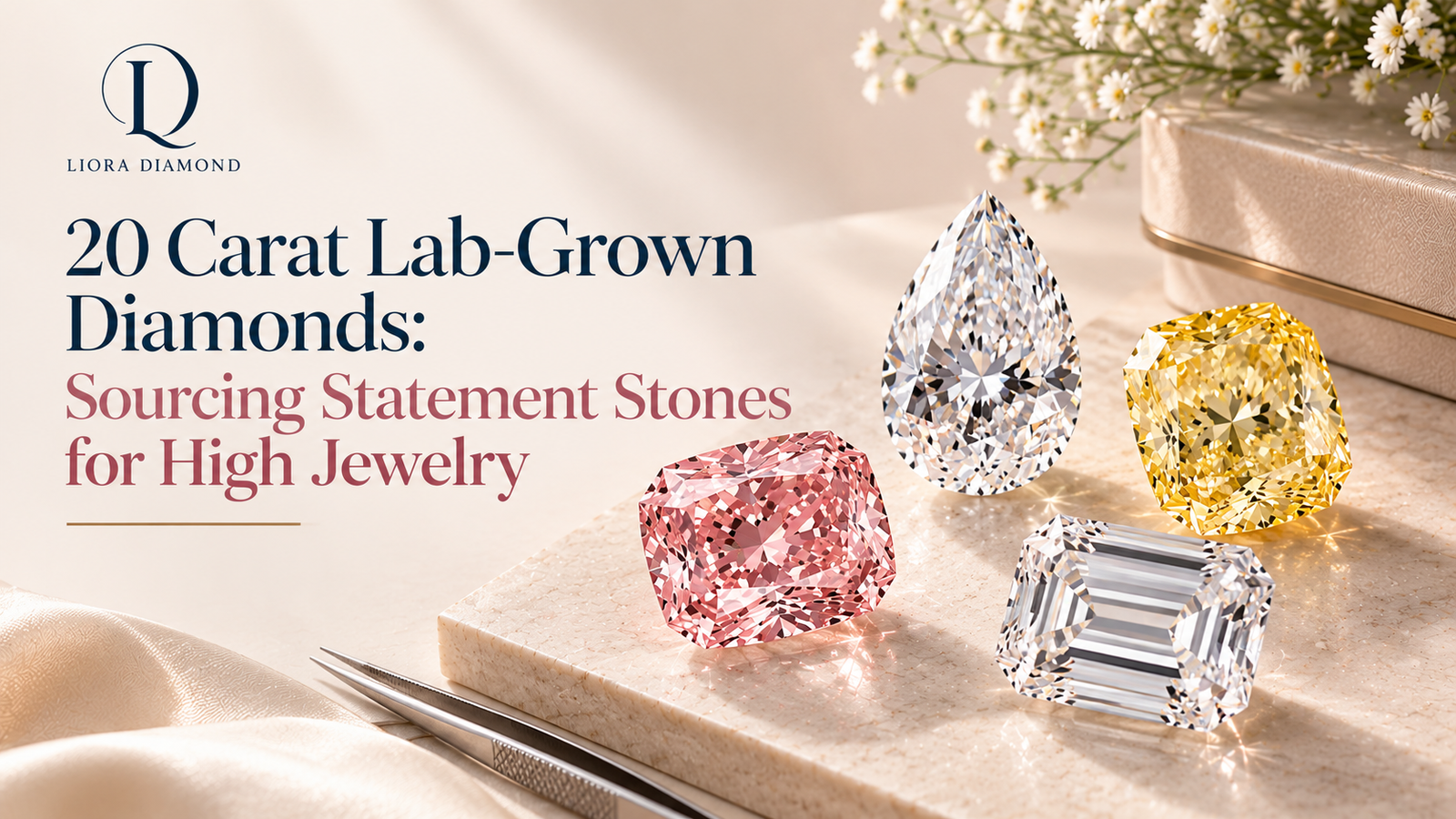
A 20-carat laboratory-grown diamond is no longer a curiosity. It is a real sourcing category, but a thin one. At this size, every stone is close to unique; the shortlist is short, and the questions a trade buyer has to answer before paying are different from those at 2 or 5 carats: will it fit the mount, how does it face up, how will the color read across a stone this deep, and how do you judge it from another continent?
This guide is for high-jewelry designers, wholesalers, and retailers sourcing 20 ct lab-grown statement stones for their clients. It covers what these stones are used for, what is realistically available in white and in fancy color, how to check setting fit from measurements, what moves the price, how to inspect a stone from a distance, and what to send us to get a shortlist of real stones.
What 20 Carat Stones Are Used for in the Trade
At 20 carats, the stone is the design. Everything else on the piece, from the head and prongs to the side stones and the metal weight, is built around its measurements. In practice, trade inquiries at this size fall into four groups:
1. High-jewelry centerpieces.
Cocktail rings, pendants, and brooches where a single stone carries the piece. Fancy colors dominate here, because a strong pink or yellow reads as color from across a room.
2. Collector and exhibition pieces.
One-off commissions for private clients, window pieces, and trade-show display stones, where scale and rarity are the point.
3. Bespoke commissions through retailers.
A jeweler's client asks for "something no one else has, and the retailer sources the stone before the mount is drawn.
4. Inventory for dealers.
Wholesalers hold a small number of statement stones to show their retail accounts.
These use cases share one trait: the buyer usually has a design, a client, or a budget in mind before they search. That is why a 20 carat inquiry works best as a specification, not a browse. Laboratory-grown diamonds have made this size far more accessible than mined stones of the same weight, and GIA research shows how quickly the category has grown.
In its review of lab-grown diamonds submitted to the lab, GIA reported that most CVD stones it now sees weigh more than 3 ct, and that the largest faceted CVD diamond it had recorded had reached 75.33 ct (GIA, Gems & Gemology). Statement sizes are now a working part of the trade, not a showpiece for growers.
White 20 Carat vs Fancy 20 Carat Availability
Fancy color makes up most of the statement-size supply. At the time of writing, Liora's live catalog listed eight 20 carat lab-grown diamonds between 20.00 and 29.99 ct. Seven were fancy color, and one was white. All eight were CVD-grown and carried IGI reports.
| Stone | Shape | Colour | Clarity | Measurements (mm) | Ref |
|---|---|---|---|---|---|
| 25.07 ct | Heart | Fancy Intense Pink | VS1 | 18.28 × 20.35 × 9.01 | LDA9666B |
| 21.16 ct | Cushion | Fancy Intense Pink | VS2 | 14.91 × 14.87 × 10.13 | LD7C0085 |
| 21.10 ct | Pear | Fancy Vivid Pink | VVS2 | 22.84 × 13.89 × 9.10 | LD53C28E |
| 21.00 ct | Heart | Fancy Intense Yellow | SI1 | 15.37 × 17.54 × 10.09 | LD1FD56D |
| 20.09 ct | Heart | Fancy Intense Pink | VS1 | 16.22 × 17.73 × 9.05 | LDC9A1E2 |
| 20.09 ct | Oval | Fancy Intense Yellow | VS2 | 21.34 × 13.81 × 8.65 | LDF2B779 |
| 20.05 ct | Heart | Fancy Vivid Pink | VS2 | 15.93 × 18.09 × 9.52 | LD27AF83 |
| 20.03 ct | Round | H (white) | VS2 | 17.24 × 17.38 × 10.78 | LD34B57B |
Stock moves through the day, and stones on hold for other buyers can drop out between refreshes. Treat this table as a snapshot and ask the trade desk what is available when you enquire.
What the split means for buyers:
1. Fancy color is where the choice is.
Pink is the deepest color at this size, followed by yellow. Hearts lead, with cushions, pears, and ovals also represented. If your client is open to color, you will see more candidates. Our guide to large pink lab-grown diamonds from 5 to 30 carats covers intensity and treatment disclosure in detail.
2. White 20 ct stones are rarer on the shelf.
Only one of the eight stones in the snapshot was colorless. If you need a white stone at this size, plan to request it rather than browse for it. Our trade desk sees more than the website shows, including incoming goods and stones held for production, and can source to order when nothing fits.
3. Above 20 ct, the next tier is thinner still.
Stones of 30 ct and above exist in the listed range, but in very small numbers.
For context on how the choice between colors plays out commercially, see white vs fancy color lab-grown diamonds for B2B buyers.
Measurements, Depth, and Setting Fit
Carat weight tells you how heavy a stone is, not how big it looks or whether it fits. At 20 carats, two stones of almost the same weight can differ by several millimeters face-up, and a millimeter is the difference between a mount that fits and one that has to be remade. Quote and approve against measurements, depth, and table, not weight alone.
The stones in the snapshot above show how wide the spread is:
| Stone | Face-up (mm) | Depth (mm) | Depth % | Table % | What it means for the setting |
|---|---|---|---|---|---|
| 20.03 ct round | 17.24–17.38 | 10.78 | 62.2 | 55 | Classic proportions; predictable fit for a round head |
| 21.16 ct cushion | 14.91 × 14.87 | 10.13 | 68.1 | 64 | Heavier than the round but faces up smaller; carries its weight in depth |
| 21.10 ct pear | 22.84 × 13.89 | 9.10 | 65.5 | 58 | Long outline (ratio 1.64); needs a pendant or elongated ring head |
| 20.09 ct oval | 21.34 × 13.81 | 8.65 | 62.6 | 60 | Large face-up spread per carat; ratio 1.55 |
| 20.05 ct heart | 15.93 × 18.09 | 9.52 | 52.6 | 64 | Moderate spread for a heart |
| 25.07 ct heart | 18.28 × 20.35 | 9.01 | 44.3 | 70 | Very shallow; maximum spread, but check for windowing on video |
Three checks to make before you approve a 20 carat stone for a mount:
1. Face-up size against the drawing.
Ask your setter or CAD designer for the seat dimensions and compare them with the length, width, and depth on the quote. Every Liora quote carries measurements, depth, table, and ratio for this reason.
2. Depth against the head and gallery.
A deep stone (above about 65 %) needs a taller head and can sit high on the finger. A shallow stone (below about 50 %) spreads wider but can show a "window", a washed-out area in the center where light passes straight through.
3. Ratio for fancy shapes.
Pears, ovals and hearts are judged by their length-to-width ratio. Mirror-image designs and halos need a ratio that suits the drawing. If you are building a three-stone ring, send the center stone's measurements so side stones can be matched or cut to fit.
Weight also affects metalwork. A 20 ct stone is heavy enough that prong count, prong thickness, and head height are engineering decisions, not styling choices. Settle them with the setter before the stone ships, not after. If you need the jewellery made as well, our B2B lab-grown diamond jewellery manufacturing team can build the mount around the stone's actual measurements.
Price Levers at Statement Size
We do not publish prices. Trade prices depend on the exact stone, quantity, and your account history, so we quote every 20 ct stone privately. What we can explain is what moves the number, so you can brief the trade desk with a budget and the flexibility you are willing to trade for it.
1. Weight thresholds
Prices step up at round weights. A 19.80 ct stone can look the same as a 20.05 ct face-up and cost noticeably less. If the design allows, give a weight range that straddles the threshold.
2. Color and intensity.
In white stones, color shows more as size increases; G–H is a common value point for statement pieces. In fancy colors, Fancy Vivid generally commands more than Fancy Intense, and a secondary hue (brownish, orangy) changes both the look and the price.
3. Clarity
At 20 ct, inclusions are larger in absolute terms. VS clarity is a typical working range for statement stones; an SI stone can make sense when the inclusion sits under a prong or away from the table. Ask for a video before you decide.
4. Shape
Elongated shapes such as ovals, pears, and radiants look larger per carat than rounds and usually cost less than a round of the same weight.
5. Make
Excellent polish and symmetry, and a depth that suits the shape, keep a big stone lively. We flag stones with deep or shallow proportions on the quote.
6. Grading lab
IGI is standard on our larger stones. GIA can be arranged, which adds time and cost; note that GIA's reports for laboratory-grown diamonds now use a different format from IGI's (see the FAQ below).
7. Lead time
Listed stones ship fastest. Growing to order suits exact specifications at large sizes, but we must grow and cut the rough first; we provide a date before you commit.
Growth method is a specification, not a quality grade. Every stone in the 20 ct snapshot above was CVD-grown. If your client needs a particular method, put it in the request; our CVD diamond supplier guide explains the difference.
Inspecting from a Distance: Video, Ruler, UV
Most trade buyers will approve a 20 ct stone without holding it. That only works if what you see is the stone you will receive, filmed in a way that answers your client's questions. For every big stone, Liora sends high-resolution photos and a 360° video of the exact stone, not a sample, and shares the grading report before invoicing.
Ask for the filming that matches the decision you need to make:
| Filming | What it shows | When to ask for it |
|---|---|---|
| 360° video | Brilliance, extinction, inclusions, overall make | Always; it is the baseline |
| Daylight | True color without studio lighting | Every fancy color; white stones near your color limit |
| Next to a ruler | Real face-up size and spread | When fit or visual size is the question, especially shallow or deep stones |
| Under UV | Fluorescence color and strength | Any stone whose report lists medium or strong fluorescence |
| Pair or set filmed together | How stones read side by side | Matched pairs, three-stone sets, suites |
UV filming matters more at this size than buyers expect. Several of the pink stones in the snapshot above carry strong fluorescence on their reports. Fluorescence is not a defect in itself, but your client should know how the stone behaves under UV light before it is set.
Then check the paperwork:
1. Verify the report number.
On the grading lab's website, confirm that the weight, measurements, and grades match the quote. Our guide to IGI-certified lab-grown diamonds for wholesale buyers walks through the checks.
2. Read the comments section.
Reports for laboratory-grown diamonds state the origin and record post-growth treatment where it applies. GIA research found that around four in five CVD diamonds it examined since 2020 had been processed after growth, so read the comments rather than assuming.
3. Confirm the stone is still available before you pay.
Stones on hold for other buyers can drop out during the day, so the trade desk confirms availability before issuing the pro-forma invoice.
For a wider view of what a grading report does and does not guarantee, see why diamond certification matters for B2B buyers.
How to Request a 20 Carat Shortlist
At statement size, a precise brief is the fastest route to the right stone. Send the trade desk:
- Shape — one preferred shape, plus any you would accept.
- Carat range — for example, 19.50–22.00 ct, rather than "20 ct".
- Color — a white color range (for example, F–H), or a fancy hue with an intensity range (for example, pink, Fancy Intense to Fancy Vivid) and any secondary hue you will or will not accept.
- Clarity floor — the lowest clarity your client will accept.
- Measurements or seat size — the face-up dimensions the mount needs, with a tolerance.
- Grading lab — IGI as standard, or GIA if your market requires it.
- Single, pair or set — with size and color tolerances for matched goods.
- Destination and timeline — the country the stone ships to and when it needs to be with you or your setter.
Our RFQ template for large lab-grown diamonds lays out these fields in a copy-ready format.
The trade desk replies, usually within one business day, with matching stones, a trade quote, video, and the grading report. If nothing listed fits, we tell you what can be sourced or grown to order and give a date before you commit. Once you confirm, we issue a pro-forma invoice; first orders are prepaid by bank transfer. Stock stones usually ship within two to three business days after payment is cleared via an insured, tracked valuables courier; we can arrange secure hand-carry for high-value consignments. Full details are in our shipping policy.
Buying for a specific market? See our trade pages for buyers in the UAE, Hong Kong, the USA, and Switzerland.
Liora supplies trade buyers only, with a minimum order of US$2,000. Most single 20 ct stones exceed that on their own.
**Request a 20 ct shortlist**. Send shape, carat range, color, clarity, and whether you need a single stone or a pair, and the trade desk will come back with real stones.
Related reading: 10 carat lab-grown diamonds wholesale: a sourcing guide · Browse lab-grown diamonds from 20 ct · Big lab-grown diamonds for the trade
Frequently asked questions
1. Do you have white 20 carat lab-grown diamonds?
Sometimes, in small numbers. At the time of writing, one white stone was listed in the 20–29.99 ct range, a 20.03 ct round, H color, VS2, IGI-graded and CVD-grown. Most listed stones at this size are fancy color. If you need a white 20 ct, send the specification: the trade desk can see stock that is not on the website and can source or grow to order, with a date confirmed before you commit.
2. Can a 20 carat stone be graded by GIA?
Yes. Our big stones come with IGI reports as standard, and GIA grading can be arranged on request, at extra time and cost. Be aware that GIA reports for laboratory-grown diamonds differ from IGI's. For colorless and near-colorless stones, GIA's quality assessment classifies each diamond as Premium or Standard rather than issuing color and clarity grades, and colored lab-grown diamonds have their own report types (GIA). If your client expects a graded color and clarity on paper, an IGI report gives you that.
3. How is a 20 carat stone shipped?
By a specialist insured valuables courier, tracked door-to-door, with secure hand-carry available for high-value consignments. Each shipment is insured for its invoice value until delivery and travels with a commercial invoice and packing list describing the goods as laboratory-grown, plus the original grading report. The importer of record, normally the buyer, pays import duties and taxes.