Lab-Grown Diamond Wholesale USA: Top Sourcing Trends for B2B Buyers
Liora Diamond helps US jewelry businesses source laboratory-grown diamonds with a wholesale approach built around quality, selection, and dependable supply. Explore the key 2026 sourcing trends shaping wholesale buying decisions, pricing, certification, and supplier relationships.
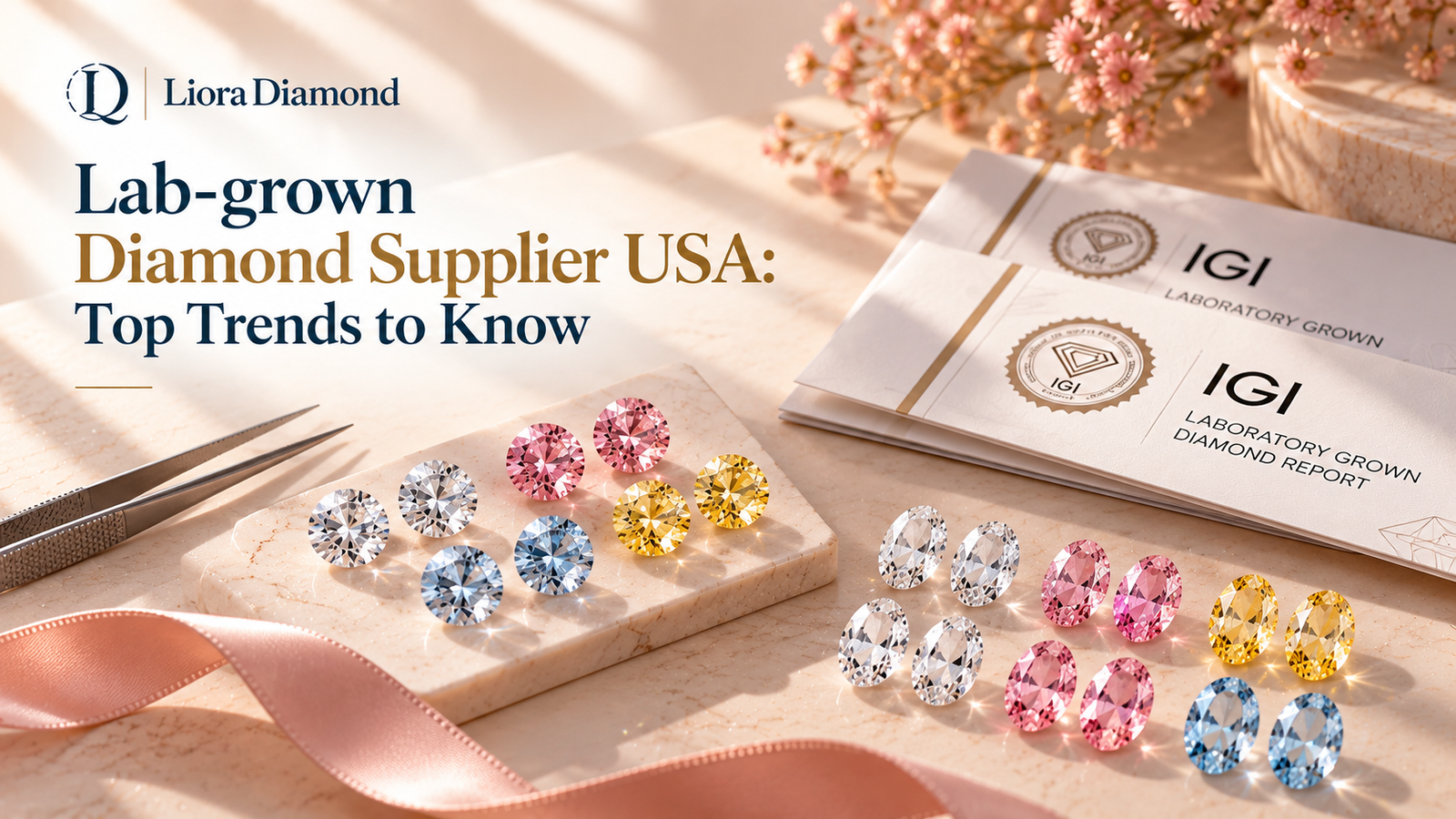
Buying lab-grown diamonds wholesale for a US business now involves three questions that barely existed two years ago.
- Where was the stone polished, and how does that affect landed cost?
- Which carat sizes still carry margin?
- How much certification detail does a stone need before it belongs in your inventory?
This article covers six sourcing trends shaping those decisions for independent jewelers, bridal designers, and e-commerce diamond brands.
Quick Take on Lab-grown Diamond Wholesale in B2B
US buyers of wholesale lab-grown diamonds face a split-price market (larger stones still falling, one-carat rounds firming), a country-of-origin duty that changes landed cost, and IGI reports now treated as a baseline rather than a selling point. The strongest sourcing strategy pairs a core of ready stock with make-to-order for exact specifications, and prices every stone on landed cost rather than the invoice figure.
Trend 1: Wholesale Prices Have Split by Carat Size
The old assumption was that lab-grown prices fall evenly across the board. The latest data says otherwise. The Q2 2026 Lab-Grown Wholesale Price List showed an average 13% year-over-year decline, while wholesale prices for 1-carat rounds rose 1%. Stones of 1.50 to 1.99 carats fell 11%, and 2-carat stones fell 20%. The same source notes that rough prices have recently moved higher even as polished prices keep declining.
For a buyer, this changes how you plan a purchase:
- One carat is a stabilizing tier. Competitive pricing here comes from supplier selection and specification discipline, not from waiting for the market to fall further.
- Larger stones keep getting cheaper. Buying 2- to 3-carat inventory in deep stock invites markdown risk. Keep these tiers lean and replenish often.
- Rising rough is a margin warning. If polished prices stop falling, the manufacturers absorbing that squeeze will look harder at where they can trim, so check consistency on repeat orders.
To see how this plays out in practice, compare live pricing on 1-carat-and-above lab-grown diamonds against a view sorted by lowest price first. The spread between a well-cut stone and the cheapest listing in the same grade band often determines your margin.
Trend 2: Country of Origin Now Drives Landed Cost
For decades, US buyers evaluated lab-grown diamonds on the four Cs and price. Today, a fifth variable sits beside them: where the stone was polished.
From July 24, 2026, the US replaced its temporary Section 122 surcharge with a Section 301 regime that keeps a 10% additional duty on Indian exports, including lab-grown diamonds. Competing hubs such as China, the United Kingdom, Australia, Hong Kong, Thailand, Türkiye, and Israel, the UAE, Israel and Vietnam face 12.5%. This regime has no automatic expiry and can be modified by the Trade Representative, so treat today's number as a working assumption.
| Where the stone was polished | Additional Section 301 duty (as reported, Sept 2026) |
|---|---|
| India | 10% |
| China, Hong Kong, Thailand, Türkiye, UAE, Israel, Vietnam | 12.5% |
Three practical points follow:
- Origin means where the stone was substantially transformed, not where it was certified or shipped from. Ask every supplier to state polishing origin on the commercial invoice.
- Loose stones and finished jewelry are treated differently. Jewelry from India still carries the existing 5.5 to 6% MFN duty on top of the 10%, for roughly 15.5 to 16% in total. Buying loose and setting in the US can change your duty math.
- More changes may be coming. USTR is running a separate Section 301 investigation into alleged overproduction that could add tariffs on 16 countries, including India.
Illustrative example only: on a $10,000 parcel, a 10% additional duty adds $1,000 and 12.5% adds $1,250. A supplier quoting $300 lower but polishing in a 12.5% jurisdiction may leave you worse off. Confirm current rates and classification with a licensed customs broker before you commit.
Trend 3: Lab-Grown Is Now a Core Category, Not a Side Line
Demand data supports making lab-grown a core part of your assortment. In a BriteCo index built from insurance appraisals, lab-grown diamonds appeared in 51% of newly appraised engagement rings from January through June 2026, up from 47% in 2025 and 6% in 2019. Appraisal data reflects insured rings rather than every sale, so read it as a direction, not a precise market share.
What matters for a wholesale lab-grown diamond buyer is how this affects your mix. When lab-grown is the default in bridal, customers arrive expecting a wider choice of shapes and larger carat weights at their budget. Your stock plan should follow:
- Round and oval as the volume base, because they cover the most inquiries.
- Cushion, princess, and emerald as accent shapes for designers with specific styles.
- Prioritize face-up size over carat weight, such as 1-carat wholesale lab-grown diamonds. Elongated shapes and well-cut stones can look larger than their carat weight suggests, which matters when customers compare on price per carat.
Start with the shapes that turn fastest for you: round lab-grown diamonds, oval, cushion, princess, and emerald-cut stones. Shape popularity figures vary by source and region, so your own sell-through data is the better guide.
Trend 4: IGI Certification Is the Baseline, and Buyers Read the Report
For US wholesale lab-grown stones, an IGI report is now required to enter the conversation. The shift is in how buyers use it. Instead of asking, "Is it certified?" experienced buyers check what the report says.
What to verify on every lab-grown report:
- Growth process (CVD or HPHT) and any post-growth treatment. Both should be stated, and both affect how you describe the stone to customers.
- Color and clarity grades against the specification you ordered, particularly on parcels where stones must match.
- Cut grade, polish, and symmetry for rounds; proportions and visual assessment for fancy shapes.
- Fluorescence. Strong fluorescence can affect appearance and resale conversations.
- Laser inscription matching the report number on the stone itself.
A grading report describes a stone's characteristics. It is not an appraisal or a statement of investment value, and your sales copy should not imply otherwise. If you stock IGI-graded goods, browse IGI-certified lab-grown diamonds to see how report data is presented alongside each listing. IGI's own website is the reference for report formats and verification.
Trend 5: Fancy Color Is Moving From Novelty to Line Item
Fancy color diamond wholesale used to be the domain of a few specialist buyers. Bridal designers and jewelry e-commerce brands increasingly request it as a point of difference from colorless stock. Pink, blue, and yellow lab-grown diamonds are the usual starting points compared to rare colored diamonds.
Buying fancy color has its own checklist:
- Intensity grade. The difference between "Fancy" and "Fancy Vivid" is significant in appearance and in price.
- How the color was produced. Some colors are as-grown; others involve post-growth treatment. The report should state which, and your listings should reflect it.
- Matching. Pairs and multi-stone sets are much harder to source in color than in white. Allow longer lead times for matched requirements.
- Volatility. Color availability is thinner than colorless, so price comparisons are less reliable.
Compare current fancy color lab-grown diamonds to see how intensity grades and pricing vary across available stock.
Trend 6: Hybrid Sourcing Beats Pure Stock or Pure Custom
Small and mid-size US buyers rarely have the capital to hold deep inventory in every shape and size, and rarely have the time to wait weeks for every order. The pattern that works is a hybrid:
- Ready stock for high-turn specifications: round and oval, popular carat bands, standard color and clarity.
- Make-to-order for exact specifications, matched pairs, unusual shapes, and larger carat weights. Liora Diamond's typical make-to-order lead time is around four to six weeks.
- Live inventory access so you can check availability before you promise a customer a date.
This lets you keep working capital low on slow-moving specs while protecting sales on the stones that move. It also insulates you from tariff swings, since you are not sitting on a large stock bought at last quarter's duty rate.
For US-focused sourcing, see Liora's lab-grown diamond supplier for the USA page. For parcels, matched sets, or specifications not in stock, submit a B2B sourcing inquiry.
How to Evaluate a Wholesale Lab-Grown Diamond Supplier for the US
Use this list as a screening tool before you place a first order with a bulk lab-grown diamond supplier:
- Certification: Is every stone IGI-graded, with the report number inscribed on the girdle?
- Origin disclosure: Will the invoice state where the stone was polished?
- Documentation: Can they supply commercial invoices and paperwork suited to US customs entry?
- Consistency: How do they control color, clarity, and cut across repeat orders?
- Inventory visibility: Is stock live, and how often is it updated?
- Specification flexibility: Can they source to your exact parameters when stock does not match?
- Shipping and insurance: Is shipment insured, and who bears risk in transit?
- Return terms: Are they clear and written, not verbal?
You can browse Liora Diamond's full loose diamond inventory to see how these details appear in a live listing.
Conclusion
The winning approach for US buyers in 2026 is to price by landed cost, treat one carat and larger sizes as separate purchasing decisions, verify what is actually on the IGI report, and blend stock with make-to-order. Start by comparing current certified lab-grown diamond stock, then visit Liora Diamonds' wholesale loose diamonds.
FAQ
1. Are wholesale lab-grown diamond prices still falling?
Yes, on average, but unevenly. One industry price list showed a 13% year-over-year fall in Q2 2026, with one-carat rounds up 1% and 2-carat stones down 20%. Price direction now depends on carat band, so a single "lab-grown price trend" tells you little.
2. Do US tariffs apply to lab-grown diamonds from India?
As reported in July 2026, lab-grown diamonds polished in India face an additional 10% Section 301 duty. Rates and rules can change, so verify with a customs broker before ordering.
3. Is IGI or GIA better for wholesale lab-grown diamonds?
IGI is the most common report for lab-grown wholesale stock. Both labs grade lab-grown diamonds, so choose based on what your customers and channels expect, and require the same lab across a matched parcel.
4. What order size do wholesalers expect?
This varies widely by supplier. Ask about minimums and mixed-parcel options before you compare prices.
5. Can I buy fancy color lab-grown diamonds wholesale?
Yes. Ask for intensity grade, whether the color is as-grown or treated, and lead times for matched stones.