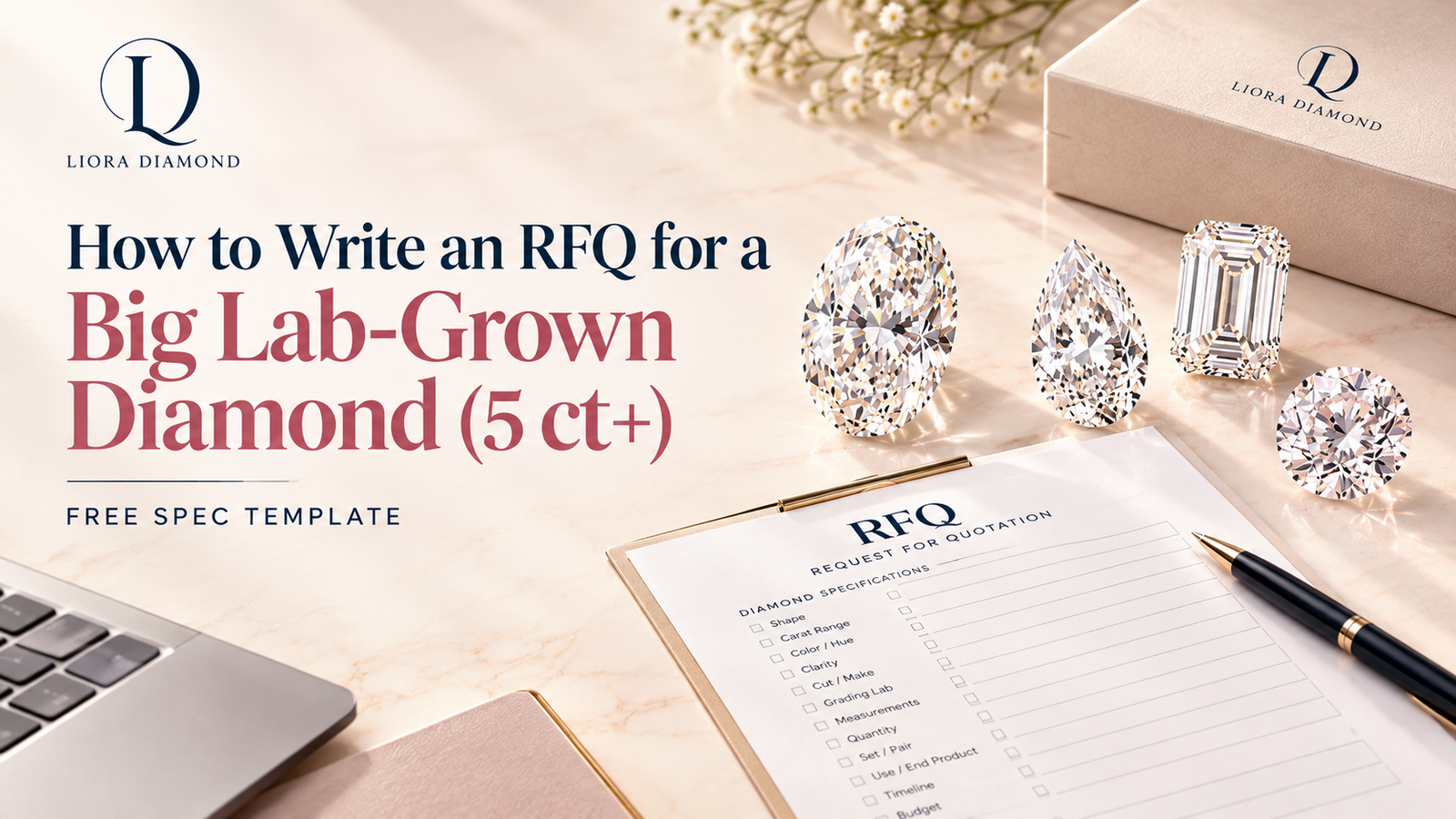
How to Write an RFQ for a Big Lab-Grown Diamond (5 ct+): Free Spec Template
Learn how to write a clear RFQ for a 5 ct+ lab-grown diamond. This guide covers the key specifications suppliers need, including shape, carat, color, clarity, cut, grading, measurements, matching requirements, budget, and timeline, plus a free copy-ready RFQ template.
A request that says "need a 10 ct pink, best price" usually gets one of two replies: a list of questions, or a quote for a stone you didn't want. Above 5 carats, small differences in shape, color, clarity, and measurements can move the price by thousands of dollars. Hence, the quality of your request for quotation (RFQ) determines how fast and how accurately a supplier can respond.
This guide gives trade buyers a copy-ready RFQ template for big loose lab-grown diamonds, built around the fields our trade desk actually quotes against. Each field explains why it changes the quote, where a range works better than a single grade, and which extra details matter for fancy color and matched pairs.
Why a Precise RFQ Gets a Faster, Better Quote
A supplier of large lab-grown diamonds matches your request against two things: stones already cut and graded, and what can be grown and cut to order. A vague request forces a supplier to guess, and guesses produce either a shortlist that's too wide to be useful or one that misses your budget.
A precise lab-grown diamond RFQ does three things:
- It narrows the search. "Oval, 7.00–7.99 ct, F–G, VS1–VS2, IGI" can be matched in one pass. "Big oval, good quality" can't.
- It makes quotes comparable. If you send the same specification to more than one supplier, you can compare like with like.
- It flags feasibility early. A matched pair at 10 ct each, or a rare hue in a large size, may need stones grown to order. A clear RFQ lets the supplier tell you that, and give you a date, before you commit.
At Liora Diamond, a complete specification lets the trade desk reply with matching stones, photos, video, and grading reports, usually within one business day.
The 12 Fields Every Big-Stone RFQ Needs
These fields cover what a trade desk needs to quote a single 5 ct+ stone. Fill in what you know and use ranges where you're flexible.
| # | Field | What to write | Why it changes the quote |
|---|---|---|---|
| 1 | Shape | Oval, pear, radiant, emerald, cushion, round, heart, other | Shape affects yield from the rough and how large the stone looks face-up. Elongated shapes tend to cost less than rounds of the same weight. |
| 2 | Carat range | e.g. 5.00–5.99 ct | Price steps up at round weights. A 4.90 ct can look the same face-up as a 5.02 ct and cost noticeably less. |
| 3 | Colour (white) or hue + intensity (fancy) | e.g. E–G, or Fancy Vivid Pink | In big stones, color shows more. Each grade or intensity step changes price. |
| 4 | Clarity | e.g. VVS2–VS2, or "eye-clean" | Inclusions are easier to see at size. A range lets the dealer find the best value. |
| 5 | Cut/make | Polish, symmetry, depth and table limits | Proportions decide how lively a big stone looks. Deep or shallow stones can face up smaller. |
| 6 | Grading lab | IGI or GIA | IGI is standard for big stones; GIA grading can be arranged but adds time and cost. |
| 7 | Measurements/ratio | Length × width (mm) and L/W ratio, or setting dimensions | A stone must fit the mounting. Measurements matter as much as carat weight for fit. |
| 8 | Single, pair or set | Single, matched pair, three-stone set | Matching multiplies the search. Pairs are quoted as a set, not as two singles. |
| 9 | Quantity | Number of stones or sets, one-off or repeat | Volume and repeat supply affect pricing and planning. |
| 10 | Use / end product | Ring, pendant, earrings, high jewelry, loose resale | Helps the desk advise on make, durability, and matching. |
| 11 | Destination country | Where the goods ship and who imports them | Affects courier, documents, and shipping terms. |
| 12 | Timeline and budget | Date needed and target order value | Decides stock. grown-to-orderer, and which trade-offs make sense. |
If you're not sure what a field means for your design, say so in the RFQ. A note like "flexible on clarity if color is strong" is useful information. If the big stone is part of a larger order, such as melee, parcels, or repeat stock, mention it so the desk sees the whole order; see our wholesale lab-grown diamond supply for parcels and trade accounts. If you need the stone set into finished pieces, add your CAD or design brief and look at our private-label B2B jewelry service.
Writing a Range Instead of a Single Grade
Single grades narrow the pool more than most buyers expect. "8.00 ct, E, VVS1" might match very few stones in stock. "7.80–8.30 ct, E–F, VVS1–VS1" can match several, giving you a real choice on price and look.
Practical rules for ranges:
- Carat: stay just below round thresholds where the look matters more than the number. A 9.85 ct can be quoted at a different level from a 10.02 ct.
- Color: for white stones, a two-grade range (for example F–G) is common. For big white stones, G–H with VS clarity often gives the best value; D–E is usually chosen for top bridal.
- Clarity: "eye-clean, VS2 or better" tells the desk what you actually need, rather than a grade you assumed.
- Hard limits: mark anything non-negotiable. "Must be D–E" or "depth no deeper than 65%" saves time on both sides.
If you have a ceiling price, share it. A budget doesn't weaken your position; it lets the desk propose a specification that fits rather than quoting stones you'll reject.
Extra Fields for Fancy Color Lab-Grown Diamond
Fancy color lab-grown diamonds need more than "pink" or "yellow". Add these fields:
- Hue and overtone: for example, pink, purplish pink, or orangy pink. Overtones appear in the report name and change the look.
- Intensity: Fancy Light, Fancy, Fancy Intense, Fancy Vivid, or Fancy Deep. For big stones, most requests are Fancy Intense or Fancy Vivid, which read clearly as color in a setting.
- Color reference: a photo, a stone reference from a catalog, or a description of the tone you want ("light rose", "strong canary").
- Treatment disclosure: lab-grown fancy colors are usually created or intensified after growth. This is normal for the category, but your customer should know. Ask for the treatment to be stated on the report and invoice so your own disclosure is simple.
- Lighting for video: ask for filming in daylight, and under UV if fluorescence matters to you.
Our guides to sourcing fancy color lab-grown diamonds and pink lab-grown diamonds wholesale go deeper on hue and intensity.
Extra Fields for Pairs and Three-stone Sets
Matching is where vague RFQs fail most often. For pairs and sets like B2B diamond jewelry, add:
- What must match: color, clarity, measurements, and make. Say which matter most for the design. Earrings usually need closer face-up size and color matching than a ring with side stones.
- Tolerance: for example, "length within 0.10 mm" or "same color grade".
- Center stone reference: for three-stone rings, send the center stone's measurements or a catalog stone reference. Side stones can be cut to fit.
- Set video: ask for the pair or set filmed together, not separately.
Matched pairs are commonly available from 2 ct each; larger pairs are sourced to order, so allow more time.
Copy-Ready RFQ Template for Wholesale Lab-Grown Diamonds
Copy this into your email, WhatsApp message, or the "Your requirement" box on our inquiry form. Delete what doesn't apply.
BIG LAB-GROWN DIAMOND RFQ
Company/business type:
Country of delivery:
1\. Shape:
2\. Carat range: \_\_\_ to \_\_\_ ct
3\. Colour (white): \_\_\_ to \_\_\_
OR hue + intensity: e.g. Fancy Vivid Pink
4\. Clarity: \_\_\_ to \_\_\_ (or eye-clean)
5\. Cut / make limits: polish/symmetry, depth %, table %
6\. Grading lab: IGI / GIA
7\. Measurements / ratio: \_\_\_ x \_\_\_ mm, L/W \_\_\_
8\. Single / pair/set:
9\. Quantity: \_\_\_ stones/sets, one-off or repeat
10\. End product: ring / pendant / earrings / loose resale
11\. Destination + importer of record:
12\. Date needed: Target order value: US$ \_\_\_
Fancy color only:
\- Overtone accepted:
\- Color reference (photo or stone ref):
\- Video lighting: daylight / UV
Pairs or sets only:
\- Must match on:
\- Tolerances:
\- Center stone measurements or ref:
Non-negotiables:
Flexible on:
Example (white stone): Oval, 5.00–5.60 ct, F–G, VS1–VS2, excellent polish and symmetry, depth 58–63%, IGI, L/W 1.35–1.45, single stone for an engagement ring, delivery to the USA, needed in three weeks, target order value US$5,000–15,000. Flexible on clarity if eye-clean.
What Happens After You Send It
Once your specification reaches the trade desk, the process is straightforward:
- We shortlist. You receive matching stones or a costed proposal, with photos, video, and grading reports, usually within one business day.
- You inspect the exact stone. High-resolution photos and a 360° video show the stone you'll receive, not a sample. Filming next to a ruler, in daylight or under UV, is available on request.
- You check the report. We share the grading report before invoicing, with a number you can verify on the lab's website. Measurements, depth, table, and ratio come with every quote so you can check fit against your setting.
- You confirm. We invoice, you pay, then we insure and track delivery, with the commercial invoice and original grading reports in the parcel.
If a stone isn't in stock, we'll tell you whether we can grow and cut it to order, with a date before you commit. Common shapes and colors in smaller big-stone sizes usually take days; larger or unusual stones take longer.
Liora supplies the trade only: jewelers, wholesalers, manufacturers, and brands. A trade minimum of US$2,000 per order applies, and most single big stones exceed it on their own. You can read more about Liora Diamond or check the trade FAQ.
Frequently Asked Questions
1. Do I need to know the exact carat weight?
No. A carat range is better than a single weight because it broadens your stone options. If you know the setting dimensions, send the measurements; the desk can work out which weights fit.
2. Should I ask for IGI or GIA?
IGI is the standard report for big lab-grown stones and is supplied as standard. You can arrange GIA grading, which helps with some retail customers, but it adds time and cost. If your customers don't ask for GIA, IGI keeps the timeline shorter. See why diamond certification matters for B2B buyers.
3. How fast will I get a shortlist?
The trade desk replies within one business day, and usually faster on WhatsApp. A complete specification gets the most useful reply the first time.
Send Your Specification to the Trade Desk
Paste your completed template into the trade inquiry form, choose Big diamonds (3 ct and above) under "Interested in", and select your order value. Or send it to the trade desk on WhatsApp for a faster reply. We'll come back with matching stones, video, and reports.