10 Carat Lab-Grown Diamonds Wholesale: A Trade Buyer's Sourcing Guide
Explore the essentials of sourcing 10-carat lab-grown diamonds wholesale at Liora Diamond, from selecting the right cut, quality, and certification to evaluating suppliers, pricing, and consistency. This trade-focused guide helps jewelers and diamond buyers make informed purchasing decisions with confidence.
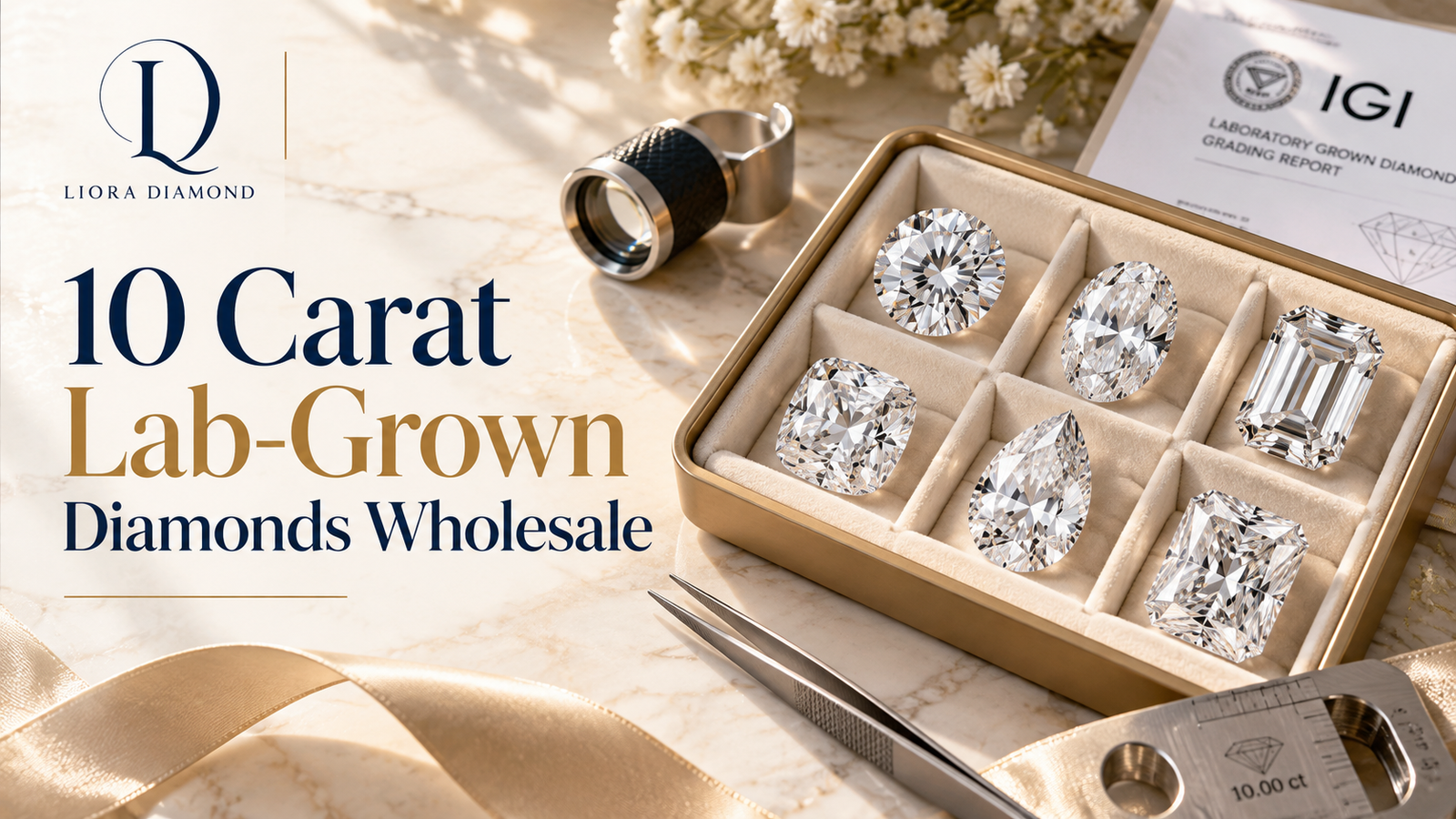
A 10-carat laboratory-grown diamond is a showpiece stone, and buying one for resale is a procurement job, not a browse. You need the stone's real measurements, a grading report you can check yourself, video of the exact stone, and a supplier who tells you plainly what is in stock and what has to be grown.
This guide is written for jewellers, wholesalers, dealers, and brands sourcing 10 to 19.99 ct stones. Every size and pattern in it comes from the 44 stones listed in that band. Stock changes throughout the day, so treat the figures as a dated snapshot, not a promise.
At a glance
1. 44 stones listed between 10.00 and 19.99 ct, all fancy color; no white stone in this band.
2. 32 of the 44 weigh between 10.00 and 10.10 ct.
3. 40 carry an IGI report; 4 are ungraded, with a report available on request.
4. 43 are stated as CVD-grown; one listing does not state the growth method.
5. Trade only, with a minimum of US$2,000 per order.
What 10 Carats Looks Like in Millimeters, by Shape
Diamond carat is weight, but your customer sees spread. At 10 ct, the same weight can look like a 14 mm heart or a 23 mm elongated pear. That gap matters when a setting, a pendant drop, or a display case is already designed.
The ranges below come from our listed stones weighing 10.00 to 10.10 ct. They are real stones, not a formula.
| Shape | Stones measured | Face-up size (mm) | Depth % seen |
|---|---|---|---|
| Heart | 18 | 11.8–13.0 × 13.4–14.7 | 46.9–60.7 |
| Pear | 6 | 17.5–20.2 × 10.9–12.2 | 52.3–64.4 |
| Pear step cut | 2 | 23.2–23.3 × 11.0–11.1 | 57.0–63.9 |
| Radiant | 2 | 15.2–15.7 × 9.8–10.3 | 61.0–71.0 |
| Oval | 1 | 16.35 × 11.10 | 63.8 |
| Cushion | 1 | 14.29 × 10.38 | 67.8 |
| Portuguese cut | 2 | 13.4 × 13.4 | 58.5–61.6 |
| Round (no stone listed) | 0 | about 14 mm diameter, industry rule of thumb | — |
Two things stand out. Elongated pears and step-cut pears spread far wider than hearts or cushions at the same weight. And among 18 hearts of almost identical weight, depth runs from 46.9% to 60.7%. A deeper stone hides weight below the girdle and faces up smaller, so always quote and compare on measurements, never on carat alone.
What Our Live 10 CT Listing Tells You About Supply
The big-stone catalog filtered from 10 ct showed 44 stones in the 10–19.99 ct band. Pink and pink-modified hues made up 31 of them, followed by yellow, with a few blue, green, red, and brown stones. Hearts were the most common shape, then pears. For that, a fancy color lab-grown diamond wholesale supplier is important.
The weight pattern is the useful part. 32 of 44 stones sit between 10.00 and 10.10 ct, with a few between 10.5 and 15 ct. Our reading is that cutters protect the 10.00 ct mark because buyers and price lists treat it as a threshold. For you, that means a 10.02 ct stone is easy to find; an 11.5 ct stone in a given hue may need sourcing.
Several laboratory-grown diamonds are worth naming as reference points for a brief:
1. 10.03 ct cushion, Fancy Vivid Yellow, VS1, IGI, CVD — 14.29 × 10.38 × 7.04 mm, ratio 1.38.
2. 15.06 ct pear, Fancy Vivid Pink, VS2, IGI, CVD — 20.20 × 12.58 mm.
3. 10.06 ct pear, Fancy Vivid Green, VS1, IGI, CVD — 20.18 × 12.17 mm.
Quote the reference when you message us, and the trade desk can send the price, video, and the report for that exact stone. If you want the wider picture first, see the full range of big lab-grown diamonds from 3 ct upward.
How 10 Carat CVD Stones are Grown and Cut
Nearly every stone in our 10 ct band is listed as CVD (chemical vapor deposition). CVD grows diamonds in layers on a thin diamond seed plate inside a vacuum chamber. A finished 10 ct stone needs a crystal large and clean enough to cut it from, so big stones take longer to produce than everyday sizes. Read our CVD lab-grown diamonds sourcing guide.
That is why our big diamonds page lists 10–20 ct as "selected stock, grown to order", and 20 ct+ as on request. When a stone must be grown and cut, we provide a date before you commit; we don't quote a fixed lead time in advance because it depends on the specifications.
HPHT (high pressure, high temperature) is the other growth method. If HPHT matters to your customers, our guide to sourcing HPHT diamonds covers how the two compare.
What Moves the Price of a 10 Carat Lab-grown Diamond
We do not publish prices for big stones because they move with stock, hue, and make. These are the levers that decide a quote, in the order buyers usually feel them:
1. Weight thresholds. Price steps at round weights. A stone at 9.90 ct can face up much like a 10.02 ct and cost noticeably less, which is a lever when the setting allows it.
2. Color intensity. Between white and fancy colors, diamonds, Fancy Vivid and Fancy Intense dominate big-stone requests. In our 10 ct band, 28 stones were Vivid and 15 Intense.
3. Clarity. Most of the band sits at VS1–VS2; VVS2 stones cost more and SI1 stones less. For a complete overview, use our 4Cs of diamonds guide for business.
4. Shape and spread. Elongated shapes look larger per carat than rounds, as the mm table shows.
5. Make. Polish, symmetry, and depth decide how lively a big stone looks. We flag stones with deep or shallow proportions on the quote.
6. Grading lab. IGI is our standard. GIA grading is available; it adds time and cost but helps with some retail customers.
7. Stock versus grown to order. Stock stones ship fastest; growing to order suits exact specifications and larger sizes.
White or Fancy Color at 10 Carats?
Every stone in our 10–19.99 ct listing was fancy color. That reflects today's stock, not a limit: our big diamond range is offered in white and fancy color, and we source or grow white 10 ct stones to your specification.
For white big stones, D–G color with VVS–VS clarity covers most bridal and statement demand in B2B jewelry as well. G–H with VS clarity often gives the best value at size, because color shows more in a large stone. If your clients are color-led, start with our fancy color lab-grown diamonds or the live pink listing, our deepest big-stone category.
What to Check On the Grading Report Before You Pay
A report protects you only if you read it against the stone. On every 10 ct quote, check:
1. The report number online. IGI lets you enter a report number on its website to confirm the details. Do this before invoicing, not after delivery.
2. That it is a laboratory-grown report, stating the stone is lab-grown and, where shown, the growth method.
3. Any post-growth treatment comment. Read the comments section, especially for fancy colors.
4. Measurements against the video and the quote. The mm figures should match what you were sent, to the hundredth.
5. Color, clarity, and, for fancy colors, the full color description, including modifiers such as "Brownish" or "Orangey", which change price and appearance.
6. Whether the stone is graded at all, four stones in our 10 carat band were ungraded on 6 October; a report is available upon request. Ask for the report before you commit.
If you resell in the United States, the FTC's Jewelry Guides require that lab-created diamonds be clearly disclosed as not mined, using terms such as "laboratory-grown" or "laboratory-created" (Federal Register, 2018). Check the rules in your own market before you write retail copy. For more on reports, read our guide to IGI-certified lab-grown diamonds for the trade.
How to Request a 10 Carat Wholesale Purchase Shortlist
The fastest shortlists start from a complete brief. Send us:
1. Shape, or two acceptable shapes.
2. Carat range, for example 10.00–10.50 ct, or a mm size if a setting is fixed.
3. Color (white grade range, or hue and intensity for fancy color).
4. Clarity range.
5. Single or matched pair. Pairs are matched for color, clarity, measurements, and make.
6. Report preference (IGI as standard, or GIA).
7. Destination country and timing.
You then receive a shortlist of matching stones or a costed proposal. For each stone: high-resolution photos and a 360° video of the exact stone you will receive, measurements, depth, table and ratio, and the grading report before invoicing. On request, we film in daylight, under UV, or beside a ruler for scale. You confirm, we invoice, and the stone ships insured to your door — see our shipping policy for terms.
We supply businesses only, with a minimum of US$2,000 per order; most single 10 carat stones exceed that on their own. The trade desk replies within one business day. Buyers in our core markets can also read our supplier pages for the USA, UAE, Hong Kong, and the UK.
Request a 10 ct stone shortlist. Send shape, carat range, color, clarity, and whether you need a pair. Prefer chat? WhatsApp the trade desk.
Frequently Asked Questions
1. Are 10 ct lab-grown diamonds usually CVD?
In our stock, yes: 43 of the 44 stones listed at 10–19.99 ct were stated as CVD-grown. The growth method is shown on each stone page and, where applicable, on the report.
2. Can I see the exact stone on video before paying?
Yes. We send photos and a 360° video of the exact stone, not a sample, and can film it in daylight, under UV, or next to a ruler.
3. How long does a 10 ct stone take if it is not in stock?
It depends on shape, color, and size, because the crystal has to be grown and cut. We confirm a date before you commit rather than quote a standard lead time.
4. Do you supply matched pairs at 10 ct?
Pairs from 2 ct each are common. Larger pairs are sourced to order, matched for color, clarity, measurements, and make, with video of the set together.
5. Is there a minimum order?
Our trade minimum is US$2,000 per order. A single 10 ct stone normally exceeds it.
6. Which report lab do you use for 10 ct stones?
IGI is our standard, and the report number can be verified on IGI's website. GIA grading can be arranged for an additional fee.