IGI-certified lab-grown diamonds wholesale give B2B buyers verified quality, transparent grading, and greater confidence when sourcing certified loose diamonds in bulk.
There are two loose lab-grown diamond buyers with different expectations: 1. A D2C fine jewelry retailer in Texas prefers only certified diamonds. 2. A private-label brand in Dubai likes to buy diamonds without IGI certification. After six months, only one of those buyers can answer a customer's question about clarity, prove authenticity to a payment processor, or replace a stone from a matched parcel without a color mismatch.
That gap is what certification actually buys a wholesale buyer. This guide covers what an IGI report contains, and why it matters more at the B2B level than the retail level. Learn how an IGI certificate compares to GIA, and what to check before placing a bulk order.
Why IGI Certification Matters for Wholesale Buyers
IGI lab-grown diamond certification gives wholesale buyers an independent, third-party verification of the following:
1. Lab-grown diamond's 4Cs
2. CVD or HPHT growth method
3. Proportions
All these details are recorded against a laser-inscribed report number on the stone itself. For a wholesale loose diamond buyer, this means every stone in a parcel can be checked against its paperwork. This helps ensure repeat orders can be specified with confidence, and customers or business partners can be shown documentation that doesn't rely on the CVD or HPHT diamond supplier's word alone. Without it, a buyer assumes quality, authenticity, and consistency risk with no independent recourse.
What an IGI Lab-Grown Diamond Report Actually Covers
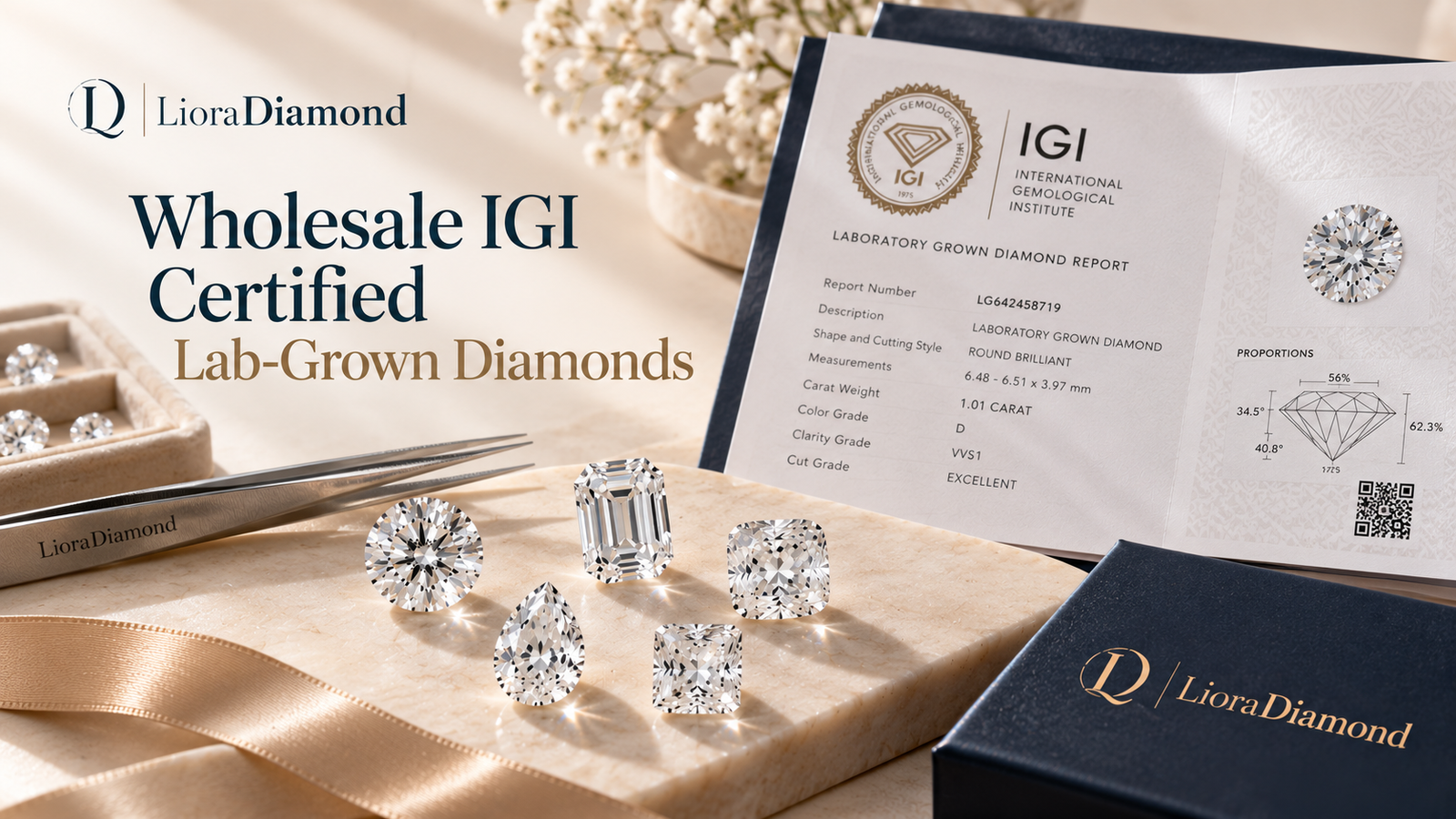
It evaluates the stone on its own merit rather than the seller's description. In other words, an independent third-party laboratory issues a diamond certificate with no financial stake in the sale. For lab-grown stones specifically, the International Gemological Institute issues a Laboratory Grown Diamond Report that documents:
1. Growth method — CVD (chemical vapor deposition) or HPHT (high pressure, high temperature), stated explicitly so it's never confused with mined origin
2. Carat weight, measured to the hundredth
3. Color grade, typically on the same D-to-Z scale used for natural stones, sometimes with a "lab-grown" qualifier
4. Clarity grade, from Flawless through the Included range
5. Cut grade (for round brilliants) or proportions and finish notes (for fancy shapes)
6. Measurements, table and depth percentages, girdle thickness, culet, polish and symmetry
7. Fluorescence, where present
8. A unique report number, laser-inscribed on the girdle so the physical stone can always be matched back to its paperwork.
For a buyer sourcing IGI-certified lab-grown loose diamonds at volume, that report number is the operational detail that matters most—it's what lets you audit a parcel stone by stone on arrival rather than take it on trust.
Why IGI Is the Default Standard for Lab-Grown Stones
IGI provides specific grading for all four Cs and is used across most of the lab-grown market. It helps create consistency across the industry and lets buyers compare stones from different sources on the same terms. That consistency is precisely why IGI functions as a standard: a buyer comparing quotes from three suppliers can hold every parcel to the same reporting format instead of reconciling three different documentation styles.
Scale reinforces this. Certification across the global jewelry market is projected to rise from roughly 70–75% today to 80–85% by 2030. There is continued growth in lab-grown diamond production and stabilized wholesale pricing.
Certification is no longer a niche add-on — it is becoming the baseline expectation for any stone entering a serious supply chain, wholesale or retail.
What is the Difference Between IGI and GIA for Lab-Grown Diamonds
| Factor | IGI | GIA |
|---|---|---|
| Lab-grown market share | Dominant — most widely used lab for LGD reports | Has only recently expanded into lab-grown grading, with far fewer GIA-graded lab-grown stones available |
| Turnaround for bulk parcels | Generally faster, built around lab-grown volume | Slower, historically natural-diamond focused |
| Buyer recognition (B2B) | Recognized across US, Middle East, and Asian wholesale markets | Recognized as the natural-diamond benchmark; growing in LGD |
| Best fit | High-volume wholesale lab-grown sourcing | Buyers specifically requesting GIA-graded LGD for a niche retail program |
IGI and GIA-certified lab-grown diamonds serve different points in the market. For most B2B lab-grown sourcing, IGI's volume and turnaround make it the practical choice; a buyer with a specific retail program built around GIA paperwork should confirm that requirement with their supplier before ordering.
Why Certification Matters More at the Wholesale Level Than at Retail
Stone quantity measurements matter. A retailer may check only a single stone or a small batch, but wholesale buyers must inspect dozens or hundreds of stones across repeat orders. It stakes compound differently:
1. Parcel consistency
A jewelry manufacturer ordering calibrated melee or matched parcels needs every stone in that shipment to sit within a tight color range, such as fancy pink, yellow, or green diamond, and within a clarity band. Certification provides an objective reference point for checking that consistency, rather than relying on a supplier's visual sort.
2. Repeat-order reliability
A private-label brand reordering the same specification six months later needs the new loose lab-grown diamond parcel to match the last one closely. So, customers don't notice a difference. With certified reports, comparison is possible; without them, it isn't.
3. Customs and import documentation
Many customs authorities and payment processors now expect bulk diamond grading documentation as part of standard paperwork for diamond shipments. For importing lab-grown stones, disclosing the origin makes the process easier.
4. Downstream trust
A retailer or brand reselling certified stones can pass that documentation to their own customers. This is a genuine commercial advantage — it shortens the sales conversation and reduces returns driven by quality disputes.
5. Fraud and substitution risk
Laser inscription tied to the lab-grown diamond certificate number makes it possible to confirm that the physical stone in hand matches the one described on paper, which matters considerably more when a buyer receives a bulk shipment sight-unseen from overseas.
What to Check Before Placing a Wholesale Order
A certificate alone isn't a complete due-diligence process. Before confirming a bulk loose diamond order, a buyer should verify the following:
1. That the report is current and matches the physical parcel; ask for report numbers per stone, not a single summary sheet for the whole parcel.
2. That laser inscriptions are present and legible on a sample of stones from the shipment, not just the top layer.
3. That the supplier discloses the growth method (CVD or HPHT) on every report, since this affects both pricing and how the stones should be marketed downstream.
4. That grading terminology is used correctly — a "grading report" is not the same as an appraisal or a valuation, and no legitimate report should claim to establish investment value.
5. The supplier can produce matched parcels within a stated color and clarity range, not just individually certified stones sold as a batch.
6. That certification should cover the shapes and carat ranges needed for production—round, oval, cushion, princess, and emerald cuts each behave differently under grading and should be checked accordingly.
Also, ask for sample stones to judge quality, then place the order to reduce the chances of returns and document handling.
Certification and Customs: What International Buyers Need
For buyers importing lab-grown diamonds across borders — a common scenario for wholesalers in the US, UK, UAE, and other markets sourcing from India — certification does more than confirm quality. It becomes part of the import paperwork itself.
1. Country-of-origin and growth-method disclosure
Because lab-grown and natural diamonds are treated differently for tariff and disclosure purposes in a growing number of jurisdictions, a report that explicitly states the growth method (CVD or HPHT) helps a buyer document that distinction cleanly at customs. This reduces the chance it will be inferred or challenged on arrival.
2. Per-stone documentation for bulk shipments
Customs authorities and freight forwarders increasingly expect itemized paperwork for diamond parcels rather than a single combined invoice. A per-stone IGI report, matched to a laser inscription, gives a buyer a ready-made audit trail that meets this requirement without extra border administration.
3. Insurance and carrier requirements
Worldwide insured shipping for loose wholesale diamonds typically requires supporting documentation of value and authenticity. Certified reports are the standard reference point insurers and carriers use to validate a shipment's declared contents.
4. Reconciliation on arrival
For a buyer receiving a parcel of, say, 200 calibrated melee stones, certification (where issued at the parcel level) or spot-check reports on a sampled batch make it possible to reconcile what arrived against what was invoiced — a basic but essential step before the shipment is accepted into inventory.
5. Specification consistency for repeat sourcing
Buyers placing recurring orders — for private-label production or standardized retail jewelry collections — rely on certified specifications to confirm that a new shipment matches previous ones closely enough to maintain consistent finished-product quality across production runs.
6. Additional disclosure for fancy color stock
Shipments of fancy color lab-grown diamonds often warrant extra attention at customs, since color treatment and origin need to be documented clearly alongside the standard 4Cs to avoid delays or disputes on arrival.
None of this replaces working with a supplier experienced in cross-border documentation, but certification is the foundation that makes the rest of the paperwork defensible.
How Liora Diamond Approaches Certified Wholesale Sourcing
Liora Diamond supplies IGI-certified lab-grown and natural loose diamonds to wholesalers, retailers, manufacturers, and jewelry brands, with laser-inscribed reports issued on individual stones as well as matched parcels. Buyers can browse certified loose diamonds by IGI grading and filter 1-carat diamonds for larger production requirements. Also, check the exact wholesale lab-grown diamond price when working within a defined parcel budget. For sourcing that needs a specific color, clarity, or shape combination not currently listed, the team also works on make-to-order specifications for repeat B2B buyers.
Working Certification Into Your Sourcing Process
Certification lets a wholesale buyer manage risk across a supply chain they can't personally inspect stone by stone. IGI-certified stones help wholesale jewelry suppliers avoid disputes, keep repeat orders clean, and simplify downstream resale.
For businesses ready to source certified stock directly, request wholesale pricing and current parcel availability from Liora Diamonds, or browse the full loose diamond inventory to see current IGI-certified lab-grown and natural stock.
FAQs
1. Does every lab-grown diamond need an IGI certificate?
Not actually. But serious wholesale diamond buyers avoid purchasing uncertified lab-grown diamonds at high volume. It becomes tough to verify the 4Cs or growth method like CVD or HPHT.
2. Is an IGI report the same as an appraisal?
A diamond certificate describes a stone's physical and optical characteristics. An appraisal assigns a monetary value for insurance in loose diamond parcels or resale purposes.
3. Can GIA-certified lab-grown diamonds be sourced wholesale?
Yes, though GIA has only recently expanded into lab-grown grading, availability is limited compared with IGI-certified stock. Buyers with a specific GIA requirement should confirm lead times with their supplier in advance.
4. How do I verify that a certificate matches the physical stone?
Check the laser inscription on the girdle against the report number and, where possible, cross-reference the report through the issuing lab's verification tool before finalizing a large order.
5. Does certification affect wholesale pricing?
Yes. Wholesale loose diamond importers may notice the 8-10% price hike compared to retail pricing for certification. Certified stones typically carry a modest premium over uncertified equivalents, reflecting grading costs.