Lab-Grown Diamond Supplier Dubai: Connecting Global Buyers to Quality Stones
Liora Diamond connects Dubai-based jewelers, manufacturers, retailers, and global buyers with certified lab-grown diamonds for wholesale sourcing. Explore how supplier selection, documentation, certification, specifications, and re-export requirements shape quality-focused diamond sourcing in Dubai.
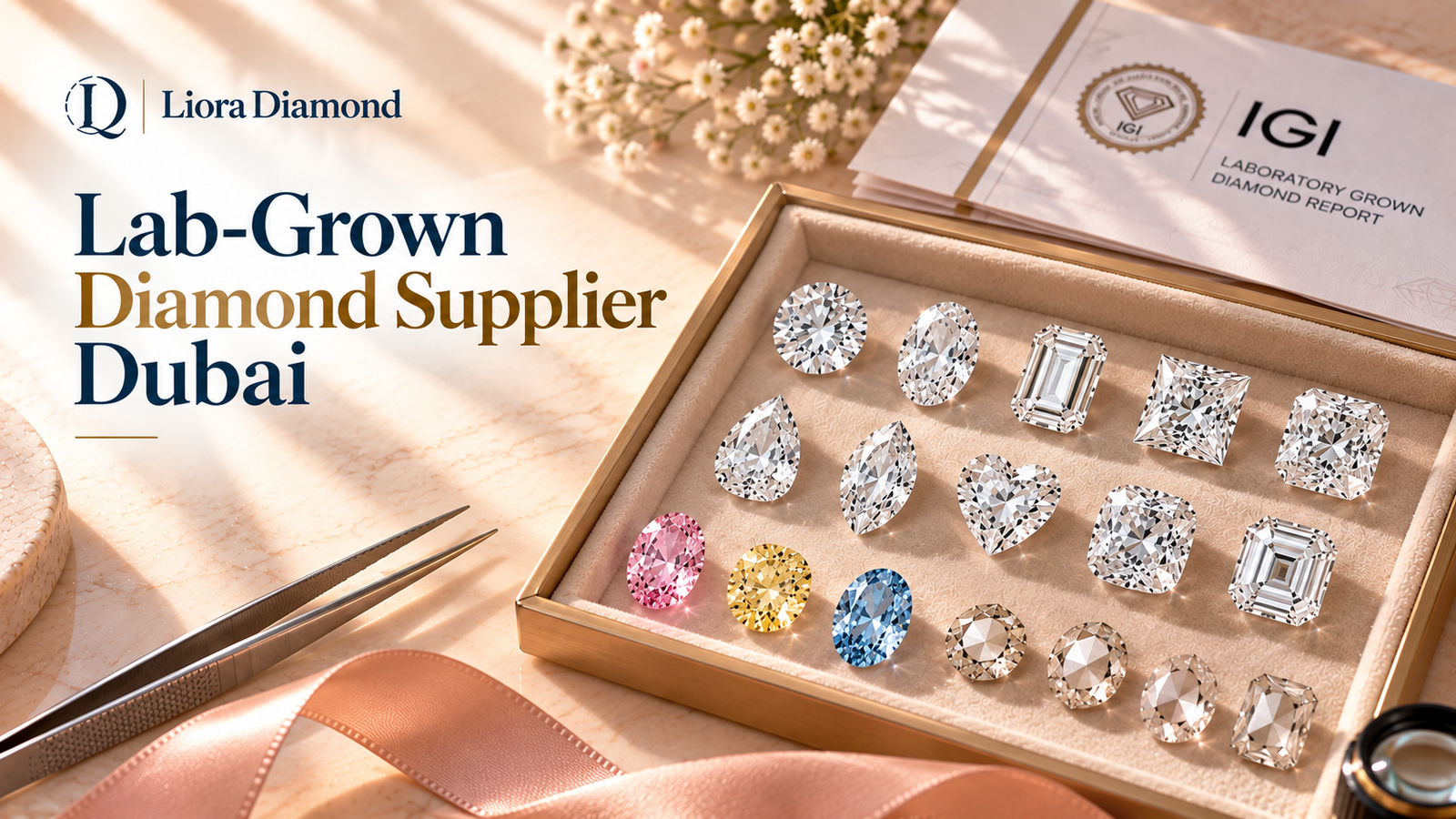
Dubai jewelry retailers rarely buy lab-grown diamonds the way retail customers do. A jeweler in Deira needs stones that match an existing collection. A re-exporter in a free zone needs a parcel that will survive a second round of scrutiny from the next buyer in Nairobi or Istanbul. This guide covers what a lab-grown diamond supplier serving Dubai has to deliver: paperwork that clears UAE customs, certification that survives a re-export chain, and specifications chosen for where the stone will end up.
What Should a Dubai Buyer Look for in a Lab-Grown Diamond Supplier?
A dependable supplier for Dubai should provide IGI or GIA reports matched to laser inscriptions, a clear record of where each stone was manufactured, the export documents UAE customs expects, and the ability to repeat a specification across orders. Price matters, but only after those four points are settled, because a cheap stone with a weak paper trail becomes expensive at the second sale.
Why Dubai Became a Lab-Grown Trading Hub
The UAE traded a record 76.9 million carats of lab-grown diamonds in 2025, up 91.5 percent year-on-year, with trade value rising 7.5 percent to $1.3 billion. Volumes have more than doubled since 2022, and DMCC has since established a Lab-Grown Diamond Vertical that runs separately from its natural diamond and coloured stone activity.
Read those numbers carefully. Volume nearly doubled while value grew by under 8%. Trade flows of this kind include material that is not finished, jewelry-grade polished stone, so headline carats say little about demand for polished stone. What they do confirm is that the infrastructure, banking, and logistics around lab-grown diamonds in Dubai are maturing quickly.
Two buyer types use that infrastructure differently.
Domestic jewelers and retailers buy wholesale loose lab-grown diamond stones or finished B2B jewelry for sale in the UAE. They care about consistency across a collection, fast replenishment, and reports that local customers recognize.
Re-exporters and traders buy to resell across the GCC, Africa, Europe, and South Asia. Their margin depends on documentation quality and on being able to hand a stone onward without re-grading it.
From Surat to Dubai: Duty, Tax and Paperwork
India manufactures most lab-grown polished goods, and Surat is the center of that work. The India-UAE CEPA gives Indian gem and jewelry exports duty-free access, including polished diamonds, both natural and lab-grown. Polished diamonds previously faced a 5% import tariff in the UAE. Exports of lab-grown diamonds from India to the UAE grew by 58.2 percent to US$172 million in FY2024.
The duty benefit is conditional. To claim CEPA rates, you need a preferential Certificate of Origin issued through India's eCoO system; goods that do not qualify fall back to the standard GCC rate of 5% of CIF value. UAE import VAT of 5% also applies, though its treatment can differ where goods move into or within a free zone. Confirm the exact treatment with your customs broker before quoting a landed price.
| Document | Why it matters |
|---|---|
| Commercial invoice | Must describe goods as laboratory-grown, with value and Incoterm |
| HS code and packing list | Drives duty classification and lets customs match contents |
| IGI or GIA report numbers | Must match the laser inscription on each stone |
| Certificate of Origin | Required to claim CEPA preferential duty |
| Insurance and airway bill | Proves insured, traceable transit for high-value consignments |
Dubai Customs requires commercial invoices, HS codes, packing lists, authenticity certificates for stones, and Certificates of Origin where CEPA benefits are claimed. Dealers in precious stones also fall under UAE anti-money-laundering rules, so expect suppliers to ask for your trade license and customer due diligence documents. That signals a compliant counterparty, not friction. Liora's dispatch approach is outlined in its shipping policy; ask any supplier for the equivalent.
Three Ways to Source, and What Each Costs You
| Route | Strength | Limitation |
|---|---|---|
| Direct from a Surat manufacturer | Widest range, parcel and make-to-order access, price close to source | Longer lead time, you manage import paperwork |
| Dubai-based stockist | Immediate viewing, single stones, no import step | Extra margin layer, narrower specification range |
| Online B2B listing platforms | Fast comparison of many sellers | Variable seller quality, harder to secure repeat matching |
A workable split for many trade buyers is a Dubai stockist for urgent single stones from a wholesale fancy color diamonds supplier and a manufacturer relationship for parcels, calibrated sizes such as 1-carat bulk diamonds and repeat programs. The manufacturer route matters most when consistency counts, since only the source can reproduce a specification twice.
Reading a Dubai quote: What the Price Actually Covers
Two quotes for the same specification can differ by more than the headline number suggests, because the terms behind them differ. Before comparing suppliers, put each offer on the same footing.
1. Price basis
Confirm whether the figure is per carat or per stone, and whether it applies to a single stone or a parcel. Wholesale diamond trade is generally quoted in US dollars, and the dirham is pegged to the dollar, so currency risk is small, but you should still state the invoice currency.
2. Incoterm
An ex-works, FOB, or CIF price leaves different costs with you. Ask who pays freight, insurance, and any duty or VAT at the UAE border, and who carries risk in transit.
3. Grading tolerance
A quote for "G VS" should name the laboratory. A stone graded by one laboratory may not carry the same grade at another, so a lower price sometimes reflects a softer grading standard rather than a better deal.
4. Payment terms
Bank transfer before dispatch is common for a first order. Repeat buyers can ask what terms are available once they have a track record, and should agree them in writing.
Build a simple landed-cost sheet per order: stone price, freight, insurance, any duty or VAT, and your broker's fee. Comparing landed cost per carat across three suppliers usually shows the real gap faster than comparing list prices.
Specifications to Lock Before Requesting Stock in Lab-Grown Diamond Wholesale Dubai
1. Shape
Round stones are the easiest to move down a trade chain because grading and pricing conventions are most standardized. Fancy shapes vary more in cut quality, so ask for measurements, length-to-width ratio, and video before committing. You can filter Liora's inventory by round, oval, cushion, emerald, and princess cuts. Remember that shape is the outline; cut grade describes proportions and finish.
2. Size
Larger stones behave differently from small ones in resale. If your clients ask for center stones, review certified lab-grown diamonds of 1 carat and above and confirm color and clarity on each report rather than assuming a size band implies a grade. Liora also deals in large carat-weight diamonds, ranging from 3 to 40 carats in any shape. Manufacturers buying melee need calibrated sizing and parcel matching, which is a specification conversation, not a catalog one.
3. Color
Fancy color lab-grown diamonds, such as pink, blue, and yellow, require separate sourcing. Reports usually state whether post-growth treatment was applied, and that line affects how you should describe the stone to your buyer. Start with fancy color lab-grown wholesale diamonds and ask for color grade, intensity, and treatment notes together.
4. Growth method
CVD and HPHT are both real diamond production routes. CVD builds a crystal from a carbon-bearing gas onto a seed plate, while HPHT uses high pressure and temperature with a metal catalyst. The report states which process was used and notes post-growth treatment, since HPHT is sometimes applied to CVD stones to improve color. Find information for HPHT diamond suppliers and CVD lab-grown diamond suppliers. Buyers with strict specifications should state a preference in their inquiry rather than discover it in the report.
5. Budget stones
To scan entry-level supply, sort by lowest price. Compare like with like, because two stones at the same price can differ in cut grade, fluorescence, and eye-cleanliness.
Certification and Disclosure Across a Re-export Chain
1. IGI and GIA reports are the working standard in wholesale lab-grown trade.
Filter for IGI-certified lab-grown stock if your customers expect it, and confirm each report number on the laboratory's own website before payment. The laser inscription should carry the report number and identify the stone as laboratory-grown. The report also records the growth method, CVD or HPHT, which some buyers specify.
2. Disclosure needs to hold at every hop.
DMCC's decision to build a separate lab-grown platform reflects how the market now treats the two categories, and your own practice should match: keep lab-grown parcels physically and administratively apart from natural stones, and describe them as laboratory-grown on every invoice and memo.
3. Origin needs the same care.
Where a stone was cut and polished can affect duty when it is re-exported to a third market. Trade commentary in 2026 noted that US tariff exposure depended on where a diamond was polished, not where it was certified or shipped from. Rules of this kind change, so a Dubai re-exporter should confirm current destination-market requirements before quoting and keep country-of-manufacture records for each parcel.
Vetting a Supplier Before the First Order
- Ask for a stone list with report numbers, then verify a sample on the grading laboratory's site.
- Request images and video for a few stones, including fancy shapes, and check dimensions against the report.
- Confirm the paperwork set the supplier issues with each shipment, including origin documentation for CEPA.
- Clarify insurance and dispatch responsibility, and who bears risk at each stage.
- Test repeatability with a small second order to the same specification before scaling.
- Check make-to-order terms, including realistic lead time and how substitutions are handled.
Where Liora Diamond Fits
Liora Diamond operates from Surat and supplies certified lab-grown and natural loose diamonds to wholesalers, retailers, manufacturers, and jewelry brands. The Shah family has worked in the diamond trade since the 1970s. Stones are IGI- and GIA-certified and laser-inscribed, and buyers can browse live inventory of certified loose diamonds or request make-to-order stones, which typically take about four to six weeks. Shipping is insured and worldwide, with customs documentation supplied. Confirm current stock, pricing, and lead times with the sourcing team, since these change.
Visit our lab-grown wholesale diamonds for UAE page for complete details.
Conclusion
Dubai rewards buyers who treat paperwork and specifications as seriously as price. Choose a supplier whose documents clear customs and whose reports hold up at the next sale. Then lock your specification before asking for a quote. If you are ready to source, submit your requirements to the B2B team and request wholesale pricing.
FAQ
1. Is there import duty on lab-grown diamonds from India into the UAE?
Polished diamonds from India can enter duty-free under the CEPA when you present a valid preferential certificate. Without it, the standard GCC rate of 5% may apply, and 5% VAT is generally charged. Your customs broker should confirm treatment for your specific entry route.
2. What license does a Dubai buyer need to import loose diamonds?
An importer needs a valid trade license covering the relevant activity, from a free zone such as DMCC or from the mainland authority, and precious-stone dealers must meet UAE anti-money-laundering registration and due diligence duties. Check the requirements with your licensing authority.
3. Should I ask for IGI or GIA on lab-grown stones?
Either is accepted in trade. IGI is the more common standard for lab-grown wholesale, while GIA suits buyers whose end customers specifically ask for it. Decide once, per program, so parcels stay comparable.
4. Can I order calibrated sizes or specific parcels?
Yes, we can source custom specifications on a make-to-order basis. Send target sizes, shape, color, clarity, and report preference so the sourcing team can confirm feasibility and timing.
5. How should I compare quotes from different lab-grown diamond suppliers?
Convert each offer to landed cost per carat, including freight, insurance, duty, VAT, and broker fees. Then confirm that the grading laboratory, color, clarity, cut grade, and fluorescence match. Quotes that differ on any of those are not comparable.