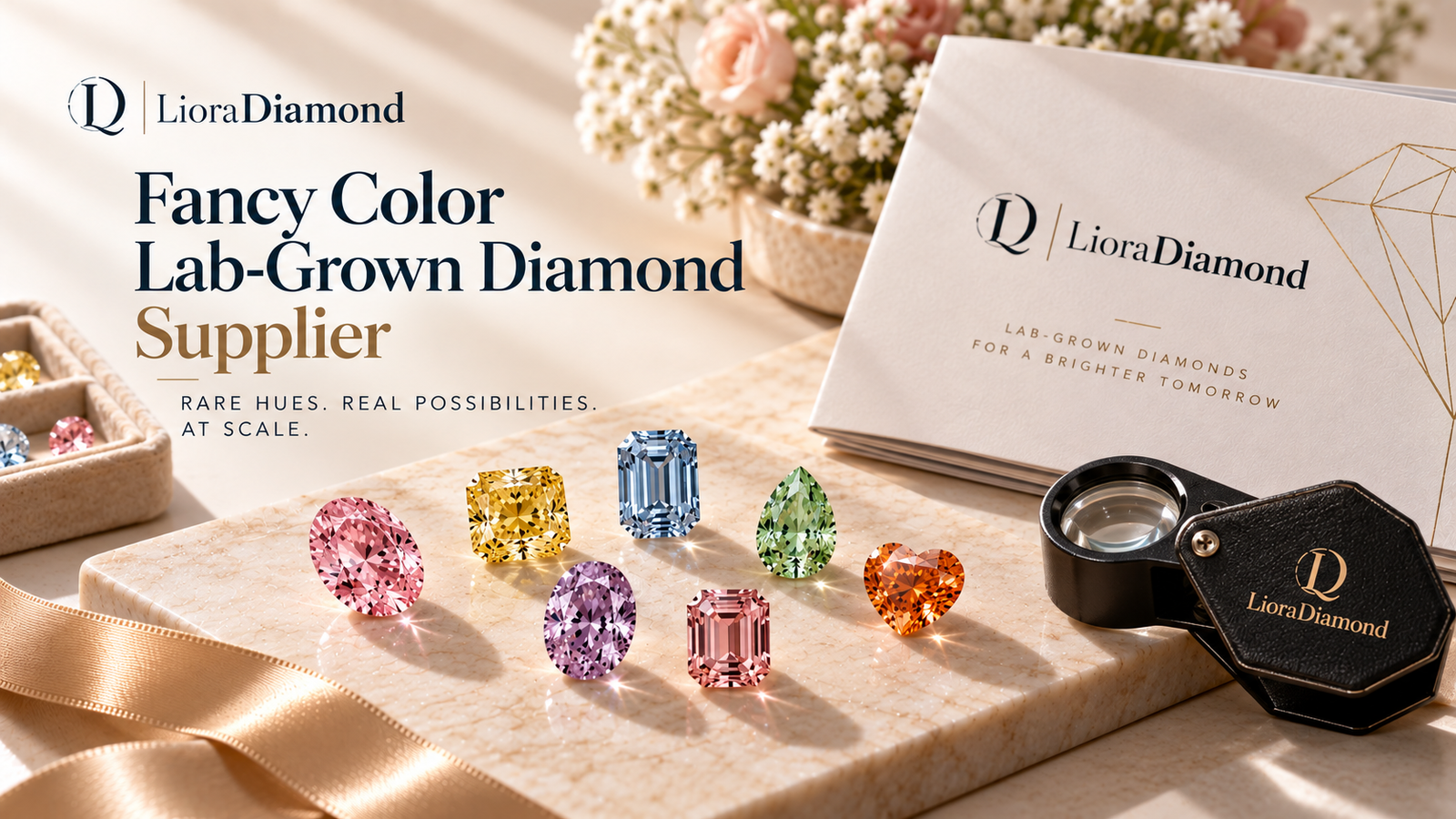
Explore how to source fancy color lab-grown diamonds at scale, from vivid pinks to blues and yellows. This buyer-focused guide covers quality, consistency, certification, and bulk sourcing, with Liora Diamond as a B2B partner for jewelers worldwide.
Finding one fancy pink or blue lab-grown diamond is easy. Finding forty that sit in the same hue, tone, and saturation band, arrive with matching reports, and can be reordered next quarter is the real sourcing problem. That gap separates a listing from a genuine fancy color lab-grown diamond supplier.
This guide is for jewelers, bridal designers, e-commerce brands, and manufacturers buying colored lab-grown stones in volume. It covers how the colors are produced, what a grading report must disclose, how to hold color consistency across parcels, and what to compare when quotes arrive.
What Should You Look for In a Fancy Color Lab-Grown Diamond Supplier?
1. First, look for independent grading reports (typically IGI) that state color grade, growth method, and any post-growth treatment.
2. Then add live inventory you can filter by color, shape, and carat; written color tolerances for matched or made-to-order stones; and a clear process for repeat orders.
3. Price matters, but disclosure and consistency decide whether a parcel sells at the margin you planned.
Which Fancy Colors Can You Source, and How Are They Made?
Fancy color lab-grown diamonds are diamonds: carbon in a cubic crystal lattice, grown by CVD or HPHT. They are not simulants such as cubic zirconia or moissanite. Color comes from a controlled impurity or a lattice defect, and the route determines what you should ask a supplier to disclose.
| Color | Typical color mechanism | Growth-stage or post-growth? | What to confirm |
|---|---|---|---|
| Yellow | Nitrogen in the lattice | Commonly as-grown | Intensity grade and hue modifier |
| Blue | Boron incorporated during growth | Growth-stage doping | Tone match across stones |
| Pink | Nitrogen-vacancy centers | Commonly processed after growth | Treatment statement on the report |
| Green, orange, others | Varies by producer | Varies | Range on request; often sourced to order |
Post-growth treatment is not a flaw. HPHT diamond supplier processing is an established way to produce stable color, and GIA notes that its laboratory-grown reports state both the growth method and any post-growth treatment. The commercial risk is undisclosed treatment. A pink diamond priced as if it were as-grown but processed afterward invites disputes with your own customers. This is why lab-grown pink diamond wholesale deserves the closest report scrutiny of any color.
How Are Fancy Color Lab-Grown Diamonds Graded?
Compared to white color diamonds, fancy color stones are graded on color presence, not the D-to-Z absence scale used for white diamonds. IGI describes grading hue, tone, and saturation, plus how evenly color is distributed. On GIA's colored diamond scale, grades rise from Fancy Light through Fancy, Fancy Intense, and Fancy Vivid, with Fancy Dark and Fancy Deep alongside. Fancy Intense and Fancy Vivid generally command the higher prices.
A report worth buying should show:
1. Color grade with hue and modifiers. A pink with an orangey or purplish modifier is a different product from a pure pink.
2. The growth method the diamond supplier used: HPHT or CVD.
3. A treatment statement, or an as-grown note.
4. Carat weight, clarity, cut grade, and shape.
5. A laser inscription number that matches the stone.
Diamond cut grade is handled differently. Colored diamonds are usually cut to maximize face-up color rather than light return, so the "Excellent cut" filter you apply to white stones is the wrong screen here. Judge by face-up color in per-stone photos and video. For more on report types, browse IGI-certified lab-grown diamonds directly.
How Do You Keep Color Consistent Across a Parcel or Repeat Order?
A grade band is wide. Two Fancy Intense pinks can differ visibly in tone, and stones from different growth runs can differ within the same grade. Buying by grade alone is how mismatched pairs happen.
1. Write the spec as a range plus a modifier tolerance. For example: "Fancy Intense to Fancy Vivid, pink, no brownish modifier."
2. Request a per-stone photo or video under consistent lighting, not catalog imagery.
3. For pairs, halos, and three-stone sets, ask the supplier to match by eye before dispatch and agree in writing what happens on a mismatch.
4. Keep report numbers of stones that sold well and cite them as the benchmark on the next order.
5. Treat colored melee the same way. Match the whole parcel by hue and saturation, not by the average.
Manufacturers buying colored melee for pavé, halo, and accent work face a slightly different problem: hundreds of small stones must read as one color. Ask for calibrated sizing by millimeter range, specify a hue and saturation band rather than a single grade, and approve a sample drawn from the actual parcel before committing volume. Melee is often sold without individual reports, so a written parcel description and tolerance replace per-stone documentation.
Diamond size changes appearance too. The same body color reads stronger in a larger stone, so a 0.30 ct and a 2 ct stone cut from similar material can grade differently. Specify by target grade rather than "same as last time." For statement pieces, start with fancy color stones at 1 carat and above, where the grade is easiest to judge.
Which Shapes Suit Fancy Color Stock?
Shape changes how color reads face-up, so stock decisions should follow the design you plan to sell.
1. Oval and cushion: These shapes are common choices for pink and yellow bridal and halo designs. Oval also tends to show a larger face-up area than round at the same carat weight.
2. Emerald cut: The diamond's elongated shape has step facets that clearly show color evenness. That rewards even stones and exposes zoning, so inspect video before committing.
3. Round: The round diamond is the standard for stacked, pavé, and accent work, and most buyers already know how to specify the shape.
4. Princess: The princess diamond cut fits well with square-profile settings and channel work.
5. Radiant: Radiant-cut diamonds are considered a fancy shape used in solitaire and other popular ring settings, like bridal sets and pendants.
6. Marquise: For a woman's tennis bracelet or diamond stud earrings, marquise-cut loose diamonds are usually suitable because of their sharp edges.
7. Pear: Pear-shaped lab-grown diamonds are becoming the next popular choice for hoop earrings, layered necklaces, and rings the younger generation prefer.
Remember, shape is the outline, and cut is the faceting quality. A fancy color wholesale diamond supplier may list a stone as "cushion" while its proportions vary widely, so ask for measurements and depth alongside the grade.
Should You Buy Ready Stock or Make to Order?
Ready stock suits replenishment and bridal orders where a customer is waiting. You see the exact stone, approve it, and ship. Made-to-order in fancy color wholesale purchase suits specification-driven work: a defined hue, a calibrated size, or a matched set that current stock cannot supply.
The trade-off is time and certainty. Made-to-order means committing to a specification before you see the finished stone, so tighten the tolerance, ask for interim photos, and agree on what happens if the result falls outside the range. At Liora Diamond, made-to-order typically takes about 4 to 6 weeks, which matters when you plan collection launches or seasonal peaks. A sensible pattern is to test demand for a color with ready stock, then use made-to-order to fill a line that has proven itself.
What Should You Compare When Requesting Wholesale Quotes?
Per-carat pricing for fancy colors moves with color, intensity grade, carat weight, clarity, shape, report, and treatment status. Two quotes are comparable only when all of those match. A cheaper Fancy Light stone quoted next to a Fancy Vivid one tells you nothing.
A practical way to benchmark is to sort live color lab-grown diamonds by price, then compare each stone against its grade, modifier, and report instead of the headline number. Wholesale value, retail price, and resale value are separate figures, so build your margin from the wholesale quote and your own market.
When you buy round, princess cut, or cushion-shaped fancy color lab-grown diamonds in bulk, also ask:
1. Does per-carat pricing change with parcel size?
2. Is the stone ready stock or made to order, and what is the lead time?
3. What are the payment terms, and what are the mismatch or return terms?
4. Is shipping insured, and does the supplier provide customs documentation?
What Should a First-Order of Fancy Color Diamond Checklist Include?
Before a first order, confirm each of these in writing:
1. The grading lab and that each inscription matches its report.
2. Treatment status per stone.
3. Color tolerance for the parcel.
4. Photo or video for every stone.
5. Ready-stock versus made-to-order timing.
6. Mismatch and return terms.
7. Insured shipping and export paperwork.
8. How repeat orders will reference earlier report numbers.
What Mistakes Do Buyers Make with Fancy Color Diamond Parcels?
1. Comparing across intensity grades. Fancy Light and Fancy Vivid are different price tiers, not variants of one product.
2. Ignoring modifiers. "Pink" without the modifier can cover several visibly different hues.
3. Skipping the treatment line. It affects how you describe the stone to customers.
4. Applying white-diamond cut filters. These screen out stones cut for color.
5. Ordering a full parcel unseen. A small test order or approval on a sample stone costs little and confirms the supplier's matching standard.
How Can Liora Diamond Support Fancy Color Sourcing?
Liora Diamond is a wholesale diamond supplier serving jewelry retailers and manufacturers. Buyers can filter fancy color lab-grown diamonds by shape, carat, report, and price within the wider certified loose diamond inventory. Certified stones are laser-inscribed, shipping is insured worldwide, and we provide documentation for customs clearance.
Liora Diamond certification range for fancy color stones starts from 1 ct to 15 ct+. Availability and lead times change, so confirm both when you send a requirement.
To discuss a parcel, submit your specifications and request wholesale pricing, including color, grade range, shape, size, and quantity.
Conclusion
Sourcing fancy colors at scale comes down to specification discipline. Define the grade range and modifier, require disclosure of growth method and treatment, verify matching before dispatch, and benchmark every quote against comparable grades. A supplier who welcomes those checks is one you can reorder from. For a first inquiry, send one color, one grade range, and a quantity band. It is the fastest way to see whether a supplier can hold a specification before you scale the order.
FAQ
1. Are fancy color lab-grown diamonds real diamonds?
Yes. They share the crystal structure and physical properties of mined diamonds but differ in origin, as stated in the grading report. Cubic zirconia and moissanite are simulants, not diamonds. Liora Diamond's natural vs. lab diamonds guide covers the wider comparison.
2. Is the color permanent on the diamond?
Color produced during growth, or through established HPHT processing, is stable under normal jewelry wear. Ask for the treatment statement on the report so you know exactly which process was used.
3. Which lab should certify fancy color stones for wholesale?
IGI reports are the common trade standard for lab-grown stock, and GIA is also widely recognized. Treat a grading report as a procurement requirement, and confirm that the growth method, treatment, and color grade are all stated.
4. What is the minimum order for wholesale fancy color diamonds?
Minimums vary by supplier and by whether stones are ready stock or made to order. State your quantity and specifications in the inquiry and ask for terms in the quote.
5. Does Liora Diamond allow shipping wholesale lab-grown diamonds to the US or other countries?
Yes, Liora Diamond ships loose lab-grown diamonds to the United States of America and worldwide, with secure shipping and complete documentation.