Buy 1 Carat Lab-Grown Diamond Wholesale: Pricing, Quality & Sourcing Tips
Discover how to buy 1-carat laboratory-grown diamonds wholesale with insights into pricing, diamond quality, certification, and reliable sourcing. Learn what to look for when comparing suppliers, evaluating wholesale costs, and selecting diamonds that meet your business needs.
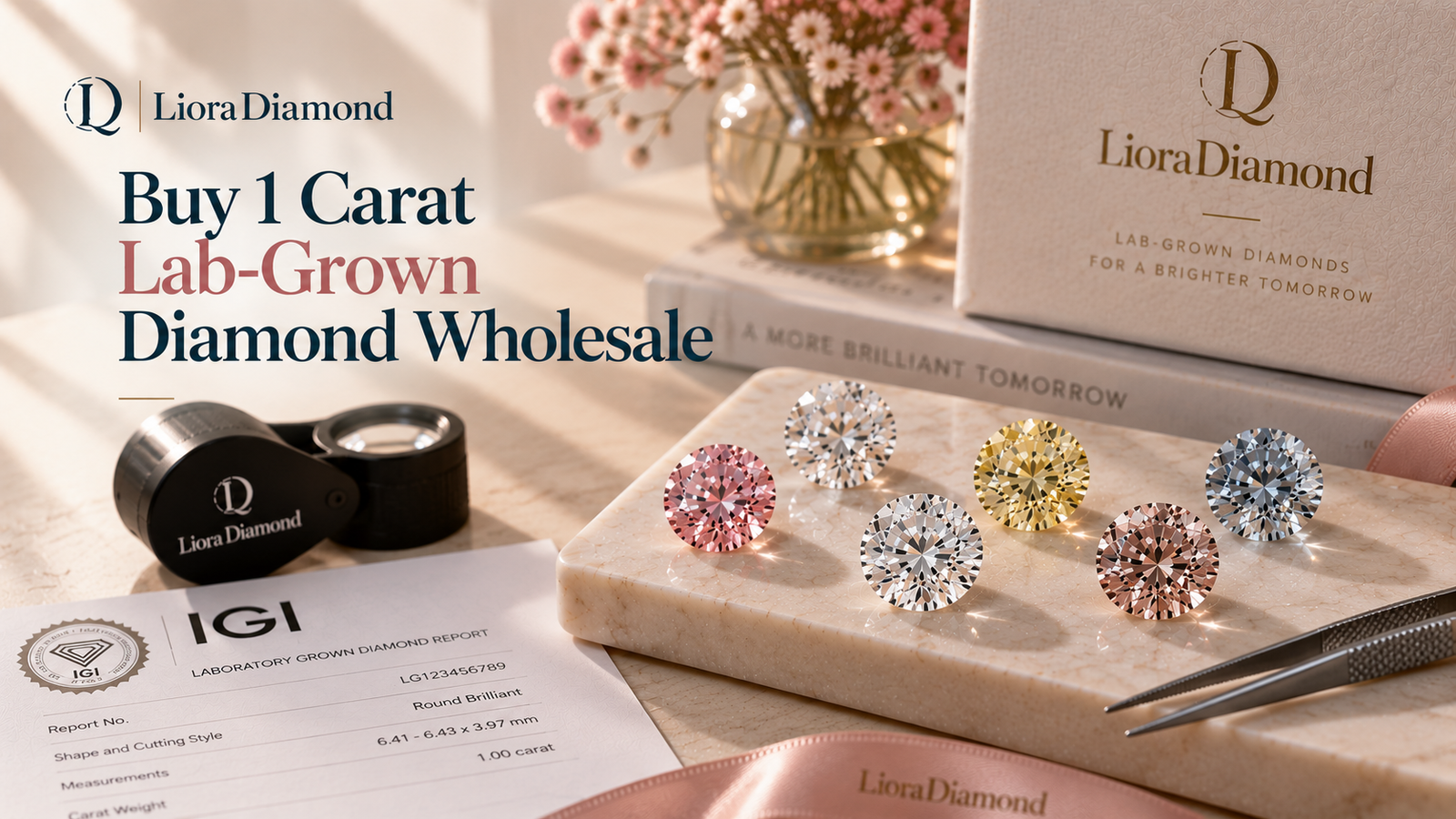
Most B2B buyers who search "1 carat lab-grown diamond wholesale" aren't actually placing a one-stone order. They're using that search as an entry point into a much wider procurement decision — building a size curve, testing a supplier, or scoping a parcel that also needs to cover melee, fancy shapes, and increasingly, supplying fancy color diamond stock. Treating a 1 carat inquiry as an isolated transaction is the first mistake most new buyers make, and it's usually the reason their first order underperforms on margin.
This guide covers what actually determines wholesale price at 1 carat, the adjacent research every serious bulk buyer does before ordering, and how to structure a first order so it sets up a repeatable and trustable wholesale lab-grown diamond supplier relationship rather than a one-off purchase.
Direct Answer: What Determines 1 Carat Wholesale Price?
Price at 1 carat is set by cut, color, clarity, and shape — in that order of impact on visual performance — with certification lab (IGI is the wholesale standard) acting as a non-negotiable baseline rather than a price lever. Commercial-grade stock (G–H color, VS1–VS2 clarity, Excellent cut) delivers the strongest cost-to-eye-clean ratio for resale. Because lab-grown production output and per-carat pricing move with supply conditions, treat any figure you see online as a reference point and request a current specification quote before committing.
Why "1 Carat" Is Rarely the Whole Order
Buyers researching this weight are almost always cross-shopping several related decisions at once, and suppliers who only answer the narrow question miss the chance to build a real account.
- A retailer stocking a bridal collection needs a 1 carat anchor stone, but also needs a supply of calibrated melee for pavé settings and side stones.
- A manufacturer building a fancy-shape line is comparing 1 carat round pricing against oval, cushion, and pear at the same weight to see where the margin actually sits.
- A private-label brand testing lab-grown for the first time is often quietly evaluating fancy color diamond inventory alongside standard white stock, because fancy color has become one of the fastest-growing categories in lab-grown wholesale demand and carries different pricing logic entirely.
If your research is genuinely just about 1 carat white stock, it's still worth comparing adjacent weight brackets before locking in a specification — 0.50 carat, 1.5 carat, 2 carat, and 3 carat and above all move differently on a per-carat basis, and a buyer who understands the whole curve negotiates from a stronger position than one anchored to a single weight.
What Bulk Buyers Actually Research Before They Order
Before placing a wholesale order for lab-grown diamonds, experienced buyers typically work through a cluster of related questions that 1-carat pricing alone won't answer. Knowing this cluster is often more useful than the headline number itself:
1. Parcel pricing structure — how price per carat changes when ordering a matched parcel versus a single stone
2. Matched parcels and pair matching — how suppliers guarantee color and clarity consistency across multiples, critical for stud earrings, eternity bands, and tennis bracelets
3. RFQ process — what information a supplier needs (shape, size range, color/clarity tolerance, quantity, delivery window) to return an accurate quote rather than a generic price list
4. Make-to-order lead time — the gap between ready-stock availability and custom specification orders, typically several weeks longer. The lab-grown diamond growing process CVD and HPHT also takes time to create the stone.
5. Fancy color diamond pricing logic — why fancy color lab-grown stones (pink, blue, brown, green, black, purple, orange, and yellow) don't follow the same D-to-Z pricing scale as white diamonds and require separate benchmarking
5. Calibrated melee tolerances — acceptable size variance when ordering small stones in volume for setting work
6. Wholesale price benchmarking — how to double-check a quote against current market movement rather than a static number from an old article
7. Import documentation — what paperwork accompanies a shipment for customs clearance in the buyer's destination country
A supplier who can speak fluently to all of these, not just headline carat pricing, is generally a better long-term fit than one who only quotes on request.
Pricing Mechanics: Cut, Color, Clarity, and the Trade-Offs Between Them
1. Cut Sets the Ceiling on Perceived Size
Diamond cut quality has more influence on how large and bright a 1-carat stone appears than any other factor, yet it's the one most buyers underweight relative to color and clarity. An Excellent or Ideal cut returns significantly more light than a Good or Fair cut at identical weight, and poor cut quality is the single most common source of retail returns and customer disappointment — more so than a marginal clarity difference the eye can't detect.
2. Color Is Where Most Commercial Margin Sits
D–F color is the highest-cost tier and typically reserved for premium bridal or clients explicitly requesting colorless stock. G–H color is the commercial center of gravity — it reads colorless in white gold and platinum settings and offers retailers the best margin-to-perception ratio across a broad catalog. I–J remains usable for yellow gold work where warmth is less visible, provided it's disclosed accurately rather than sold as premium-grade.
3. Clarity Beyond VS Is Often Wasted Spend
VVS1–VVS2 clarity carries a real price premium for inclusions that are invisible without 10x magnification — money spent on a grading label rather than a visual outcome. VS1–VS2 is the practical commercial standard. SI1 can still be eye-clean depending on inclusion type and position. Still, it demands stone-level verification rather than a blanket parcel purchase, since SI clarity varies more widely stone to stone than any other grade band.
Lab-Grown Diamond Shape Economics at 1 Carat
| Shape | Rough Yield Efficiency | Typical Per-Carat Position vs. Round |
|---|---|---|
| Round | Lowest | Highest cost — benchmark price |
| Princess | Moderate | Slightly below round |
| Oval | Higher | Below round; strong face-up size |
| Cushion | Higher | Below round |
| Emerald | Higher | Below round; clarity more visible |
| Pear / Marquise / Heart | Highest | Lowest per-carat cost among standard shapes |
This table is a planning reference, not a live price sheet — shape demand shifts with retail trends, so verify current spread against your target margin before finalizing a purchase order.
Diamond Certification: The One Line Item You Shouldn't Negotiate On
IGI functions as the working wholesale standard for lab-grown diamonds, and buyers increasingly ask for it by name rather than accepting a supplier's internal grade. Every IGI-certified wholesale lab-grown stone should carry a laser inscription that ties the physical diamond to its report number — this is what protects you during a resale dispute or a customs inspection. It's an easy detail to overlook when a quote looks attractive on price alone.
Building a Balanced First Order Instead of a Single-Stone Purchase
Buyers who get the most value from a new supplier relationship rarely start with a single 1 carat request. A stronger opening order typically blends a core weight (1 carat), a secondary weight for accent work, one or two fancy shapes to test margin against round, and — where the catalog supports it — a small fancy color allocation to gauge customer response without committing significant capital. This approach gives you real pricing and quality data across categories in a single transaction, rather than repeating the sourcing process from scratch for every new specification.
Avoid These Mistakes on Wholesale Diamond Purchase
- Ordering purely on carat weight and clarity while ignoring cut quality is the most frequent error, and it produces stones that underperform visually against their stated size.
- A close second is treating every IGI-certified 1 carat quote as interchangeable — color, clarity, and cut combinations within the same lab can shift wholesale cost substantially, so a low quote without full specification detail should raise questions rather than close the deal quickly. For example, HPHT lab-grown diamond supplier and CVD lab-grown diamond supplier.
- Buyers also frequently skip customs and documentation questions until after payment, which creates avoidable delays on international shipments.
How Liora Diamond Can Help
Liora Diamond supplies IGI-certified lab-grown and natural loose diamonds across standard and fancy shapes, with live inventory, laser-inscribed stones, and parcel matching built for repeat B2B ordering. Buyers expanding beyond standard white stock can review current fancy color lab-grown diamond availability across 15+ countries, including the USA, UK, UAE, Canada, Japan, Hong Kong, Singapore, Switzerland, etc.
Ready to Source 1 Carat Lab-Grown Diamonds?
Specifications and pricing shift with supply, so the most reliable way to plan an order is against current stock. Request wholesale pricing and submit your specifications directly to Liora Diamond's B2B team.
FAQ
1. What's the real difference between a "1 carat quote" and a "wholesale parcel quote"?
A single-stone quote reflects one diamond's specification; a parcel quote reflects a matched set with defined color/clarity tolerance across multiple stones, which usually carries a different per-carat structure than buying stones individually.
2. Should I ask for fancy color pricing separately from white diamond pricing?
Yes — fancy color lab-grown diamonds are priced on hue, saturation, and intensity rather than the D-to-Z white diamond scale. Hence, they need to be quoted and evaluated on their own terms, including 4C diamond grades.
3. How long does a make-to-order 1 carat specification typically take versus ready stock?
Ready stock ships immediately from existing inventory, while make-to-order specifications generally require a multi-week production window—confirm the exact timeline with your supplier before it affects a launch date.
4. What documentation should accompany an international wholesale shipment?
At minimum, a laser-inscribed IGI certified wholesale diamond, an invoice with per-stone value breakdown, and customs documentation appropriate to the destination country — confirm specifics with your supplier before shipping.
5. Is it worth ordering across multiple shapes in a first order rather than just round?
Generally yes — comparing shapes in the same order gives you real cost and sell-through data to plan future purchasing, rather than sourcing each shape separately later.