5 to 30 Carats Large Pink Lab-Grown Diamonds for the Wholesale Trade
This trade guide explains how jewelers and high-jewelry brands can source large pink lab-grown diamonds from 5 to 30 carats, compare Fancy Intense and Fancy Vivid grades, evaluate shapes, understand color treatment and disclosure, match pairs, and request a precise shortlist from Liora Diamond.
If you buy pink laboratory-grown diamonds for wholesale or resale, the hard part is rarely finding a pink stone. It is finding a pink stone above 5 carats, at the intensity your client expects, with a grading report that discloses how the color was produced, and, when the design needs it, a second stone that matches.
This guide is for jewelers, high-jewelry designers, and online brands sourcing large pink lab-grown diamonds for the trade. It covers how intensity grades behave at size, how lab-grown pink color is produced and disclosed, which shapes are realistic above 5 carats, how pairs are matched, and what to send us to get a shortlist of real stones.
Why Large Pink is the Busiest Big-Stone Category
Pink is the deepest part of Liora's big-stone catalog. The live catalog listed about 130 pink laboratory-grown diamonds at 5 ct and above, more than nine in ten with IGI reports. The largest was a 30.16 ct Fancy Intense Pink pear, followed by a 30.08 ct Fancy Intense Pink cushion and a 25.07 ct Fancy Intense Pink heart.
| Carat band | Pink stones listed |
|---|---|
| 5.00–9.99 ct | 91 |
| 10.00–19.99 ct | 30 |
| 20.00–29.99 ct | 5 |
| 30 ct and above | 3 |
That depth matters for trade buyers for three reasons:
1. Choice at size. Above 10 carats, most suppliers can show a handful of stones at best. A deeper pink range means you can compare several candidates by intensity, shape, and proportions before committing.
2. Matching becomes possible. Pairs and suites need two or more stones that read as one color. A larger pool of similar stones is what makes matching realistic.
3. Faster shortlists. When a requirement can be met from listed stones, the shortlist step is about selection, not growing to order.
Stock changes daily. Treat every figure in this guide as a snapshot and ask the trade desk for what is available on the day you enquire.
Fancy Light vs Fancy Intense vs Fancy Vivid at Size
Fancy-color grades describe the strength and depth of color seen face-up. Grading labs use a scale that, for pink, typically runs from Faint and Very Light through Fancy Light, Fancy, Fancy Intense and Fancy Vivid, with Fancy Deep and Fancy Dark describing darker tones. The grade on the report, not a photo or a listing title, is what you should quote against.
| Grade | How it reads face-up | Typical trade use at 5 ct+ | Pink stones listed at 5 carat+ |
|---|---|---|---|
| Fancy Light | Soft, pastel pink | Bridal and softer statement pieces | 4 |
| Fancy | Clear, moderate pink | Versatile center stones; easier to match across a suite | 5 |
| Fancy Intense | Strong, saturated pink | Statement rings and pendants where color carries the design | 55 |
| Fancy Vivid | Very strong, bright pink | High jewellery and showpieces | 65 |
| Fancy Deep | Rich, darker pink | Designs that favor depth over brightness | 0 |
At size, most of Liora's listed pinks are Fancy Intense or Fancy Vivid, which is also what most trade buyers order because those grades read clearly as color in a setting. About a dozen carry a modifier in the grade, such as orangey pink or brownish pink.
Size changes how a grade looks.
A larger stone shows more body color because light travels farther through it, so two stones with the same grade can look different at 5 carats and 20 carats. Diamond cut grade matters too: elongated shapes such as pears and ovals often show color concentrated at the tips, while hearts and cushions can spread it more evenly.
Practical advice for big pinks laboratory-grown diamonds:
1. Specify a grade range (for example, Fancy Intense to Fancy Vivid) rather than a single grade. It widens the shortlist without diluting your brief.
2. State any secondary hue you will or will not accept, such as purplish pink or orangy pink. Modifiers change both look and price.
3. Ask for daylight video, not only studio photos. Screens shift pink noticeably, and a video under neutral light is the closest substitute for seeing the stone.
How Lab-grown Pink is Produced and Disclosed
Most strongly colored pink lab-grown diamonds get their color after growth, not during it. GIA research on pink CVD diamonds describes color produced by nitrogen-vacancy (NV) centers, created through a sequence of high-pressure high-temperature (HPHT) annealing followed by irradiation and lower-temperature annealing (GIA, Gems & Gemology). For pink lab-grown diamonds, post-growth treatment is the norm, not the exception.
For a trade buyer, what matters is disclosure:
1. Read the report comments.
Grading reports for lab-grown diamonds state laboratory-grown origin and record post-growth treatment where it applies. Liora's invoice states the treatment too, so your own disclosure is straightforward. Check the report number on the lab's website before you invoice a client (why IGI certification matters for wholesale buyers).
2. Pass the disclosure on.
Your invoice and product page should carry the same origin and treatment wording as the report. Consumer-protection rules in many markets require it, and it protects you in a dispute.
3. Do not describe pink lab-grown as "natural color".
The diamond is a real diamond; its color origin is laboratory-grown and, typically, post-growth treated. Growth method (CVD or HPHT) is a specification, not a quality ranking. If your client needs a specific method, put it in your request and we will filter for it.
Diamond Shapes Available Above 5 Carat Wholesale
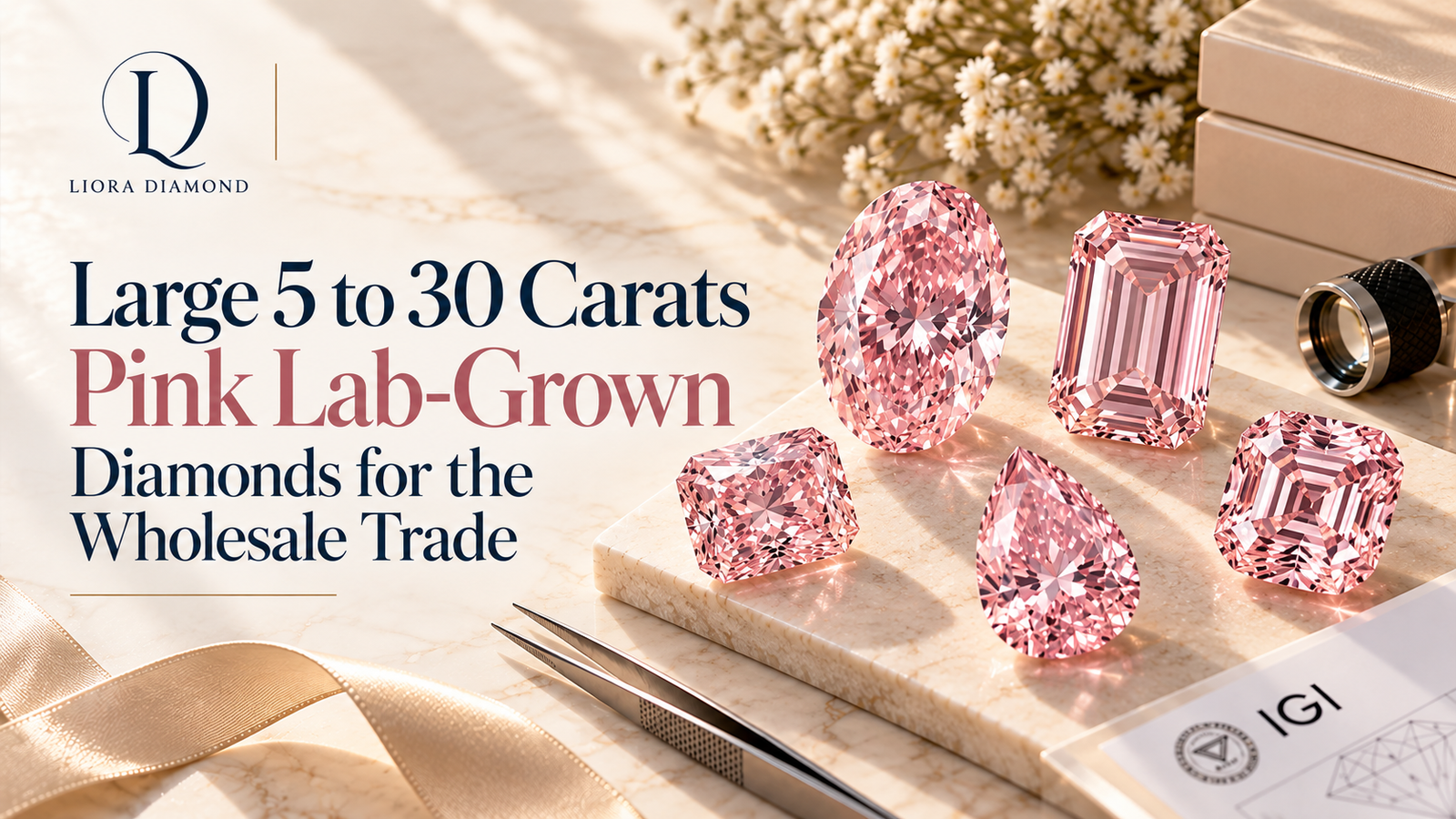
Hearts dominate Liora's large pinks: 57 of the roughly 130 stones listed at 5 carats+. Lily cuts (19), pears (18), ovals (14), cushions (10), radiants (8), and Portuguese cuts (3) made up the rest. A 21.16 ct Fancy Intense Pink cushion, a 21.10 ct Fancy Vivid Pink pear, and a 10.00 ct Fancy Vivid Pink radiant.
How each shape behaves in a large pink:
| Shape | Strengths at 5 ct+ | What to check |
|---|---|---|
| Heart | Romantic, high-recognition statement shape; the deepest pink range | Symmetry of the lobes and cleft; ratio close to 1.00 |
| Pear | Long face-up spread; pendants and drops | Color concentration at the tip; length-to-width ratio; bow-tie |
| Lily cut | Distinctive floral outline for fashion and high-jewelry lines | Setting fit — prongs must suit the petal points |
| Oval | Elongates the finger; good spread | Bow-tie and ratio |
| Cushion | Holds color evenly; classic high-jewelry center | Depth percentage; whether it faces up smaller than its weight |
| Radiant | Brilliant faceting with corners that protect the stone | Depth and corner condition |
If your design is flexible, say so. Allowing two or three shapes in a request can turn up a better color at your budget than insisting on one.
Matching Pinks for Pairs and Suites
Matching two large pinks is harder than matching two whites because hue, intensity, tone, and secondary color must all align. A pair that matches on paper can still look mismatched side by side.
When you request a pair, tell us:
1. The application. Earrings, side stones for a three-stone ring, or a suite of pendant and earrings. Earrings can tolerate a little difference; side stones beside a center stone cannot.
2. Size tolerance—for example, each stone 5.00–6.00 ct with no more than 0.30 ct between them.
3. Color tolerance—same report grade, or same grade plus the same secondary hue.
4. Shape and ratio. Mirror-image pears and hearts need close ratios to read as a pair.
Ask for candidate pairs to be filmed together in the same light, so you judge them as your client will see them. Liora matches pairs and layouts for color, size, and make. Matched availability depends on stock on the day; if no pair is listed, ask whether one can be assembled from stones in the range, or sourced to order.
Requesting a Large Pink Laboratory-Grown Diamond Shortlist
The fastest way to a useful shortlist is a precise brief. Send the trade desk:
1. Hue and modifier — pink, purplish pink, orangy pink, or "pink family, open to modifiers".
2. Intensity range — for example, Fancy Intense to Fancy Vivid.
3. Carat range — for example, 8.00–12.00 ct.
4. Shape(s) — one preferred, plus acceptable alternatives.
5. Clarity floor — the lowest clarity you will accept.
6. Report — the grading lab you need on the stone.
7. Single, pair, or suite — with size and color tolerances for matched goods.
8. Quantity and destination — how many stones, and which country they ship to.
9. Timeline — when the stone needs to be with you or your setter.
The trade desk replies with matching stones, a trade quote, video, and the grading report, and confirms availability before you pay, because stones on hold for other buyers can drop out during the day. The listed catalog is a live sample; the desk also sees incoming goods and stones held for production, and sources to order when nothing fits. Liora supplies trade buyers only, with a minimum of US$2,000 per order.
See our pink loose diamonds from 5 ct and ask for large fancy colors. Send hue, intensity, shape, size, and quantity, and the trade desk will come back with real stones.
Frequently Asked Questions
1. Is the color of lab-grown pink diamonds treated?
Usually, yes. Strong pink color in lab-grown diamonds is typically produced after growth through HPHT annealing, irradiation, and low-temperature annealing. The grading report records it, Liora's invoice states it, and you should carry the same disclosure on yours.
2. Which intensity do trade buyers usually choose for big stones?
It depends on the piece. Fancy Intense and Fancy Vivid suit statement rings and high jewellery, where color has to carry the design. Fancy and Fancy Light are easier to match across suites and suit softer, everyday designs. Requesting a range gives you more stones to compare.
3. Can you match two large pinks for earrings?
Often, depending on stock. Send the size and color tolerance you can accept, and ask for candidate pairs filmed together in the same light so you can judge the match before you buy.