Lab-Grown Diamond Supplier for Jewelry Manufacturers: What to Look For
Choosing the right lab-grown diamond supplier, such as Liora Diamond, can shape your production quality, costs, and consistency. Learn what jewelry manufacturers should look for, from calibrated melee and cross-batch matching to certification, lead times, sourcing support, and market-specific compliance.
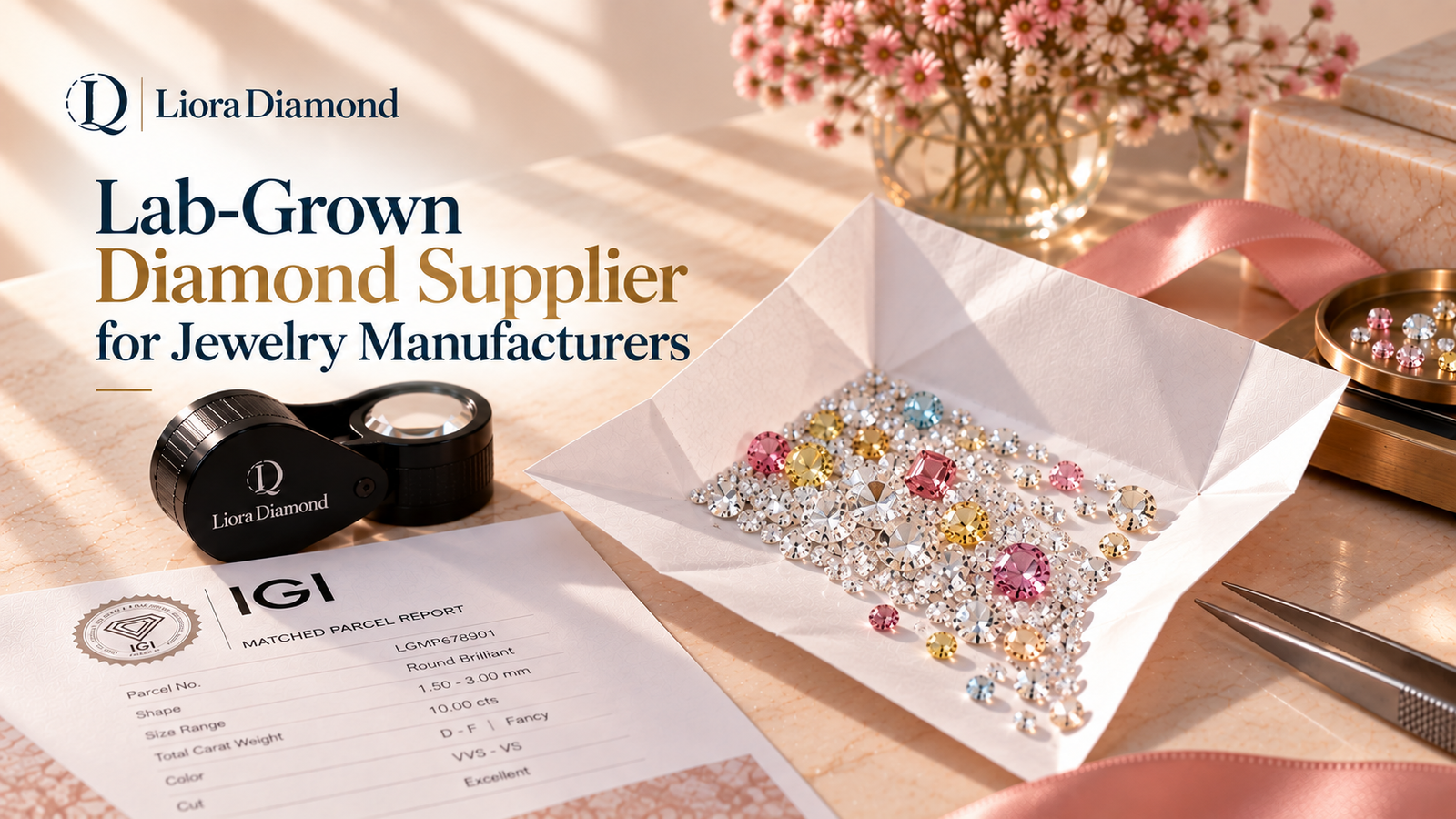
Jewelry manufacturers and retailers usually source lab-grown diamonds in bulk. They buy repeatable specifications across production runs—calibrated melee that must fit the same setting a thousand times, matched parcels that need to look identical to the batch ordered six months ago, and certification that must survive scrutiny at customs and the retail counter. Jewelry manufacturers judge a lab-grown diamond supplier by whether it can reliably reproduce a specification, not by whether one parcel looked good on delivery.
Direct Answer: What to Look for in a Bulk Lab-Grown Diamond Supplier
A lab-grown diamond supplier for jewelry manufacturers should be evaluated on such factors:
- Documented cross-batch consistency
- Calibrated melee capacity
- IGI or GIA certification with correct growth-method disclosure
- Realistic make-to-order lead times
- The ability to meet region-specific compliance requirements in the manufacturer's target export markets
Price per carat matters, but in a market where wholesale prices are still moving, it should be the last filter applied, not the first.
The 2026 Wholesale Market: What's Actually Shifting
1. Manufacturers working in a different market than a year ago.
Industry analyst Edahn Golan's Q1 2026 wholesale price report shows global wholesale prices for lab-grown diamonds falling 14% year over year, with the market still oversupplied and no clear price floor in sight — though that's a smaller decline than the sharper corrections seen through 2025. The pricing pressure isn't uniform across the board: diamonds under 0.5 carats and loose lab-grown diamonds have seen the steepest drops. Lab-grown alternatives like cubic zirconia and moissanite are squeezing fashion jewelry and tennis bracelets, with lab-grown tennis bracelet sales rising sharply in market share since 2020.
2. Calibrated Melee quotes reflect these factors.
This matters for sourcing strategy in two ways. First, a supplier quoting a price sheet from six or twelve months ago is not quoting today's market — request current pricing, not published rate cards. Second, the segment manufacturers actually buy in volume—melee and small calibrated diamonds under 2 carats—is where price compression has been heaviest, which means supplier margins in that segment are thinner and harder to protect. A fancy lab-grown diamond supplier who can maintain grading consistency while absorbing that margin pressure is a stronger long-term partner than one competing purely on price.
3. Production trends are also shifting toward HPHT for jewelry-grade material.
According to Persistent Market Research, HPHT held a 54% share of the manufacturing segment in 2025, largely because it's preferred for producing high-clarity (FL to VVS), jewelry-grade stones, while diamonds under 2 carats represented roughly two-thirds of the market by size. For a manufacturer buying primarily melee and small calibrated goods for unique, luxury jewelry, HPHT-grown material is increasingly the default rather than the alternative—worth confirming directly with an HPHT diamond supplier rather than assuming.
CVD vs. HPHT: A Sourcing Decision, Not a Quality Ranking
Both CVD (Chemical Vapor Deposition) and HPHT (High Pressure, High Temperature) produce diamonds with the same crystal structure, hardness, and optical properties as natural stones — they are diamonds, not diamond simulants.
- CVD is often favored for larger, higher-clarity centerpiece stones and for growing near-colorless rough that can later be HPHT-treated to improve color.
- HPHT is now the method for jewelry-grade melee and calibrated goods like 0.50-carat or 1.5-mm diamonds, partly because it's well suited to consistent color output at smaller sizes and higher volume.
A CVD diamond supplier and an HPHT diamond supplier aren't necessarily different companies — most established wholesale suppliers work with both, matching growth method to the specification being fulfilled. The more useful question for a manufacturer is whether the supplier can explain, stone by stone, which method produced which part of an order and why. This means a supplier who treats the distinction as irrelevant usually has a less transparent supply chain.
Certification and Disclosure: A Stricter Standard Than Most Manufacturers Assume
1. Most retailers choose certified wholesale lab-grown diamonds.
IGI certification has become the working standard for B2B lab-grown sourcing, with GIA used more heavily on larger or higher-value stones. For 0.30 to 0.50 carat lab-grown diamonds, parcel-level documentation confirming color range, clarity range, and growth method is the practical standard rather than per-stone certification.
2. Disclosure requirements have gotten stricter than many manufacturers assume
This is particularly for goods destined for the US market. Under the FTC's Jewelry Guides (16 CFR Part 23), a lab-grown stone can be described as a diamond only if its synthetic origin is disclosed clearly and conspicuously, using an approved qualifier — laboratory-grown, laboratory-created, or a manufacturer-specific "created" term — placed immediately before the word diamond.
This isn't a labeling suggestion; the FTC has issued formal warning letters over non-compliant marketing language in the past, and the disclosure requirement applies through the supply chain, not just at final retail. Internationally, ISO 18323 and the CIBJO Diamond Book impose comparable disclosure standards, so a supplier's certificates and product descriptions should already meet both frameworks if the manufacturer sells into multiple export markets.
For lab-grown diamond jewelry manufacturers, this means confirming — before the first order, not after a shipment lands — that a supplier's certification and product naming conventions match the disclosure language required in each destination market.
Calibrated Melee Diamonds and Cross-Batch Matching
1. Melee accounts for most manufacturing volume in pavé, halo, and accent work.
Calibrated sizing means every stone in a parcel is cut to a consistent diameter within a tight tolerance, so setters don't have to hand-fit stones on the bench. Ask a wholesale lab-grown diamond supplier what tolerance they hold—±0.01mm across a parcel sets noticeably faster than a looser tolerance. That difference compounds across a full production run.
2. The harder test is reorder matching.
A parcel that looks consistent on delivery means little if the next parcel, ordered for the same design six months later, drifts in color or symmetry. Even in fancy yellow or black diamonds, you can notice the difference.
Ask directly whether a diamond manufacturer keeps reference samples to check new parcels against, and whether matching is done visually or against a documented internal grading standard. Suppliers working to a structured internal protocol are far more likely to deliver a matching parcel on the second and third order, not just the first.
Sourcing by Market: Region-Specific Considerations
Where a manufacturer sells finished jewelry shapes what to prioritize in a supplier relationship.
1. In the United States, bridal remains the largest lab-grown category.
Though the picture is more mixed than headlines suggest — natural diamonds' share of engagement ring sales actually climbed back to 57.3% in 2025 after several years of decline, even as lab-grown dominates fashion and accent jewelry. US-bound manufacturers should prioritize suppliers whose certification language is already FTC-compliant, since disclosure enforcement has tightened, not relaxed.
2. Dubai has become a formal trade hub for lab-grown sourcing rather than an informal one.
According to DMCC, UAE lab-grown diamond trade volume rose 92% to 76.9 million carats in 2025, with trade value up 8% to $1.3 billion; DMCC has since stood up a dedicated lab-grown division separate from its natural-diamond infrastructure. DMCC members operate under a code of conduct requiring that lab-grown and natural diamonds are never mixed, with full disclosure required for lab-grown products—a standard worth matching if a manufacturer is re-exporting through Dubai.
3. Hong Kong remains a major re-export and manufacturing hub for Asia-Pacific and mainland Chinese demand.
Lab-grown diamonds are now a formal category at the region's largest trade shows — Jewellery & Gem World Hong Kong runs its 2026 edition September 15–21 with lab-grown diamonds listed as a dedicated exhibit category. The Hong Kong Jewelry Manufacturers' Association has described the territory's jewelry sector as a traditional industry built on craftsmanship, with younger manufacturers increasingly focused on e-commerce and tailor-made production — relevant for suppliers offering smaller, faster-turning custom runs alongside bulk melee.
4. Ramat Gan's Israel Diamond Exchange remains a center for high-value trading.
This applies to fancy-color and white lab-grown diamond wholesale trading rather than volume melee. This makes it a natural fit for manufacturers sourcing fancy-color lab-grown stones for differentiated bridal or statement lines, alongside more standard wholesale goods.
5. UK manufacturers should apply the same disclosure discipline as US buyers.
UK advertising standards on lab-grown terminology track closely with the international ISO framework rather than diverging from it, so certification language that satisfies FTC requirements typically satisfies UK expectations as well.
Fancy Color Lab-grown Diamonds for Manufacturing Runs
Fancy color stones — pink, blue, and orange in particular — are a growing differentiator for manufacturers building distinct product lines rather than competing purely on near-colorless commodity goods. Color-matching across a batch is harder to keep consistent than with white diamonds, and any color treatment must be disclosed on the certificate. Manufacturers building a fancy color line should request color-matched reference samples before full production and confirm treatment disclosure is documented, not assumed.
Private-Label Manufacturing Support
Some manufacturers need a lab-grown diamond supplier that goes beyond loose stone supply into finished or semi-finished piece production under private-label or white-label arrangements—relevant when a brand wants to expand its jewelry products without building in-house manufacturing capacity. Not every wholesale supplier offers this, but Liora Diamond does. Where it's needed, confirm minimum order quantities, sampling procedures, and whether the certification standards applied to loose stones carry through to finished pieces.
How Liora Diamond Supports Jewelry Manufacturers
Liora Diamond sources certified lab-grown and natural loose diamonds for jewelry manufacturers, with IGI-certified inventory, calibrated melee, and make-to-order sourcing for specific size, shape, and color requirements.
Manufacturers can browse certified diamonds by shape, including oval, cushion, princess, and emerald cuts, or filter IGI-certified stock directly. For centerpiece stones, 1 carat and above inventory is available, alongside fancy color diamonds for differentiated lines. Manufacturers with recurring specification needs can submit sourcing requirements to the B2B team.
FAQs
Is HPHT or CVD better for jewelry manufacturing melee?
Neither is categorically better — HPHT currently leads the jewelry-grade manufacturing segment overall, largely for consistency at smaller sizes and volume, while CVD is more common for larger centerpiece stones. Most established suppliers offer both, matched to the specification.
Does US-bound jewelry need different certification language than jewelry sold in the UAE or Hong Kong?
The underlying disclosure principle — clearly stating a diamond is lab-grown, using an approved qualifier immediately before the word "diamond" — holds across the FTC's Jewelry Guides, ISO 18323, and CIBJO standards used internationally, so certification written to satisfy one generally satisfies the others. Confirm this directly with a supplier rather than assuming.
Why are lab-grown diamond wholesale prices still falling in 2026?
The market remains oversupplied relative to demand, particularly in larger stone categories ranging from 5 carats to 20+ carat weights, and producers are adjusting through both price cuts and quality upgrades. Price declines have slowed compared to the sharper corrections seen in 2025, but no floor has clearly formed yet.
What tolerance should calibrated melee be held to for production use?
Tight tolerances — commonly around ±0.01mm across a parcel — reduce bench time significantly compared to looser sizing, since setters aren't hand-adjusting stones to fit. Ask a supplier for their stated tolerance rather than assuming "calibrated" means the same thing across vendors.
Can one supplier handle both loose diamond sourcing and private-label finished jewelry production?
Some can, and Liora Diamond is one of them. It depends on whether they have in-house or partnered manufacturing capability. Confirm minimum order quantities and whether the same certification and matching standards used for loose stones carry through to finished pieces.