How to Verify an IGI Lab-Grown Diamond Report Before You Pay
A report number is only the first check. This guide shows trade buyers how to verify an IGI lab-grown diamond report before paying: get the number early, look it up on the lab's site, compare the record with the listing and the video, and recheck the stone on arrival. It covers measurements, growth-method and treatment comments, a documented mismatch case, GIA reports, and seven red flags.
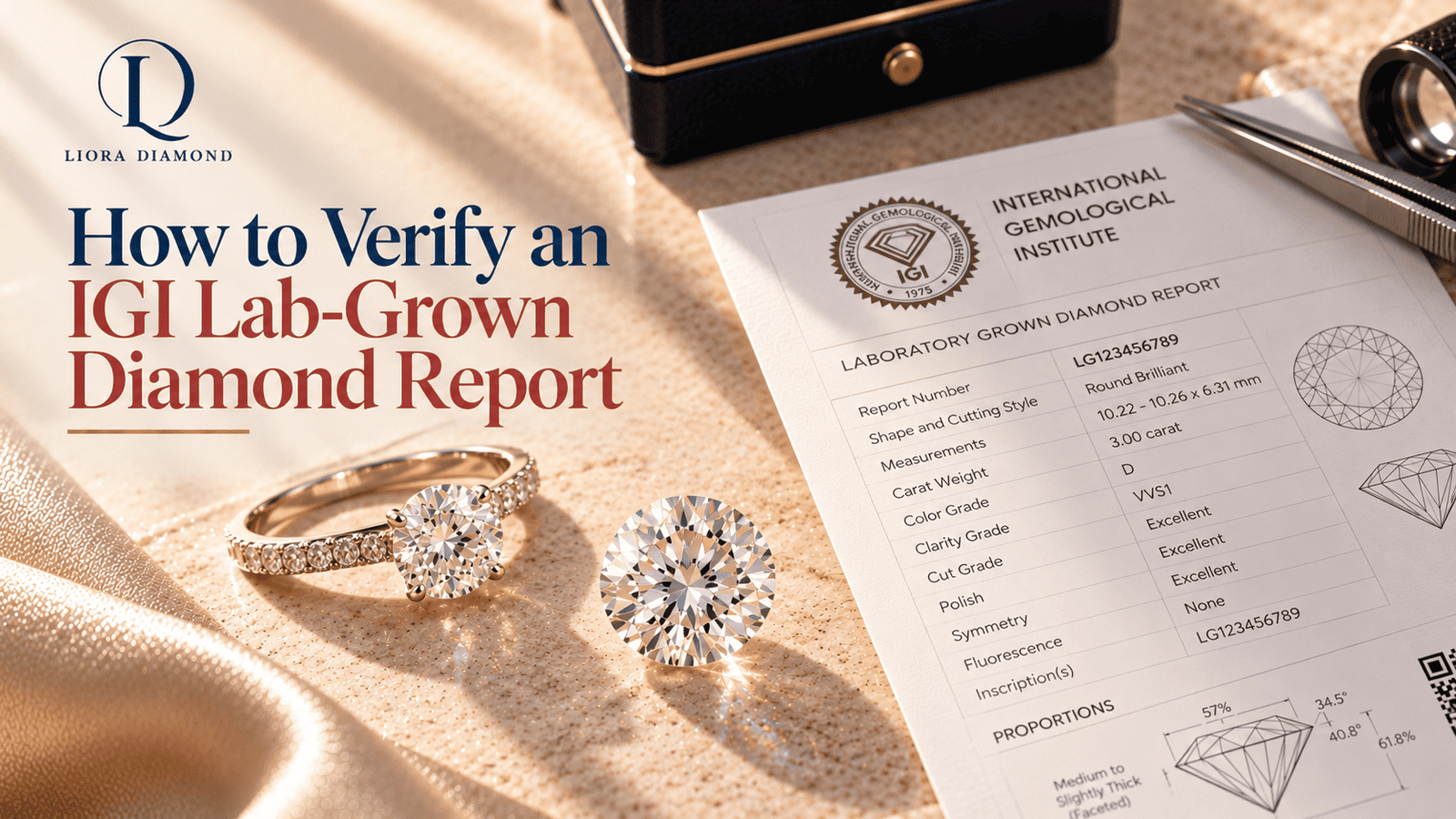
The short version: A report number lets you pull up the lab's own record of a stone. That is the first check, not the last one. A trade buyer should also compare the record with the stone itself: carat weight, measurements, shape, and the growth-method and treatment comments, using a 360° video taken from the exact stone, before any money moves. A genuine number attached to the wrong stone is the kind of mistake that catches people out, and a lookup alone will not catch it.
Key takeaways
- Verify before payment, not after delivery. Ask for the report number and a video of the exact stone while the stone is still a shortlist item. Liora Diamond are making a transparent communication and certification numbers can be verified on the lab's website, and its Big Diamonds page says the report is shared before invoicing.
- The lookup proves a record exists; it does not prove your stone is that record. JCK reported an IGI case in which a 6.01 ct lab-grown pear carried a fake GIA inscription that included a real report number belonging to a natural diamond. IGI found a carbon inclusion where GIA's record showed a feather.
- Match at least five data points. Report number, carat, shape, measurements and growth/treatment comments should all agree with the stone and the video. A one-line mismatch is a reason to stop, not to negotiate.
- Read the comments, not just the grades. IGI states that a lab-grown report "may include" the growth method, and that additional treatments may be disclosed in comments. If the method matters to your client, confirm it is on that specific report.
- For big stones and pairs, verify each stone separately. One summary sheet for a parcel is not a report. At Liora's US$2,000 trade minimum and above, the cost of checking is small compared with the cost of a wrong stone.
Quick answer
- How do I verify an IGI lab-grown diamond report? Enter the report number on IGI's report verification page, then compare carat weight, shape, measurements, color, clarity and growth-method comments with the stone and a video of that stone.
- Is the online check enough to trust a lab-grown diamond? No. The online record confirms the report exists. Check the girdle inscription and measurements against the stone to confirm the number belongs to this diamond, especially before paying for big lab-grown stones.
- When should a trade buyer verify an IGI report? Before paying the pro-forma invoice. Ask for the report number, 360° video and photos of the exact stone; verify the number online first, then confirm the delivered stone matches on arrival.
Why Verify Before You Pay?
A pro-forma invoice for a big lab-grown stone is a commitment on a single item. Once the money has moved, a mismatch becomes a dispute across borders, couriers, and customs. Verification costs minutes and shifts the risk back to the seller while it is still cheap to walk away.
Verification matters more for lab-grown stones than buyers sometimes assume. Documents can be cloned. Gem-Tech, an Italian lab cited in the JCK report, said cloning a document "is not particularly complex", and described laser-inscribed systems as "virtually impossible to counterfeit". The practical reading is that the paper or PDF is the weakest link and the inscription on the stone is the strongest, so you want to check both and make sure they point to the same record. Our why diamond certification matters for B2B buyers article covers the broader case for reports in trade buying.
What Does an IGI Laboratory-Grown Report Record?
IGI's lab-grown report page says the report documents the diamond's 4Cs: carat weight, color (D to Z, plus fancy colors), clarity (assessed at 10x) and cut, with polish and symmetry for all shapes. For a centre stone it lists shape, cutting style and measurements. Two details matter for verification:
- Growth method. IGI says a grading report "may include" the growth method, naming CVD and HPHT, and that the process can be recorded in the comments on request. Do not assume it is on every report.
- Treatment. IGI says treatments may be disclosed "when applicable". For fancy colors that are created or intensified after growth, this is where the report says so. Liora's fancy color lab-grown diamonds page states that its lab-grown fancy colors are usually created or intensified after growth and that the report and invoice say so.
IGI also lists a laser service (LaserScribe) that can add the report number to the girdle. Check whether the stone you are buying is inscribed; it is not something to assume. Our CVD diamond supplier guide and HPHT diamond supplier guide explain why the method and any post-growth step belong in the report.
A Five-Step Check Before You Pay
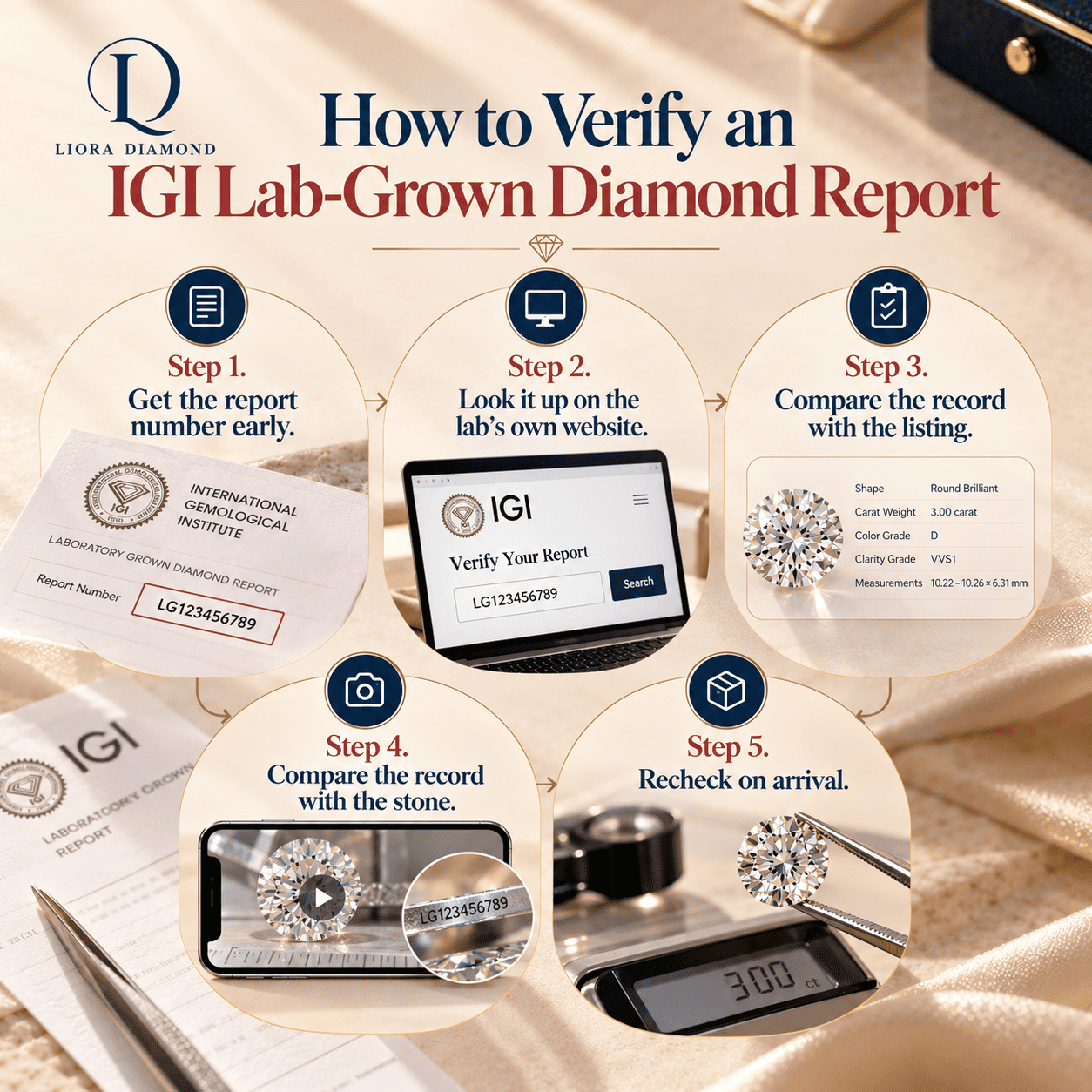
Step 1. Get the report number early.
Ask the seller for the number of every stone on the shortlist, not a parcel summary. Liora's IGI-certified lab-grown diamonds guide recommends a separate report number for each stone. Copy the whole string exactly, without spaces.
Step 2. Look it up on the lab's own website.
Go to the Verify Report page on igi.org and enter the number. Type it yourself; do not click a link inside a PDF or message that came from the seller. Note what the record shows and save a screenshot with the date.
Step 3. Compare the record with the listing.
Carat weight, shape, color grade, clarity grade, measurements and comments should match what the seller quoted. If the seller's listing and the lab's record disagree, the lab's record wins and you ask why.
Step 4. Compare the record with the stone.
Ask for a 360° video of the exact stone, shot next to a ruler if size matters, and a close-up of the girdle showing the inscription. Liora's Big Diamonds page says it sends high-resolution photos and a 360° video of the stone you will receive, not a sample, and can film in daylight, under UV or next to a ruler on request. Whoever you buy from, ask for the same. The measurements on the record should be consistent with what the video shows.
Step 5. Recheck on arrival.
When the parcel arrives, read the inscription on the stone itself (a loupe is enough for a number; a microscope is better), match it with the record and the video, and weigh and measure it. If there is a gap, document it before you accept the goods. A trade-grade checking routine for first orders starts with a clear request, as described in our RFQ template for big lab-grown diamonds.
What Should the Measurements and Weight Tell You?
Measurements are the quickest cross-check because they are hard to fake without changing the stone. Compare length, width and depth on the report to the video. A lab-grown 25.07 ct heart listed in our 20-carat lab-grown diamond guide, for example, is 18.28 × 20.35 × 9.01 mm. A stone of that weight with very different proportions is not that stone. Also, read our 30-carat laboratory-grown diamond sourcing guide for more complete information.
Small differences between a report and your own measurement are normal: reports give measurements to a hundredth of a millimetre, and handheld gauges and video are less precise. A gap in the tenths of a millimetre on a big stone deserves a question; a gap of a millimetre or more deserves a firm one. Agree an acceptable tolerance with the supplier in writing for large orders.
Can a Genuine Report Number Be On the Wrong Stone?
Yes, and this is the single most important reason not to stop at the lookup. JCK reported that IGI examined a 6.01 ct lab-grown pear that carried a fake GIA inscription naming a real GIA report number belonging to a natural diamond. The online data for that number matched the stone's carat weight and main qualities, but IGI found a carbon inclusion where the GIA record showed a feather, and a depth mismatch. Gem-Tech reported three CVD diamonds with fake GIA inscriptions describing natural stones, with similar weights but different proportions and fluorescence.
The lesson for a buyer is simple. The online lookup tells you what the lab recorded for that number. It does not tell you that the stone on your desk is that record. Inclusions, proportions and fluorescence are the details that catch a mismatch, and they require either a gemmological check or a lab re-examination. For high-value stones, a lab check on arrival, or an independent identification, is cheap insurance. The same JCK report describes same-day verification services launched in New York for matching inscriptions and reports to stones; ask what is available in your market.
What Changes for Big Stones, Pairs and Parcels?
- Big stones. Each stone has its own report; verify each. For 10 ct and above, ask for the girdle close-up in the first video. Our 10 carat guide, 5 carat guide and the Big Diamonds page show the size range.
- Matched pairs. Two reports, two numbers. Check that both stones carry the same color and clarity grade as quoted and that the measurements are close; then compare them side by side on video in the same light.
- Parcels and melee. A single sheet for many small stones is a different product from one report per stone. Decide in the RFQ which you are buying, and write it in the invoice.
- Fancy colors. Read the full color description, including any modifier, and the treatment comment. Our fancy color lab-grown diamond supplier guide and large pink lab-grown diamonds guide explain why the wording matters.
Which Red Flags Should Stop the Order in Bulk?
| Red flag | Why it matters | What to do |
|---|---|---|
| Seller will not give the report number until you pay | You cannot verify what you cannot see | Walk away or insist on a pre-invoice number |
| Number does not return a record on the lab's site | The report may be wrong, retired or typed incorrectly | Recheck the number; ask the seller to confirm in writing |
| Record's carat, shape or measurements differ from the listing | Wrong stone or wrong paperwork | Stop; ask for an explanation and a corrected listing |
| Video shows no girdle close-up, or a different stone from the photos | The "exact stone" is not shown | Ask for a fresh video next to a ruler |
| Report is a screenshot or photo of a certificate with no number visible | Easy to edit or copy | Ask for the number and verify yourself |
| Growth method or treatment not stated where your client needs it | The report may be silent on it | Ask the lab or the seller to confirm in writing before payment |
| Pressure to pay before you have checked | Time pressure is a classic cover for errors | Pause the deal |
What About GIA Lab-Grown Reports?
Some buyers ask for GIA on big lab-grown stones. GIA says a lab-grown report is authentic if it can be found on its Report Check, and that all lab-grown diamonds it assesses have their girdles inscribed with the report number.
On October 1, 2025, Gemological Institure of America launched its updated lab-grown diamond grading system. Under this policy, the certification lab replaced traditional 4Cs color and claring grading with descriptive "Premium" or "Standard" categories. Also, there's a stones below minimum thresholds receive no assesment.
It issues colored-diamond and color-identification reports for lab-grown stones as digital-only, with the girdle inscribed "Laboratory-Grown" and the report number. The principle is the same: look up the number, then match the stone. Liora's Big Diamonds page says big stones are supplied with an IGI report as standard and that GIA can be arranged, adding time and cost.
What Does Liora Diamond Do, and What Should You Still Check?

Liora's Diamond bring the full transparency and the report is shared before invoicing with a number you can verify online, that big stones come with IGI reports as standard, and that photos and a 360° video of the exact stone are available on the every diamond page and sent before you pay. We also accept the first orders are prepaid by bank transfer against a pro-forma invoice, with insured delivery. You should still run the five steps above. If you need a reservation period or a returns window for an individual stone, ask for both in writing.
Before you pay, confirm these in writing:
- The report numbers match the stones on the invoice; you have the video and the girdle close-up
- The report states what your client needs on growth method and treatment
- Who is the importer of record and who clears customs
- What happens if the stone is unavailable after payment
Our country pages for the United States, Hong Kong, Switzerland and the UAE describe shipping and documentation, and the shipping policy has the terms. For jewellers in the US, see the guide to sourcing 5 carat+ lab-grown diamonds for U.S. jewelers; for Gulf buyers, the Dubai lab-grown diamond supplier guide.
Ask for a Shortlist with the Report Number Up Front
Send your specification to the trade desk: shape and fallback, carat band, color range, clarity floor, quantity, and the report you want. Ask for the report number, photos and 360° video with every stone on the shortlist. You can browse current big stones, the fancy color range and the loose listing by shape, such as pear or oval, before you write. Trade only; US$2,000 minimum per order.
Send your specification to the trade desk, or read the lab-grown diamond wholesale and B2B jewelry pages first.
Frequently asked questions
1. Can I verify an IGI lab-grown report without having the stone?
Yes, to a point. With only the report number you can look up the lab's record and compare it with the seller's listing: carat weight, shape, grades and measurements. That checks that the paperwork exists and agrees with the offer. It does not prove that the stone being shipped is the stone on the record. For that you need a 360° video of the exact stone, a close-up of the girdle inscription if present, and a check when the parcel arrives. For high-value stones, ask whether a lab re-examination or an independent gemmological check is worth the cost before you release the balance.
2. What if the measurements differ slightly from the report?
Small differences are common because reports record measurements to a hundredth of a millimetre while handheld gauges, calipers and video give less precise readings. Measure the stone the same way each time and compare it with the report and the seller's video. A difference in the tenths of a millimetre deserves a question. A difference of a millimetre or more, or a different length-to-width ratio, suggests a different stone. Agree a tolerance in writing with the supplier for large orders, and record it on the pro-forma invoice.
3. Does an IGI lab-grown report always state CVD or HPHT?
Not necessarily. IGI says a lab-grown grading report "may include" information about the growth method and that the process can be recorded in the comments on request; treatments are disclosed in the comments when applicable. If your client needs CVD or HPHT stated, ask the seller to confirm it appears on that report before you pay, and check the record online. Some fancy colors are created or intensified after growth, and the report should say so. Read the full comments, not just the grade table.
4. Where is the report number on the diamond?
IGI offers a laser service, LaserScribe, that can add the report number to the girdle, where it is read under magnification. GIA says all lab-grown diamonds it assesses have their girdles inscribed with the GIA report number. Not every stone carries an inscription, and it can be very small, so ask for a close-up of the girdle in the video. When the stone arrives, read the number with a loupe or microscope, match it to the record and the invoice, and keep a photo with the date as part of your first-order file.
5. Is the online record proof that the diamond is real and as described?
No. The record is the lab's statement about the stone it examined under that number. If someone copies a number onto another stone, the record still looks genuine. JCK has reported a lab-grown pear with a fake GIA inscription carrying a real number for a natural diamond; the difference showed in the inclusion and depth. Treat the lookup as step one, then compare measurements, inclusion and the girdle inscription with the stone, and for high-value goods consider a lab check on arrival.
6. How early should I ask for the report number?
At shortlist stage, before you commit. A seller who is comfortable that the stone matches its paperwork can share the number alongside photos and video. Liora's Big Diamonds page says the grading report is shared before invoicing with a number you can verify online. Ask for it for every stone, not a parcel summary, and write the numbers into the pro-forma invoice so they travel with the order.